AI Writing Assistants for Content Creation
The booming market reveals four distinct tool types—and picking the wrong one wastes money.

Grammar checkers fix commas. Generative models write 800 words while someone refills a coffee cup. Both get filed under "AI writing assistant," which is a bit like calling a bicycle and a freight train "vehicles" and stopping there.
The plumbing is shared across the category: natural language processing to parse what's on the page, machine learning to spot patterns across huge volumes of text, and, in the newer tools, generative models producing sentences no human typed first. But the plumbing isn't what decides whether a tool is worth opening. What decides that is whether it's assistive (it sharpens text a person already wrote) or generative (it produces the text from a prompt). Most products blend both, but one mode usually dominates, and that dominant mode is the whole ballgame.
Precedence Research frames the category around four core functions: grammar correction, content generation, tone adjustment, and plagiarism detection. Useful as a checklist, useless as a definition. Most people fail here by picking the wrong tool for what they actually need. They fail by picking a famous one built for a different job than the one they actually need done, and that single mismatch explains more wasted subscriptions than any pricing trick the industry runs.
How large and fast-moving this market has become, and why that creates noise for buyers
Ask five research firms how big this market is and expect five different numbers, because the term stretches to fit whatever the analyst is selling. ResearchAndMarkets, using a narrower, writing-specific definition, sizes the category at $2.3 billion in 2024, climbing toward $8.3 billion by 2030, a 24.3% compound annual growth rate. Precedence Research, casting a wider net that scoops in adjacent AI tools, is $91.28 billion for 2025 heading toward $988.53 billion by 2035.
That gap is substantial. It's two different maps of two different territories, and the narrower figure is the more honest one if what's actually being measured is writing assistance rather than the entire automated-content industry. Both numbers agree on direction, though: growth fast enough to pull in every developer with an API key and a landing page.
Fast growth breeds noise. New entrants show up weekly, marketing claims get louder to cover for thinner differentiation, and buyers end up sorting real capability from a press release with a nice font. Content creation holds roughly 40% of market share by application as of 2025, per Precedence Research, which confirms who these tools are actually built for. Grammar correction, the least glamorous feature in the category, still gets used by more than 71% of people in this market. Fixing a dangling modifier, it turns out, never goes out of style.
The four functional types of AI writing assistant and what each one actually does
Four categories cover most of the market, and they overlap a lot less than the marketing copy wants anyone to believe.
Grammar and style correctors improve text that already exists. They don't generate from nothing; they take a sentence a person wrote and hand back a cleaner version. Grammarly is the reference case: a browser extension running inside Gmail, Google Docs, LinkedIn, most web text fields, free for basic grammar checks, $12/month for Premium and its deeper suggestions on clarity and tone. The documented failure mode is over-correction, where a writer's rougher, more idiosyncratic phrasing gets sanded down into something technically clean and personality-free. Fixing a comma splice is not the same job as fixing a voice, and Grammarly sometimes can't tell the two apart.
Workspace-embedded AI drafters live inside one specific tool and don't do much outside it. Notion AI is the clearest example: it drafts content, summarizes long notes, pulls action items out of meeting dumps, auto-fills database fields, all without leaving Notion. Full access now comes bundled into the Business plan at $20/user/month, after the standalone $10 add-on got retired in May 2025. The catch sits right there in the name. Someone who isn't already living in Notion daily gains almost nothing by bolting this on.
General-purpose large language model interfaces are the most flexible category, and, not coincidentally, the hardest to use well. ChatGPT's Canvas mode, launched October 2024 and discontinued May 2026, gave a side-by-side editing view, and file uploads plus web browsing let people feed in source material and ask for synthesis across formats. Canvas itself is gone now, replaced by writing and code blocks, but the underlying shape holds: these tools draft, rewrite, research, and edit across nearly any format a user names. That flexibility carries a cost measured in something other than dollars, namely prompt-writing skill and editorial judgment, because output quality swings far wider here than it does in a tool built to do exactly one thing.
Specialized content and copy generators are built around a single output type, and the brand-voice and template systems inside them are the actual product being sold. Jasper fits marketing copy at scale where a consistent brand voice matters most. Rytr covers budget short-form work, emails, social posts, ad copy, at $9/month for Unlimited and $29/month for Premium. Sudowrite is built for fiction specifically, tuned to track narrative structure and character voice in a way none of the other three categories even attempt. Copy.ai sits at the top end: $36/month for Starter, $186/month for Advanced, both on annual billing.
Voice-to-text is turning into a layer that cuts across all four types now, and the keyboard is no longer the only door into "writing." That matters more than it sounds like it should, if only because it changes what the raw draft looks like before any tool ever touches it.
Who the primary users are and what they are actually using these tools for
Commercial and enterprise buyers dominate, holding roughly 60% of the market by end-user share in 2025. Individual users are a smaller slice of the pie but the fastest-growing one, at a projected 24.9% CAGR. The market is currently built for teams and companies, in other words, even while individual writers are the group gaining the most ground.
By industry, media and entertainment leads at around 30% of the market. Education is the fastest-growing vertical, at a projected 25.5% CAGR. If AI smooths a student's writing the same way it smooths a marketer's brand voice, what exactly is getting taught? Homogenization isn't only a branding problem for companies chasing a consistent tone. It might be a classroom problem wearing a different outfit, and nobody's really pricing that risk in yet.
Large companies are also shifting away from bolt-on third-party writing apps and toward AI built directly into the CRM systems they already run, Salesforce and HubSpot among them. The tool disappears into the platform rather than sitting beside it, which is a different bet than the one an individual creator makes.
Individual creators, bloggers, freelancers, independent writers, sit in a different spot. They rarely need one purpose-built tool for one job. They need something that flexes across formats depending on what Tuesday looks like, which is exactly why the general-purpose LLM category tends to matter more to them than it does to an enterprise content team running fixed, repeatable workflows.
The genuine risk that comes with AI-generated text: homogenized voice and when it matters
Fortune Business Insights doesn't bury this finding. Its research names "the risk of homogenized writing styles" as a formal market restraint, on the grounds that tools trained on huge datasets reinforce the most statistically common patterns and phrasings rather than anything distinctive. In plain terms, the model has read a mountain of writing, has opinions about what "good" sounds like, and those opinions trend toward the average of everything it's ever seen.
This same dynamic can show up at the editing layer instead of the generation layer. The sentence comes back grammatically spotless and tonally interchangeable with a thousand other spotless sentences. Whether that's a bad trade depends entirely on what's being written, and most people are optimizing for the wrong variable when they pick a tool by reputation instead of by stakes.
For low-stakes content, product descriptions, transactional emails, SEO metadata, homogenization barely registers. Nobody reads a shipping confirmation for voice. Speed wins outright, and that trade is a fair one to make without a second thought.
High-stakes content is a different animal, and this is where the market's obsession with the flashiest, most generative tool actively works against the writer. Brand journalism, personal essays, fiction, all depend on sounding like they came from somewhere specific. Homogenize that and the reason anyone wanted to read it in the first place goes with it. Sudowrite's entire existence as a fiction-only tool is the market's own admission of this: the segmentation already happened, because a generic tool can't hold a character's voice across three hundred pages.
When someone speaks a thought out loud instead of typing it, the result tends to come out rougher and less shaped by the conventions of formal writing, which matters for creators using voice capture as a first pass before an AI tool cleans things up. The raw material starts less homogenized, even if the polishing step drags it back toward the average afterward. What matters is how much of that specific, ungeneralizable voice has to survive the editing process intact, and whether the tool in question was ever built to let it.
Pricing structures across the category and the hidden cost of introductory rates
Prices run from free to genuinely expensive, and the free tier is rarely where the real cost lives. Grammarly and Rytr both offer limited free access. From there: Rytr Unlimited at $9/month, Grammarly Premium at $12/month, Notion AI folded into Notion's paid plans starting around $10/user/month, Rytr Premium at $29/month, Copy.ai Starter at $36/month billed annually, Copy.ai Advanced at $186/month, also annual.
The trap sits one layer under the sticker price, and this is where most buyers get caught. Grammarly, Jasper, and Copy.ai all run introductory pricing at discounted rates for the first year, then auto-renew at full retail once that year runs out. Someone signs up excited about the discount, forgets the renewal date exists, and gets billed double a year later with barely any warning. Same trick a gym membership pulls. Different badge, same move.
Workspace-embedded tools carry a quieter version of the same problem. Workspace-embedded tools often carry costs beyond a single line item, so the real cost of adoption can include whatever tier of the underlying platform a team already pays for. Anyone comparing a $10 add-on against a $12 standalone tool and calling it a wash is comparing two numbers that were never actually comparable.
The fix is arithmetic, nothing fancier: calculate the total cost at the full renewal rate before signing anything, and match the tool's actual output type to the content format first. A 12-month contract with the wrong category of tool costs more than the invoice ever shows, because the real expense is the mismatch, not the monthly fee.
How to match tool type to content task rather than defaulting to the most recognized name
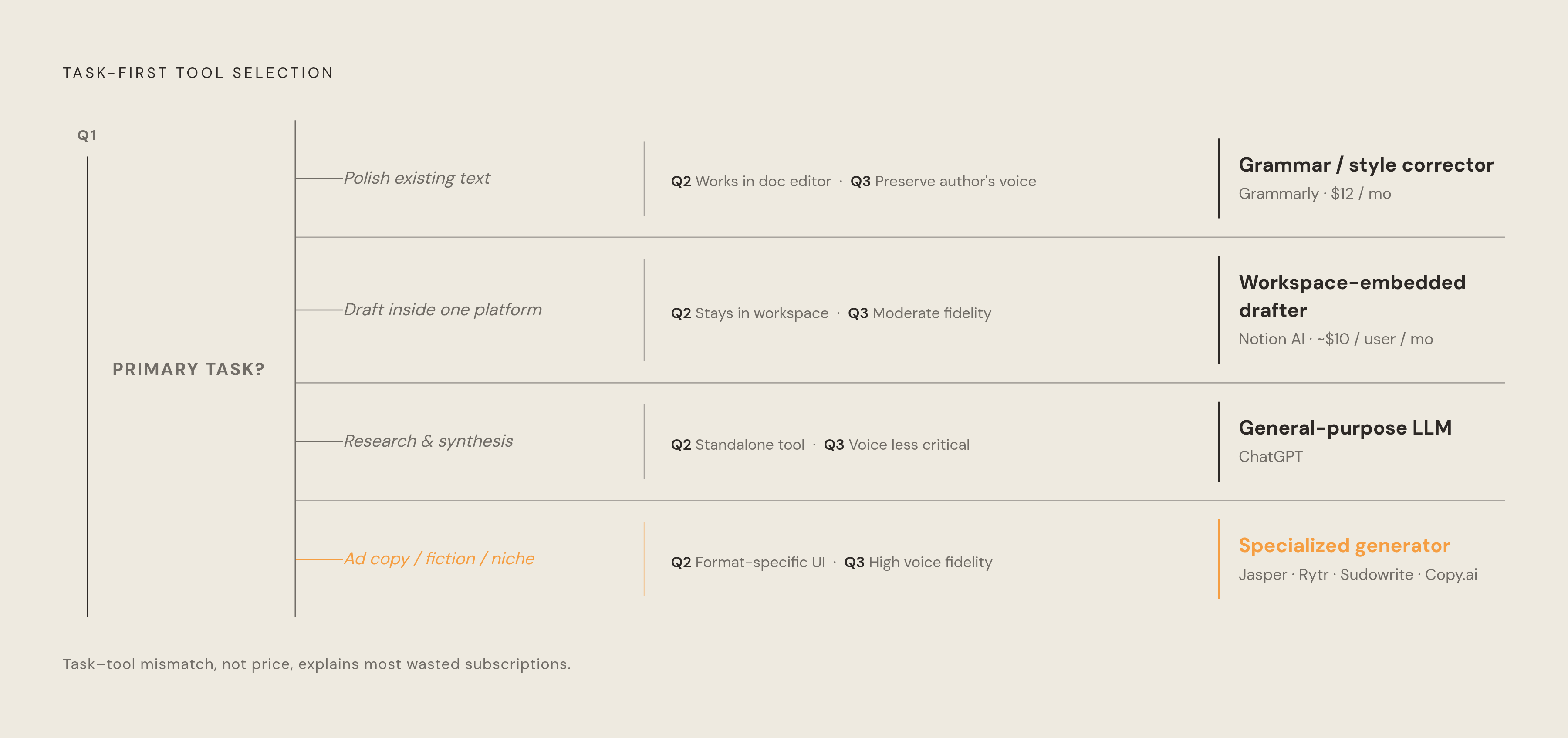
Three questions do almost all the work before a tool gets chosen, and brand recognition answers none of them.
What's the primary task: polishing text that already exists, generating something from a blank page, or producing a specialized format like fiction or ad copy? Where does the work actually happen: inside one platform such as a CRM or a workspace tool, spread across many surfaces, or mostly on a phone? And how much of the writer's own voice has to survive the process: low, medium, or high?
Line those answers up against the four types from earlier, and the choice mostly picks itself. Polishing text across many surfaces points toward a grammar and style corrector like Grammarly, with a flag on anything high-stakes where voice-stripping costs more than it saves. Solving the blank-page problem inside one daily-use workspace points toward an embedded tool like Notion AI, on the condition that workspace is already part of the daily routine and not a system adopted just for this. Research synthesis and multi-format flexibility points toward a general-purpose LLM interface, with the understanding that more flexibility demands more editorial oversight from whoever's using it.
Marketing copy at scale with a brand voice that has to stay consistent points toward a specialized generator like Jasper, tested against five to ten real brand prompts before any contract gets signed. Fiction and narrative work points toward a tool built for exactly that, like Sudowrite, which isn't interchangeable with the other three no matter how the pricing page frames it. Short-form budget work, social captions, quick emails, small ad variations, points toward something like Rytr.
The one move that keeps costing people money is skipping this whole exercise and just picking whichever name shows up first in a search. A tool's fame says nothing about whether it was built for the job actually on the desk.
A study out of Carnegie Mellon, working with 27 graduate students, found that tools like ChatGPT and Microsoft Copilot cut writing time by 65% and improved output quality, but only under what the researchers called "appropriate guidance." That phrase carries most of the weight in the sentence. Appropriate guidance is another way of saying the tool got matched to the task, the platform, and the amount of voice that needed to survive, which is the exact framework this piece just walked through. The tool was never the hard part. Knowing which question to ask before opening it was.