Gratefulness Journal Prompts for Deeper Daily Reflection
Specific prompts rewire your brain better than vague gratitude lists.

What gratitude journaling does in the brain
Most gratitude journals fail for the same reason most New Year's resolutions fail: they ask for something vague and get something vague back. "Three things I'm grateful for" produces "my family, my health, the weather," which is true and does almost nothing for the brain. The prompts that actually change how someone thinks share a structure: they force specificity, causation, or perspective-taking instead of letting the mind grab the nearest generic category. This piece maps those prompts by the layer of reflection they activate, from simple noticing up to finding meaning in hard stretches of life, so a reader can pick an entry point instead of guessing.
Naming a feeling is not the same act as having it, and the gap between those two things is where the neural benefit sits. Psychologist Sonya Lyubomirsky called gratitude "a kind of meta-strategy for achieving happiness," a phrase that sounds like a mouthful until you notice what it's claiming. A meta-strategy is a strategy for choosing strategies, and it only pays off if the entry point is right. Every prompt is treated as interchangeable in most gratitude advice, when the prompt is actually the whole mechanism. A journal full of "grateful for my health" entries is good intentions with a pen attached, and it's a mistake to assume that habit is doing much of anything.
The mechanism runs through affect labeling, a clinical term for the finding that naming a feeling in words dampens the stress response tied to it. Gratitude recruits the prefrontal cortex, tied to emotion regulation and social thinking, alongside the anterior cingulate cortex, which handles empathy and stress management. Both regions are linked to dopamine and serotonin release, the same pair behind most things that feel rewarding.
Research on gratitude letter-writing offers some of the clearest evidence that the effect outlasts the initial mood boost. Participants who wrote gratitude letters over three weeks showed sustained activation in the prefrontal cortex on fMRI scans, months after the study wrapped. That's neuroplasticity: the effect reflects lasting changes in the brain rather than a placebo bump that fades by Thursday. Separately, research on trait gratitude, the tendency to feel thankful as a general disposition rather than in a single moment, has found it's associated with measurable differences in gray matter volume. Some research adds physiological data points that don't rely on self-report, including findings that regular gratitude practice tracks with lower cortisol levels. A meta-analysis covering 64 randomized controlled trials found gratitude interventions produced real gains in life satisfaction and mental health, alongside drops in anxiety and depression.
None of that comes from feeling grateful in the abstract. It comes from specific, repeated engagement with grateful thoughts, which is what a well-built prompt forces and a vague one lets slide. A vague prompt lets the brain off the hook, so it defaults to the nearest cliché. A precise one makes it do the work that produces the neural change, so prompt design isn't a stylistic flourish sitting on top of the practice. It is the practice, and every layer below builds from that one fact.
Layer one: prompts that train noticing
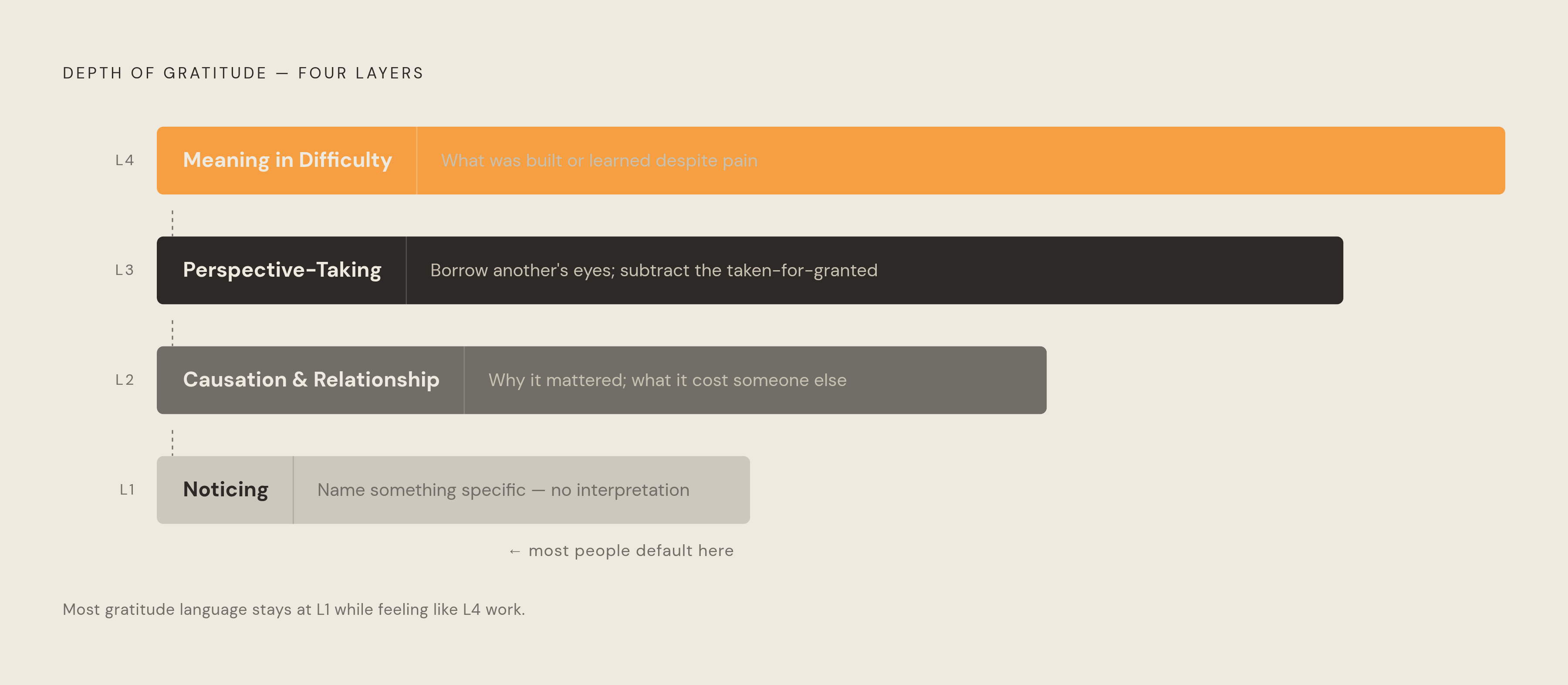
Noticing prompts ask for one thing: name something specific from the day, no interpretation required. This is the on-ramp, and it's the right one for anybody just starting out, since the early goal is repetition rather than insight. A few minutes is enough. The brain doesn't need a philosophy paper to start rewiring its scan for good things. It needs reps, the same way a muscle needs sets rather than a lecture on biomechanics.
Try these:
What's one small thing that happened today that you almost didn't register? Describe a sensory detail, something heard, tasted, or felt, that you're glad you experienced. What did someone do for you today that was so ordinary you could've missed it? What's one thing you'd have complained about yesterday that quietly worked out fine today?
The mechanism is simple. These questions block the brain from defaulting to "my health, my family," because they demand a specific time, place, or person. You can't answer "describe a sensory detail from today" with a category. You have to actually go looking, and that's the entire point.
A 2024 Clemson University study followed first-graders for 28 weeks using short daily practices, journaling and gratitude collages among them, running just 10 to 15 minutes. Gratitude and overall well-being both rose significantly. Six-year-olds got measurable gains from the simplest version of this exercise, which undercuts the idea that noticing is somehow the kiddie pool of gratitude work you graduate out of. It's the foundation, and skipping past it to chase something more advanced mostly skips the reps that make the advanced stuff work later.
It holds up during bad weeks, too. When there's no bandwidth for anything heavier, a short entry anchored to one sensory detail still counts, and it asks for zero emotional readiness to complete.
Layer two: prompts that push toward causation and relationship
Once noticing is a reflex, the next move is asking why something mattered, and what it cost someone else to make it happen. That second question is where the emotional weight actually lives, and it's also where most people quit journaling, convinced they've already covered this ground with layer one. Most people quit journaling at that point, convinced they've already covered this ground with layer one, but they have not covered it.
Compare "I'm grateful for my partner" to "I'm grateful my partner noticed I was overwhelmed and took the kids to the park so I could have an hour of quiet." The second version has a specific action, a read on someone else's state, and a small sacrifice built in. One is a label slapped on a person. The other is a scene with a plot.
The relational piece isn't a nice-to-have bolted onto the exercise. A multi-study project published in The Journal of Positive Psychology, backed by the Templeton World Charity Foundation and running across three samples (922, 880, and 266 participants), found that gratitude interventions often skip the relational dimension entirely, and that this omission shortens how long the effects last. Conditions built around relationships outperformed solo, nonsocial gratitude on measures of transcendent indebtedness and produced richer social content. Every condition, including the nonsocial one, boosted positive affect, empathy, and social connectedness compared to a neutral control. Gratitude helps regardless of format. Naming a relationship is what makes it stick.
Research from Grant and Gino found that people who are thanked directly feel socially valued, and that feeling pushes them toward more prosocial behavior afterward. That's a fairly good argument for writing the letter instead of just the private entry.
Prompts at this layer:
Who did something for you this week that took real effort or attention, and what did it cost them to give it? What skill or piece of knowledge do you rely on daily that someone else had to teach you first? What relationship has quietly gotten better over the past year, and what do you think actually drove that?
Writing an actual letter to the person, rather than keeping the reflection private, is the natural extension here. It's the same intervention behind the gratitude letter-writing fMRI results, and it produced some of the most durable brain changes in that research. Evening tends to suit this layer better than morning, since the day's relational texture needs time to accumulate before there's anything to reflect on. Morning works better for layer one: setting intention before the day happens, rather than processing it after the fact.
Layer three: prompts that ask for perspective-taking and counterfactual thinking
This layer asks the journaler to borrow someone else's eyes, or to subtract something they take for granted and sit with the gap. Researchers call the second move mental subtraction: what if this thing, or this person, had simply never existed?
The discomfort is deliberate, functioning as the mechanism itself rather than a side effect to tolerate. Comfort causes adaptation, the process by which anything good eventually becomes invisible through repetition. You stop noticing your own furnace until it breaks in January. Counterfactual thinking interrupts that slide before it finishes. It re-sensitizes.
There's field data behind why this works. A University of Tokyo study led by Norihama and colleagues tracked 47 caregivers across 958 journal entries and 5,412 coded segments, finding that psychological distance in its temporal, spatial, and social forms changes the character of the writing itself. Greater distance from an event produced calmer, more analytic, self-focused entries suited to reappraisal. Closer proximity produced writing that ran more emotional and detail-heavy, better for processing raw feeling in the moment than for making sense of it.
That's the whole design logic of a perspective-taking prompt. It manufactures distance artificially, giving access to the analytic mode even when an experience is still close and unprocessed.
Try:
Picture life without one thing you almost never think about. What's missing? Who are you without it? How might someone with far fewer resources have experienced the exact day you just had? What about your life right now would a younger version of you find completely unbelievable?
These take longer to sit with, and they're not built for a rushed two minutes between meetings. A dedicated 10 to 15 minutes, at a point when the day isn't actively on fire, works better here than squeezing it into a commute.
Layer four: prompts that find meaning in difficulty
Gratitude for a hard experience doesn't mean being glad it happened, and collapsing that distinction is where most gratitude journaling goes wrong. Treating the two as the same thing produces forced positivity, the kind that makes people distrust the whole practice and quit within a month. The honest version acknowledges what got learned or built despite the pain, without pretending the pain was worth it on its own terms.
This is the layer where gratitude journaling overlaps with expressive writing research. The Pennebaker paradigm, tested across hundreds of studies, found that writing about difficult experiences improved immune function and cut down on doctor visits. Not just mood: physical outcomes, measured, not self-reported.
Prompts here:
What strength did you not know you had until a crisis revealed it? What did a period of scarcity or want actually teach you about gratitude? How did a stretch of loneliness lead somewhere useful, and what did you find in that space? What challenge taught you the most about yourself, that you'd have no other way of knowing? What has a major transition, a marriage, a new kid, a layoff, a loss, shown you about who you actually are?
These prompts pair naturally with shadow work, stream-of-consciousness writing pointed at uncomfortable territory, which suits people who find structured formats too confining, or who journal alongside therapy rather than instead of it.
A gratitude practice that can't flex during hard seasons is a fair-weather habit wearing a serious name. During difficult stretches, these prompts read as more honest, and more sustaining, than a noticing-layer question that starts to feel hollow when everything actually feels bad. A meta-analysis covering 64 randomized controlled trials found gratitude interventions produced real gains in life satisfaction and mental health, with significant reductions in anxiety and depression across conditions. That's an argument for keeping layer four in regular rotation, instead of treating it as the emergency exit you only reach for once everything's already on fire.
Timing, psychological distance, and choice of layer
So which prompt goes with which hour? Morning sets intention, and noticing or causation prompts fit there, before the day has generated anything specific to process yet. Evening does the opposite job. It closes the day out, which makes it the natural home for relational and perspective-taking prompts that need material to work with before they can do anything useful.
The University of Tokyo data backs this up directly. Proximal conditions, close in time or space to something stressful, produced emotion-rich, detail-heavy entries, good for getting a feeling out of the body and onto the page. Distal conditions produced analytic, self-focused writing suited to reappraisal and meaning-making. Meaning-layer prompts land better once there's been time and room to gain distance, rather than in the raw first hour after something happens.
That raises an obvious question: what happens during an actual crisis? Default down, not up. Noticing-layer prompts, or basic comfort-focused ones, are the right call. Reaching for a meaning-making prompt in the first hour after something hard happens tends to produce performance rather than reflection, forced positivity standing in for the real thing. That's the single most common mistake in how people sequence these prompts: they reach for the deepest tool in the box when the moment calls for the plainest one, and the mismatch explains why so many people write "everything happens for a reason" three hours after something terrible and mean none of it.
The Five-Minute Journal format, structured around morning prompts (gratitude plus intentions) and evening prompts (highlights plus a reflection or improvement note), is probably the most widely used version of this timing logic in practice. The five-minute constraint isn't incidental. It forces entries that are more emotionally focused than open-ended journaling, since there's no room to intellectualize before getting to the point.
The deepest prompt available is not automatically the right one, and treating layer four as some kind of upgrade from layer one misreads what each layer is for. The right prompt matches the time on hand, the emotional state in the room, and how far removed the writer actually is from whatever they're reflecting on.
Practical ways to build the habit around these prompts
Consistency beats intensity, full stop. A five-minute entry every day for a year adds up to more actual reflection than a handful of soul-searching sessions scattered across the same period. Automaticity has to come before depth, and skipping straight to depth is why so many gratitude journals end up abandoned in a drawer by February.
Beginners should start at layer one, no exceptions. One prompt, one sitting, five minutes, for the first 60 days. That period is about building a reflex, not chasing insight, and insight tends to follow on its own once the reflex is there. Starting at layer three or four before the habit is automatic is a bit like trying to run a marathon before jogging around the block: technically possible, rarely pleasant, usually abandoned by week two.
Anyone with more mileage tends to end up mixing two or three approaches rather than sticking to one for good. Run a single method for at least two weeks before writing it off, since most of the payoff appears after the novelty wears thin, not before.
Going back through old entries should happen on purpose, not by accident. Recurring themes and shifts in what actually triggers gratitude over time become visible in entries when they are reviewed, and seeing that shift on the page is its own kind of motivation.
Handwriting forces real-time summarizing, since there's no backspace key, and it builds a kind of spatial memory that typing doesn't. A typed or voice-based format wins on speed and searchability, which matters more for anyone who wants to revisit old entries and track how their thinking has shifted. You can't search a paper notebook for every time you wrote about a specific coworker. A search bar handles that in seconds, which makes the revisiting habit easier to sustain over a year than a notebook ever will.
Voice-based journaling deserves a mention too, mainly because it removes the blank page, the single biggest barrier for a lot of people. Joice, a conversational journaling app where you speak your entries and it responds with follow-up questions in real time, is one app built specifically around that mode. Speaking through a prompt works for the same four layers, noticing, causation, perspective-taking, meaning-making, just in a conversational format instead of a written one. For someone who thinks out loud better than they write, that's a different door into the same room, an equally valid method.
For anyone who wants variety without extra planning, there's the 3-3-3 method: three prompts, three minutes apiece, up to three sessions a day. It's a modular way to sample across all four layers without committing to a single approach, and it makes sense once the basics are automatic. It's a poor starting point for someone still building the habit.
Sources
- The Science of Gratitude: New Findings and Practical Lessons for Mentoring – The Chronicle of Evidence-Based Mentoring
- Two Modes of Reflection: How Temporal, Spatial, and Social Distances Affect Reflective Writing in Family Caregiving
- Gratitude Journaling: 12 Science-Backed Benefits and How to Start Today