Stream of Consciousness Journaling Technique
To bypass your brain's self-censor, write faster than you can think.

The internal editor is not a flaw. It is the brain's default filtering apparatus, running perpetually to assess whether a thought is coherent enough, acceptable enough, or relevant enough to voice. In most forms of writing, that filter is the whole point. In SOC journaling, it is precisely the circuit the practice is trying to reroute.
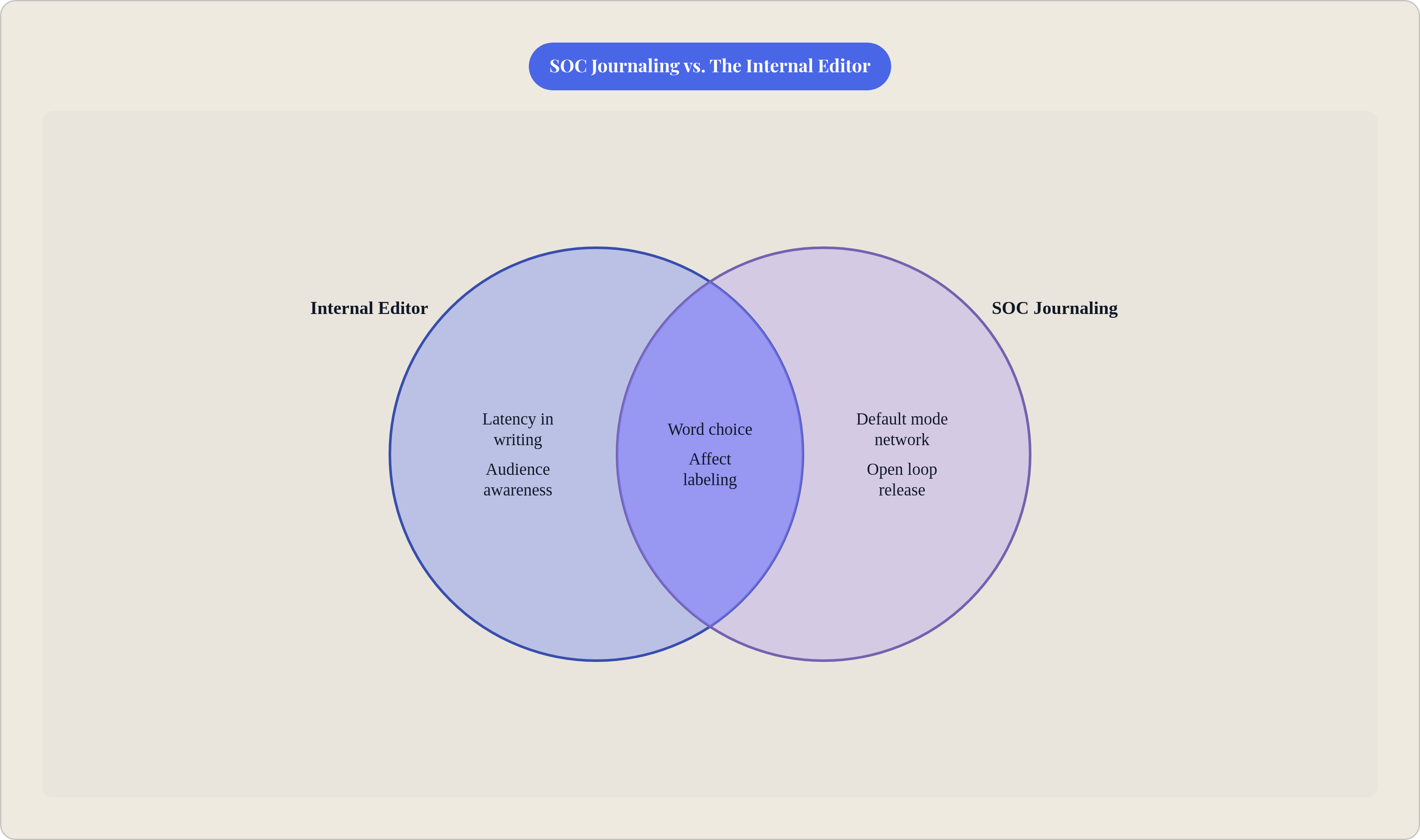
What does the filter look like in practice? It is the pause mid-sentence to decide how to finish it. It is re-reading the previous line before writing the next. It is waiting for the right word instead of writing any word. The editor does not announce itself; it quietly installs latency into the process, and by the time you notice it, the channel has already closed.
Pennebaker's research identified editing-while-writing as the most damaging behavior in this type of work, because it re-engages the self-censoring circuits the method is designed to circumvent. The filter, once activated, will not politely step aside when you ask it to. It has to be outpaced.
I noticed this the first several times I tried SOC seriously. The output looked careful. Considered. Which is to say it looked like everything SOC is not supposed to look like. I was still writing for an audience of one, which was the version of myself who would be mortified to re-read it. That is exactly the pattern Pennebaker is describing, and it is why early attempts often produce stilted, self-conscious writing — the journal equivalent of someone who knows they are being filmed. Speed and continuity are not stylistic preferences in SOC; they are the mechanism. Writing fast is not sloppy practice. It is the practice.
What the brain is doing when the editor goes quiet
SOC writing activates the default mode network, the system responsible for self-referential thought, spontaneous association, and the loose-connection thinking that surfaces during daydreaming or a long drive somewhere familiar. This is the network that does not switch off when you stop working. It is also the network the editing mind overrides before any of its output becomes language. SOC journaling intercepts that material before discarding can happen.
There is also a functional argument for writing it down rather than simply thinking it. Unresolved thoughts occupy working memory, creating what cognitive psychologists call open loops — persistent background demands on attention. Think of them as browser tabs the brain refuses to close: invisible, draining, quietly slowing everything else down. Externalizing them onto the page closes those loops, not by resolving them, but by releasing the brain from holding them. The page absorbs what the brain was carrying.
Lieberman and colleagues found in 2007 that affect labeling — putting emotions into words — reduced activation in the amygdala by something in the range of 50 percent. Worth sitting with that number for a moment. The amygdala is the brain's primary threat-response structure, and something as unglamorous as writing down what you feel measurably modulates its reactivity. The unfiltered emotional capture that SOC produces is not cathartic in the vague, warm-bath sense of the word. The prefrontal cortex engages to moderate amygdala reactivity. That shift does not happen through deliberate analysis. It happens through externalization itself, which is frankly a little embarrassing for those of us who spent years believing rigorous thinking was the point.
Why duration shapes what the technique can do
Fifteen to twenty minutes per session. That is the range Pennebaker's research identified as producing the most significant psychological benefit. Under five minutes, and you have not cleared the surface layer. Over thirty, and you risk rumination — moving from productive externalization into prolonged dwelling that produces no resolution and, according to Smyth's meta-analysis across 13 randomized controlled trials, can occasionally cause harm.
That raises an important question: why does session length matter beyond simple time management? Because the first few minutes of any SOC session are, almost universally, not the point. They are noise clearance: the to-do list, the irritation from earlier that morning, the logistical preoccupations. That material needs to be written through, not skipped. You cannot access what the default mode network has been holding until you have discharged what the executive mind has been managing. Sessions under five minutes rarely get past it.
The Smyth caveat deserves direct attention because the popular framing of SOC tends to elide it: unstructured, problem-focused writing that showed no movement toward resolution produced no benefit and, in some cases, worsened psychological outcomes. Writing about the same unresolved problem repeatedly, without any shift in perspective or integration, can entrench rather than process. That is the distinction between productive externalization and aimless cycling, and it is not a minor one.
Duration is a safeguard. Julia Cameron's Morning Pages — three longhand pages at a natural writing pace — consistently fall within the 15 to 20 minute window. Whether or not that was deliberate, the format has survived decades of daily use. That kind of durability indicates something is actually calibrated correctly.
Handwriting versus typing for SOC and why the medium affects the output
A 2024 study in Frontiers in Psychology using high-density EEG found that handwriting activated significantly more complex neural connectivity than typing, particularly in regions associated with memory and learning. The mechanism is straightforward: handwriting is slower, which means the hand cannot transcribe every thought verbatim. Something selective happens. The brain encodes what it considers worth keeping.
This creates a genuine tension for SOC specifically. The technique asks for unfiltered speed. Handwriting's slower pace deepens processing. These demands pull in opposite directions, and there is no tidy resolution.
Typing encourages linear rather than associative thinking, which works against the default-mode-network activation the practice depends on. The keyboard favors sequential output; the pen allows movement across the page in ways that are, neurologically, somewhat closer to how the mind actually moves. I find this personally true even if I cannot entirely defend it, which is perhaps itself the kind of admission that belongs in a SOC journal.
For writers who prefer a tablet workflow, Ihara and colleagues and Gerth and colleagues both found that handwriting digitally with a stylus produces essentially the same neural benefits as writing on paper. The medium question is not as binary as it appears.
The practical guidance is this: if your thoughts genuinely outpace your handwriting and the friction breaks the flow, typing is better than not writing. But the medium choice is not cosmetic. It shapes what the brain does with the content, and that is worth factoring in deliberately rather than by accident.
Where SOC journaling fits alongside other methods — and where it doesn't replace them
SOC journaling's job is to clear and externalize. It is not designed to produce resolution. It generates no arc, no reframe, no structured insight. The Smyth caveat resurfaces here: writing that stays problem-focused without any movement toward integration can entrench rather than process. SOC practiced repeatedly on the same unresolved material, without any structural complement, carries that risk.
Where does it perform best? As a morning clearing practice before structured writing or decision-making. As a pressure-release mechanism before a more focused session. As a maintenance practice between more structured cycles of reflective work. It performs poorly as a standalone method for processing difficult emotional material, because the technique provides no containment and no arc.
What it pairs well with is a single structured prompt or reflection after the SOC session ends — one question, one sentence. One method clears; the other gives direction. That pairing is more robust than either alone.
It is also worth considering what SOC is not competing with. Bullet journaling tracks and organizes. The Pennebaker protocol has a specific narrative arc designed to move toward integration. Gratitude practice works through directed attention, which is essentially the opposite of open capture. These are different instruments for different jobs. The mistake is not using them together; the mistake is expecting SOC to do all of their jobs and interpreting its failure to do so as evidence the practice doesn't work.
The practical model is SOC as the front end of a session, not the whole session, particularly for writers processing difficult material. Front-loading the clearing phase makes everything that follows it more tractable.
How to actually start a session and keep it moving
The setup is minimal. Pen and paper, or stylus and tablet. A blank document if typing is genuinely preferable. A timer set for 15 to 20 minutes. No re-reading before or during the session.
The one rule that matters: do not stop moving. If nothing arrives, write "I have nothing to write" until something does. That instruction sounds absurd until the third or fourth time it actually works — and when it does, it is the closest thing to a magic trick the practice offers, because you have essentially bored your own editor into stepping aside. The act of continuing outpaces the editor; forward motion is the only real pressure the filter cannot indefinitely resist.
Expect surface noise in the first few minutes. Tasks, stray irritations, minor observations. This is not failure. It is the clearing phase, and it is necessary. The mistake is interpreting early noise as evidence the technique is not working and stopping before it does.
Resist the impulse to shape the output mid-session. No paragraph breaks for coherence, no topic sentences, no narrative arc. The moment you start structuring, you have switched from SOC to something else. Structure is not generally the enemy; it is the enemy inside this specific window.
When the timer stops, close the notebook. Do not immediately re-read. The value of the practice accrues in the doing; re-reading immediately re-engages the editor and retroactively imports judgment into something that was specifically designed to exclude it.
One optional addition, written after the timer stops and not during the session: a single closing question. Something like "what was I circling around?" One sentence. This can surface the session's underlying preoccupation without forcing structure onto the flow itself, and it gives the SOC output somewhere useful to go.
For writers who find the blank page paralyzing, SOC is the method that removes the pressure of doing it right. There is no right. The only failure is stopping before the clearing happens.