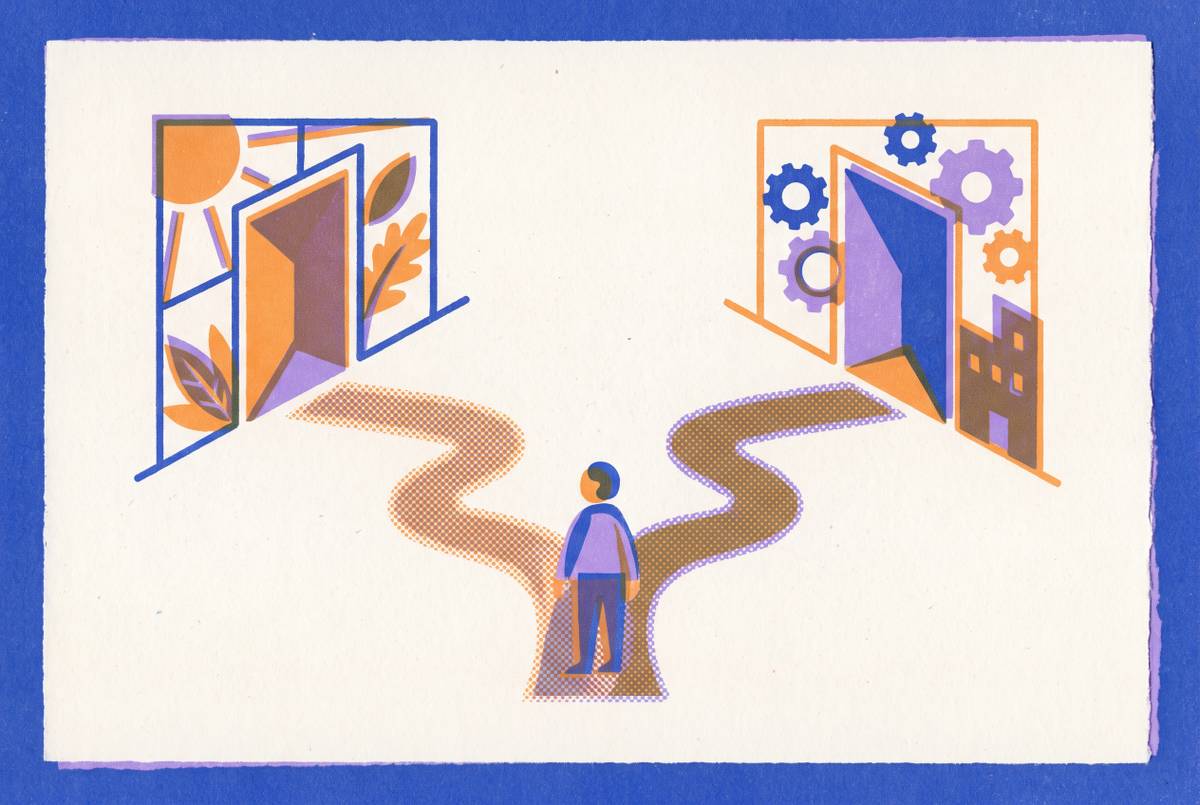
Journal Entry Prompts for Leaving a Job You Actually Liked
How to process the grief of leaving a job you loved.

Leaving a job that was genuinely good to you produces grief, not wistfulness, and the confusion that follows deserves a straight answer: you chose this, so why does it feel like something was taken from you? Grief tracks attachment, not justice. It does not check whether the thing lost deserved to be mourned before it shows up.
Why leaving a job you liked is a grief event
Career grief is the sense of loss tied to identity, purpose, and self-worth that follows the end of meaningful work, and it does not care whether the ending was voluntary. It appears the same whether someone was laid off, chose to leave for a better offer, or walked away from a role they loved for reasons that had nothing to do with the job itself. What disappears is not only a title and a paycheck. The daily structure goes. The community built around shared problems and shared coffee runs goes. The sense of direction a role provided, and the version of yourself that existed inside it, both go quiet at the same time. None of that requires the decision to have been wrong. Psychological investment in a role does not dissolve the moment logic signs off on leaving it, and that mismatch, between a decision the mind endorses and a loss the body still registers, is exactly where the trouble starts. The symptoms rarely get named for what they are: replaying old memories with more fondness than the job probably earned, guilt about wanting to go in the first place, a flat "who am I now?" feeling that has nothing to do with the new opportunity being worse, and a strange difficulty connecting with whatever is supposed to come next.
The cost of unprocessed career grief in the next chapter
Grief that goes unacknowledged does not vanish. It relocates, appearing in the next role wearing a different costume: emotional flatness toward work that is, on paper, a better fit, or a disengagement that looks like apathy but is closer to unfinished business. Identity confusion can linger well past the first week on a new job, long after the paperwork is signed and the new badge photo is taken. Whatever drove the departure, working it out before moving on affects whether that unresolved feeling follows into the next role, because baggage travels. Journaling and conversations with trusted people help identify which habits, which parts of the old culture, and which ways of operating should be carried forward and which need to be left at the door. Job loss, including the kind someone chooses, can produce a cascade of effects: withdrawal from social contact, disrupted sleep, a sense of powerlessness, and trouble picturing a future that feels hopeful. Research on grief following job loss has documented separation distress, identity confusion, yearning for what was lost, and difficulty constructing a new future, and these responses appear whether the job ended on good terms or bad ones. The risk runs higher, not lower, when the departure was a good one. Liking the job means the attachment ran deeper, and deeper attachment leaves a larger residue of unprocessed feeling with more surface area to intrude on whatever comes next.
Why writing suits this specific kind of loss
Writing builds a narrative structure around this particular kind of loss, which is what makes it more effective than talking the experience through or turning it over mentally. Psychologist James Pennebaker's research on expressive writing describes a mechanism: putting a difficult experience into written language, especially language that includes cause-and-effect reasoning and moments of insight, gives the brain the narrative coherence it needs to reclassify the memory. An experience that was coded as an ongoing threat becomes, instead, a structured event that happened in the past and carries meaning. That reclassification is not just emotionally satisfying, it appears to have practical consequences. Professionals who wrote expressively about job loss found reemployment at a markedly higher rate than those who did not, a result consistent with the idea that narrative processing does more than soothe. It clears cognitive and emotional space that the job search can then use.
The physical act of handwriting adds something of its own to this process. Nobody writes by hand as fast as they think, and that speed gap forces a selection process: the brain has to choose which thoughts earn a spot on the page, filtering in a way that typing rarely demands. Some researchers suggest this slower pace encourages deeper processing, though Pennebaker's own work locates the active ingredients elsewhere, in the narrative construction and cognitive reappraisal that the writing produces regardless of what tool puts it on the page. Either way, the mechanism points toward the same practice: writing, done deliberately, turns an open wound into a story with a shape.
The three phases a good-departure journal practice needs to move through
A departure from a job someone liked calls for prompts that move in a specific order, not a grab bag of questions asked in whatever sequence feels comfortable that day. The sequence runs from emotional acknowledgment, to values and identity excavation, to forward narration, and each phase depends on the one before it. Skipping ahead produces false closure, optimism about the next chapter built on feelings that were never actually dealt with. Staying too long in the first phase produces its own failure mode: rumination, a loop of sadness with no forward motion. Phase 1 asks the writer to name what is being felt, and guilt, sadness, and fear of the unknown are documented responses even to leaving a role someone was glad to exit. Phase 2 asks what the role revealed about identity, values, and the conditions under which the writer does their best work, treating the job as a source of self-knowledge beyond a stream of tasks. Phase 3 asks the writer to narrate what comes next in a way that has real continuity with what came before. The evidence from how grief actually resolves suggests otherwise: the order is the mechanism, not just good organization.
Phase 1 prompts: naming the grief of a good departure without explaining it away
The task in the first phase is to give feelings a specific, named place to land before the mind starts arguing them away. A useful starting prompt asks what the main reasons for leaving are and how each one actually feels, which reveals the gap between the logic that justified the decision and the emotional reality underneath it. A second prompt asks what fears or concerns about leaving exist and what each one is actually about, since practical anxieties (money, timing, logistics) and identity anxieties (who the writer is without this) tend to tangle together and need separating. A third prompt pushes for precision: what exactly is being grieved, the role itself, the people, the routine, or the version of the self that did this work? Vague sadness resists resolution; specific sadness can at least be examined. A fourth prompt asks the writer to recall the last day or week they felt genuinely glad to be in that role, and to describe what made it feel that way, anchoring the grief in something concrete. A fifth prompt sits directly inside the contradiction that makes good departures so disorienting: the decision to leave was chosen, and sadness still remains, so what does it look like to hold both of those at once without resolving the tension? Guilt deserves particular attention here, since it occurs often around resignation, especially where close relationships with colleagues or a sense of loyalty to the employer are involved, and the point of this phase is to make space for that guilt rather than instruct the writer to talk themselves out of it.
Phase 2 prompts: excavating what the role meant to your identity and values
Once the feelings have a name, the next job is figuring out what, specifically, is being lost, because a role someone liked tends to fuse with identity in ways a bad job never does. One prompt asks how the job shaped the writer's understanding of their own strengths, separating the self-knowledge gained (which stays) from the role itself (which goes). Another asks what lessons from the role should be carried forward and what should be left behind, and the leaving-behind half tends to be the harder, more important half of that question for anyone exiting a job on good terms. A third prompt names the fear directly: what did this role let the writer be that they're afraid the next one won't allow? A fourth moves from inventory to meaning by asking which accomplishments the writer is proudest of and what those accomplishments reveal about what they actually value in work, beyond what they were good at. A fifth addresses the real, unglamorous loss of community and routine by asking how the writer wants to honor the relationships and experiences built in that role, without requiring any tidy resolution. The Ikigai framework, which maps the intersection of what someone loves, what they're good at, what the world needs, and what they can be paid for, fits naturally here, since it speaks directly to the "if I liked it, why leave?" tension this whole phase exists to work through: walking through each quadrant in relation to the departing role can clarify which parts of the fit were real and which were circumstantial. Values clarification work, the practice of moving past vague feelings toward naming the specific beliefs that guided behavior and produced a sense of fulfillment, gives this phase its analytical spine and keeps the exercise from turning into a nostalgia session. This phase is best approached after a Phase 1 session has already cleared some emotional ground, not cold, since excavation goes better once the rawest feelings have already been named.
Phase 3 prompts: writing toward what comes next without erasing what came before
Forward narration is not the same project as forced optimism, and the prompts in this phase should resist any demand that the writer feel excited or grateful before they're ready. The goal is continuity: a next chapter with visible roots in the chapter just closed, not a clean break pretending the past has no bearing on what follows. One prompt asks the writer to describe the ideal next step, not just its logistics but what it would feel like and what it would offer that the departing role didn't, tying the vision directly back to the values surfaced in Phase 2. Another asks what support systems and resources exist for this transition, and whether they've actually been used or just acknowledged in theory. A third asks what boundaries or practices the writer wants to carry into the next role to protect whatever they now know they need, treating the departure as a source of instruction as well as a source of loss. A fourth tests the honesty of the whole exercise: how does the writer want to grow, personally and professionally, in what comes next, and is that growth genuinely connected to what the previous role taught them, or is it floating free of everything written in Phases 1 and 2? A fifth, optional and more emotionally direct than the rest, asks the writer to compose a letter to the person who started this job, telling them what mattered about how it went. It functions as a closure ritual, honoring the investment made without pretending the ending came easily, and it is worth trying but not worth forcing if it doesn't fit. The Decision Journal framework offers a useful structural assist here: recording the reasoning behind the move before anyone knows how the next chapter turns out, so the writer can return to it later and check whether the thinking held up. That single habit converts a grief event into a calibrated record, a document that can be reread. Ending deliberately, through journaling and specific acknowledgment rather than a vague sense of moving on, builds the psychological bridge between the identity formed in the old role and the one being built in the new one.
Building a journaling practice around this process
The gains from this kind of writing come from repetition across weeks, not from one long, cathartic sitting that resolves everything in a single evening. A workable rhythm runs several focused sessions a week, each short enough to sustain. Consistency does more work than length, and during the most emotionally active stretches of a transition, daily entries help keep pace with feelings that shift quickly enough to outrun a once-a-week check-in. The blank page is a better tool for someone already in the habit than for someone just starting out. Most people need prompts to get moving, which is the whole reason this set exists, and freewriting can take over later, once weeks of prompted entries have built the muscle. Rereading earlier entries partway through the transition does something the prompts alone can't: it shows the writer, in their own words, that the experience has been moving the whole time rather than sitting frozen in place, which is one of the things grief is best at hiding.
Sources
- Effects of Reappraisal and Self-Compassion Expressive Writing on Emotion Regulation - Teresa Jacques, Rui A. Alves, 2025
- Job Change and the Grief Cycle: The effects of losing our job or changing work role
- Expressive Writing for Grief: A Meta-Analysis of Randomized Controlled Trials - Dongpeng Yao, Shuo Xu, Jiaqi Liu, Yihan Gai, Jie Li, 2025
- Income or Job Loss and Psychological Distress During the COVID-19 Pandemic