digital journaling tools that apply expressive writing research to prompt design
Research-backed prompts pair emotional naming with cognitive reframing, not venting alone.

Journaling works, and the reason has almost nothing to do with what most apps show in their App Store screenshots. James Pennebaker laid out the actual conditions for measurable psychological benefit, and most digital tools skip past every one of them, borrowing the vocabulary of expressive writing while leaving out the architecture that made it work in the first place. I've spent a fair amount of time lining up what these apps advertise against what the studies actually tested, and the gap is not subtle. So here's the real question worth sitting with: does the prompt design mirror the research, or does it just wear the research as a costume?
Why venting alone doesn't work, and what the research says must accompany emotion
Bad news if your journaling habit amounts to "getting it all out." A study of 122 students split writers into two groups, one expressing emotion alone, the other pairing emotional expression with cognitive processing. The cognitive-plus-emotion group came away with a clearer read on the positive angle of their stressful experience. The emotion-only group actually got worse, reporting more severe physical symptoms as the weeks rolled on, and researchers traced the decline to a heavier focus on negative emotion with nowhere for it to go. Dwelling, in other words, is not processing. It just feels like it, right up until your body starts sending you invoices.
Unstructured venting can end up looking a lot like rumination in a journal's clothing: same loop of distress, nicer notebook. The neuroscience backs this up. Structured writing recruits the prefrontal cortex, the part of the brain that organizes thought and regulates emotion, and that recruitment calms amygdala reactivity down. Skip the structure and the brain keeps looping, amygdala running hot, prefrontal cortex clocked out early for the day.
So what does a prompt actually need to do? "How did that make you feel?" gets you halfway there. The other half has to push toward meaning, consequence, some kind of reframe, or the prompt just hands someone back the same distress they walked in with, no exit ramp included.
Tone matters too, and not in some minor, garnish-on-the-plate way. Research pairing self-compassion language with expressive writing has found that how a question is framed can shape emotional outcomes. How a question gets framed seems to matter almost as much as what it's actually asking.
The seven positive writing techniques research has validated, and what each targets
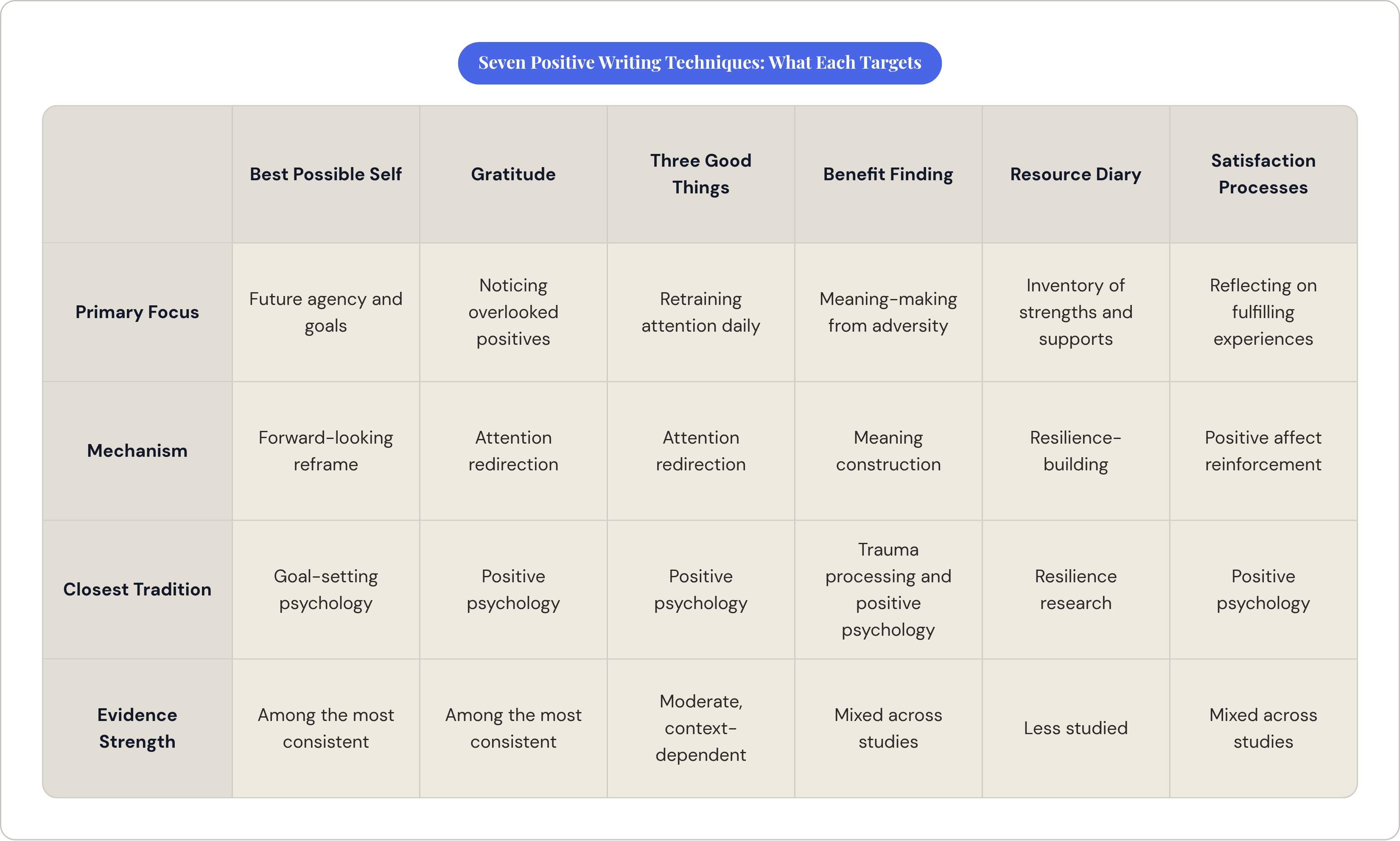
Expressive writing processes pain. Positive writing asks a related but different question: can writing build something up instead of just working something through? A 2025 systematic review in PLOS ONE pulled together 51 studies across seven techniques: best possible self, positive experiences, gratitude, benefit finding, satisfaction processes, three good things, and resource diary.
The headline finding is narrower than you'd expect walking in. Benefits showed up most consistently in wellbeing and positive affect, things like optimism and general mood, while effects on negative affect, stress, and anxiety were shakier across the studies. These techniques are not drop-in replacements for expressive writing when someone's trying to process something genuinely hard. Best possible self and gratitude came out on top, with the most consistent benefit across the full set.
Each technique does a different job, and lumping them together does a disservice to all seven. Best possible self points the writer forward, toward agency and goal-setting; it asks where you're headed, not where you've been. Gratitude and three good things retrain attention toward good things that would otherwise slide by unnoticed. Benefit finding sits in a stranger spot: meaning-making from adversity, one foot in positive psychology and the other in the trauma-processing tradition Pennebaker's work grew out of. Resource diary takes inventory of personal strengths and supports, closer to resilience-building than mood-lifting.
For anyone designing a prompt sequence, that's a decision tree, not a buffet table you graze from. Pick a technique and let the sequence follow from it. Mix techniques without a reason, and the effect either one would've delivered alone probably gets diluted. A lot of "reflection question" apps mix these freely in the name of variety, and the research doesn't back that instinct up. Here, variety looks less like a design choice and more like nobody actually decided anything.
How the brain responds to structured writing, and why prompt architecture shapes that response
What's the brain actually doing during all this? Expressive writing recruits the prefrontal cortex while amygdala reactivity drops, a fancy way of saying the brain shifts from raw emotional firing toward something closer to organized thought. Affect labeling, just putting a feeling into words, works as its own form of cognitive reappraisal. Research on affect labeling has found that naming an emotion changes how the brain processes it, linking limbic activation to the more rational networks running the prefrontal cortex.
There's a memory angle here that doesn't get nearly enough airtime. Dr. Ronald Kellogg at Saint Louis University has argued that writing functions as a kind of external memory store: once something's on the page, working memory can let go of it, freeing up room for actual insight instead of the same unresolved material looping on repeat. A 2019 study led by DiMenichi and colleagues found expressive writing improves neural processing in regions tied to cognitive control and memory. The effect shows up structurally, in how the brain handles information, well beyond some vague sense of feeling better afterward.
None of that happens automatically the moment someone opens a blank page. A prompt that walks someone through steps (name the event, then the emotion, then the meaning) actively steers them through the prefrontal recruitment the research points to. A single open question like "what's on your mind today?" leaves all that scaffolding out entirely. The writer might still get something out of it. They're just building the structure themselves with no blueprint, which is a much harder job than being handed one.
What research-translated prompt design looks like in practice, the structural features that matter
Four features keep showing up once you compare what the research validates against what a prompt sequence actually needs to do.
Topic continuity across sessions comes first, and it's the one most apps skip entirely. Pennebaker's original protocol has participants write about the same experience across four consecutive days, not a rotating grab-bag of unrelated topics. A prompt library that serves up a fresh question every morning is doing something structurally different from what got tested in the lab, even if it feels similar from the inside.
Second: emotion-plus-meaning pairing. Every sequence should ask the writer to name a feeling, then locate why it matters, and never leave the feeling sitting there with nowhere to go. Third, progression within a single session: a sequence moving from event description to emotional response to cognitive appraisal to forward-looking implication does meaningfully more work than one that quits after "describe what happened." Fourth, technique specificity. Prompts built around a named method, best possible self, benefit finding, an unsent letter, hold together better than prompts built from generic reflection language that could apply to almost anything.
A few formats deserve their own callout here. Narrative therapy prompts, rewriting your story, externalizing the problem as something separate from you, naming moments where you had agency, work through a different mechanism than Pennebaker-style processing. They move the writer from character to author, a subtly different psychological shift than simply processing an event. CBT-based prompts sit closer to clinical practice: identify a distortion, challenge the automatic thought behind it, build something more balanced in its place. This is about as close to an actual therapeutic exercise as prompt design gets.
Then there's the unsent letter, a format that matters more than it first appears to. You write to a person, a past version of yourself, or something entirely abstract (fear, grief, your own body), and it never gets sent anywhere. Whatever healing happens, happens in the writing, not in anyone reading it. Giving the writer an addressee seems to change the language on the page. Talking to someone lands differently than talking to no one in particular.
A rotating bank of inspirational-sounding questions with no session structure, no named technique underneath, and no pairing of emotion with meaning falls short here, whatever the marketing copy claims. That kind of library mostly serves as a content generator, missing a piece of therapeutic architecture no App Store description can supply.
How current digital journaling tools handle prompt design, where the research lands and where it doesn't
So how does the current crop actually hold up against all this? Unevenly, and for reasons that make sense once you look at what these companies were optimizing for in the first place.
Some of the biggest journaling apps built their reputation on infrastructure: reliable syncing, clean interfaces, photo and location logging, calendar-style flashbacks to old entries. Flashbacks create a kind of accidental topic continuity, since you're revisiting something you wrote before, but that's a side effect of a memory feature, not a designed four-session arc built around one emotionally significant event. Automatic logging that pulls in your location or activity is genuinely handy for building a personal archive, though it has little to do with expressive writing as a therapeutic mechanism, since it was never built with that in mind to begin with.
A newer wave of apps builds prompts explicitly around CBT and other named cognitive frameworks, with guided session lengths and sequencing that pairs emotion with meaning by design instead of by accident. These land closest to Pennebaker-aligned architecture on the current evidence. They ask how you feel, then actually walk you somewhere with it.
Apps built around Stoic philosophy land closer to the research than a framework a couple thousand years old might lead you to expect. Morning and evening check-ins mirror the multi-session continuity the research supports, virtue tracking and memento mori exercises are technique-specific rather than open-ended, and the philosophical scaffolding hands the writer a direction instead of a blank page and a shrug.
AI-guided journaling might be the most interesting opportunity sitting on the table right now, and probably the trickiest one to get right. An AI system can track what you wrote yesterday and adapt today's prompt, holding topic continuity across sessions in a way a static prompt bank never could, and it can apply technique-specific scaffolding on the fly instead of from a fixed script. The risk sits right next to the opportunity, though. An AI-generated prompt can feel responsive, can feel like it's really listening, while following no structured arc underneath at all. Responsiveness and structure are separate qualities, and it's easy to mistake one for the other when the surface feels smart enough to be trusted.
Voice-first journaling raises a different question entirely. Speaking removes some of the performance anxiety that comes with a blank page, but it also removes the page's built-in nudge toward structure, so the prompt itself has to carry more of the scaffolding than it would in writing. A conversational sequence (name the event, describe the feeling, find the meaning) delivered as spoken prompts can carry the Pennebaker arc into a format that suits people who think out loud better than people who think on paper.
The gap running under most of this, regardless of format, is treating the prompt library as a content feature, something to advertise by volume ("500+ prompts!"), when a therapeutic structure needs an actual shape to back it up. A deep prompt bank and a prompt bank faithful to the research are not the same purchase, even if they look identical in a screenshot.
What to look for when choosing a tool, matching prompt design to your actual journaling goal
Two questions do most of the filtering here, and they're worth asking before anything else about the app.
Does it offer continuity across sessions, or does it hand you a new prompt every day with no thread connecting any of them? If you can't return to the same topic across multiple guided sessions, the tool isn't built for the core mechanism the four-day Pennebaker protocol depends on, no matter how good any individual prompt sounds in isolation. Second: does each sequence pair naming a feeling with making sense of it? An app that only ever asks "how do you feel about that?" runs a real risk of replicating rumination instead of resolving it, per the emotion-only findings above.
From there, matching technique to goal is mostly what's left, and the research maps this out cleanly enough. Processing one specific stressful experience calls for expressive writing or narrative therapy structure, built around continuity and progression. Building general optimism or wellbeing points toward best possible self or gratitude sequences, the two techniques that the 2025 PLOS ONE review found the strongest support for. Work-related stress has its own evidence base: a 2024 peer-reviewed review found 9 out of 13 studies reported significant positive effects from structured expressive writing on mental health variables, personal resources, and organizational outcomes. And for challenging distorted thought patterns specifically, CBT-based prompt design remains the most clinically grounded option on the table.
Format carries real weight too. The best therapeutic structure in the world does nothing if the friction of using it means you quit after four days, which, let's be honest, is roughly when most of us quit most things we start in January. Someone who thinks better out loud than on paper might do better with a conversational, voice-based sequence, one that strips out the blank-page barrier without losing the structured arc underneath it.
Personality is worth a mention too. Introverts often get more out of private written or spoken reflection than talking things through with another person, and the broader journaling research, spanning chronically ill patients, caregivers, students, and workers, shows the modality working across a genuinely wide range of people and situations. Whether journaling works for a given temperament matters less than which interface actually gets you to sit down on day three, once the novelty's worn off and the notebook stops feeling new and starts feeling like homework.
Does the app explain why its prompts are built the way they are? Not just what to write today, but what the structure underneath is trying to do, and why. An app willing to show its reasoning is usually one whose prompts came from somewhere real, rather than from a brainstorm meeting and a content calendar.