Daily Journaling Prompts for Consistent Writing Practice
Specific prompts solve the blank-page problem that stops most people from journaling consistently.

Many people who start journaling don't stick with it, and it's rarely a willpower problem. A 2023 OnePoll survey put regular journalers at just 16% of the population, with 42% never having tried it at all. The usual explanation is that people lack discipline, but the more honest read is that they were handed a blank page and told to do two jobs at once: invent a topic, then say something true about it. Prompts solve that structural problem, but only when the prompt actually matches the job you need your journal to do.
How giving a journal a specific job changes whether people stick with it
Why does crossing an item off a to-do list feel good, while "be more mindful" just sits there mocking you from a sticky note? Specificity of purpose. A journal with one clear job, say, processing a feeling or generating an idea, gives you something to actually finish. A vague journal never resolves, so it never feels done, and an unfinished task left open long enough starts to feel like homework nobody assigned you.
Guided journaling tends to work better than free-form journaling for beginners, and for anyone working through something genuinely hard, for a fairly unglamorous reason: free writing asks you to generate a topic and a response at the same time, stacking two jobs on top of each other. Pull the topic-generation task out of the equation, and the mental energy that was going toward "what do I even write about" gets freed up for the part that matters, which is the reflecting itself.
Look at what each journal type is actually asking of you. Self-reflection wants to know who you are and why you keep doing the thing you do. Emotional processing wants to know what happened and what it meant. Idea generation wants to know what's possible that you haven't let yourself consider. Gratitude wants to know what's already working. Planning wants to know what happens next. Four distinct mental modes, and cramming them into one catch-all "write about your day" prompt dilutes all of them simultaneously. You end up with something that's technically about your life but points at nothing in particular.
James Pennebaker's expressive writing research is worth bringing up here because it kills the time excuse before it starts. His studies found that short sessions, 15 to 20 minutes across just 3 to 4 days, produced significant effects on immune function. Regularity and intention did more of the work than sheer volume ever did. The categories that follow aren't interchangeable, and they're not built to be run all at once; pick the one matching what you need right now and let the prompt handle the steering.
Self-reflection prompts that surface patterns rather than just events
Self-reflection has one job: figuring out the self. "I had a hard day at work" is a report. "I notice I feel this exact way before every difficult conversation, so what's that telling me?" is reflection. The gap between those two sentences looks small on the page and turns out to be enormous in practice.
There's something happening at the level of language production that helps explain why. Putting a half-formed feeling into words runs it through both Wernicke's area (comprehension) and Broca's area (production), and that process forces something vague to become something coherent enough to say. The articulation isn't just recording what you already knew; it's doing some of the figuring-out.
A handful worth rotating through: "What did I do today that felt most like me, and what felt least like me?" "What am I avoiding, and what is that avoidance actually costing me?" "Describe your ideal day start to finish; what does the gap between that and today tell you?" "What would you attempt if you knew failure wasn't on the table?" "What belief am I carrying around that I haven't actually examined lately?" "Where did I surprise myself this week?" "What would a future version of me think about the call I made today?"
Evening, or the tail end of the week, is the natural slot for these, since reflection needs raw material to chew on and there's no reflecting on a day that hasn't happened. Cycle through several prompts instead of leaning on one, because repetition breeds a shallow, rehearsed answer, and that tells you more about prompt fatigue than about your actual inner life.
Emotional processing prompts that move feelings forward instead of replaying them
Write about a hard feeling with no direction and you'll likely end up rehearsing it instead of working through it: the same argument, the same rejection, on loop. A prompt in this category has one job, and it's to move the feeling somewhere instead of leaving it parked.
Three mechanisms are doing the actual work here. Emotional labeling, naming the feeling precisely instead of vaguely, quiets activity in the limbic system and hands some control to the brain's more deliberate regions; a prompt like "what exactly am I feeling, and where in my body do I feel it?" is doing real neurological work, not just journal-prompt theater. Cognitive reappraisal, the practice of rewriting a thought into something more workable, is a recognized approach in emotion-regulation practice. And self-distancing, writing about your own situation as though you were an outside observer describing someone else, is a technique used to reduce emotional reactivity in a way first-person venting simply doesn't.
Prompts built on those mechanisms: "What am I feeling right now, not the story of what happened, but the feeling itself?" "Write about this as if you were advising a close friend in the exact same spot." "Write an unsent letter to whoever or whatever hurt you; say the thing you haven't said out loud." Nobody reads it. That's the entire point. "What story am I telling myself here, and is it the only story available?" "What would I need to believe to feel differently about this?" "What emotion am I most trying to dodge, and what happens if I sit with it for five minutes instead?" "Where in my body is this living, and what would letting it go actually feel like?"
Worth saying plainly, since it matters: these prompts aim at clarity, not diagnosis. If something needs a professional, the journal is a supplement to that, never a replacement. This category works best as something you reach for after a specific bad moment, not a daily ritual forced through on an unremarkable Tuesday. Having the prompts ready is what makes the journal useful in a rough moment instead of one more overdue chore.
Idea generation prompts that break habitual thinking
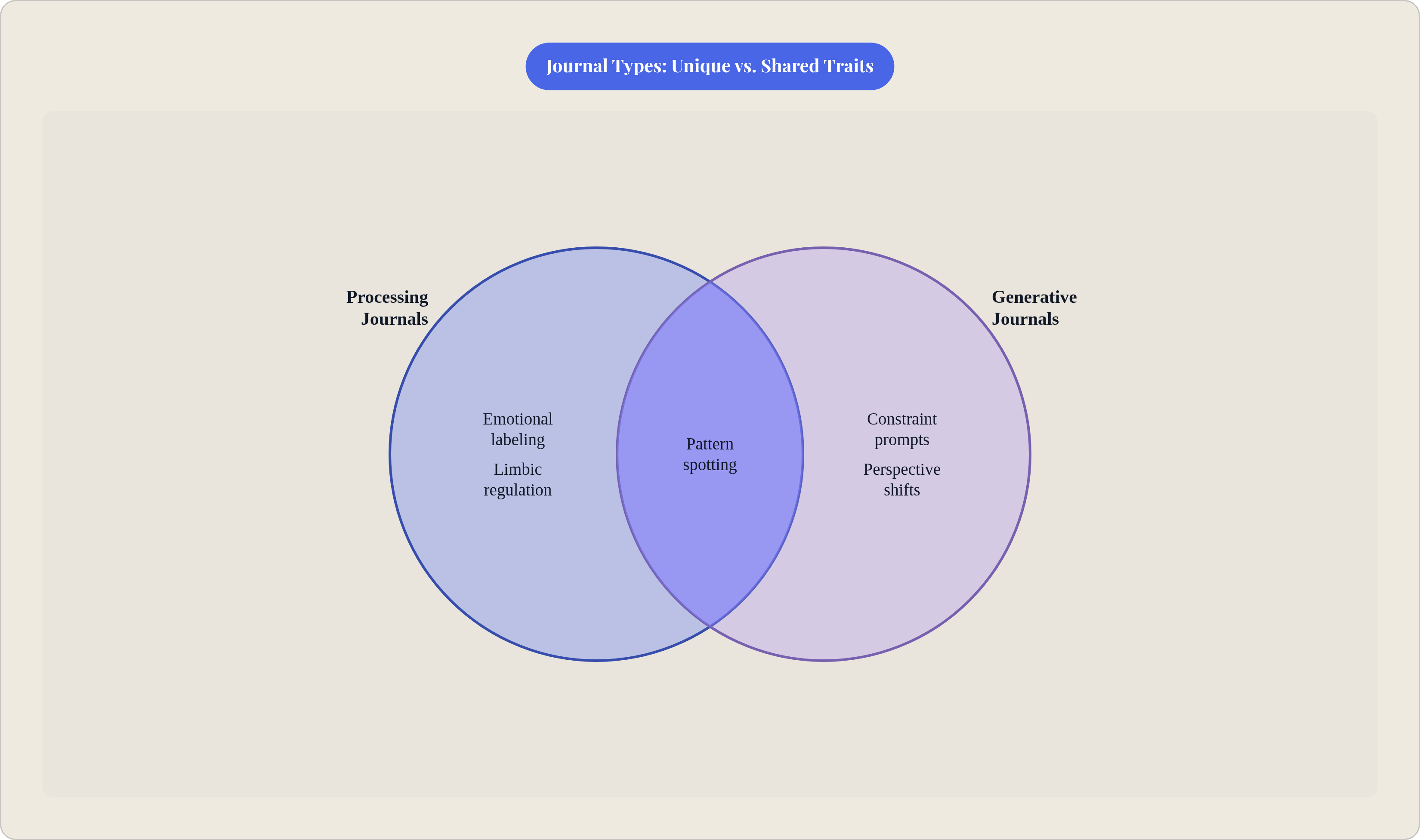
This category flips the whole premise around. It opens up whatever hasn't happened yet, rather than processing something that already happened, and the journal becomes a thinking tool instead of a feelings tool, which means a good prompt here looks nothing like a good prompt above.
Self-criticism is usually the thing standing between you and an idea worth having, so a good generative prompt gives you permission to think from an angle you'd normally shut down. A few techniques earn their keep. Constraint prompts open thinking rather than closing it, oddly enough: "What would I do here with half the time and twice the resources?" Perspective shifts, taking on someone else's view, or a fictional character's, force an angle you'd never wander into on your own. And dream logging, jotting the imagery and internal logic of a dream before the waking brain edits it into something tidy, is a genuinely underused source of raw material.
Keep these on hand: "What problem have I been circling the same way for too long, and what does the opposite approach look like?" "List ten ideas on a topic, bad ones included; what on that list surprises you?" "What would I do differently if I started from scratch today?" "What have I noticed this week that nobody else seems to have caught?" "If I had to explain my current project to a ten-year-old, how would I do it?" "What idea have I been too embarrassed to take seriously, and what happens if I do?" "What connection between two unrelated things has been rattling around my head?"
Julia Cameron's Morning Pages practice is a useful reference for anyone who wants something less prompt-by-prompt and more structural: three pages of stream-of-consciousness writing done right on waking, unread, especially early on, built to clear out mental static before the day narrows your range of thought. Morning really is the better window for this category. Once the day's obligations start piling up, the mind shrinks to fit whatever's already on the calendar.
Gratitude prompts that work because of specificity, not repetition
The research case for gratitude journaling is strong enough to state plainly before picking at it. Emmons and McCullough's landmark 2003 study found that participants keeping weekly gratitude entries over 10 weeks reported higher well-being and fewer physical complaints than those journaling about daily hassles or neutral events. That's a real effect, and it's been replicated enough times that nobody's seriously arguing with it anymore.
Here's where the average gratitude practice quietly falls apart, though: "I'm grateful for my family, my health, my job," written the same way every morning, stops registering as language within a couple of weeks. It becomes furniture. You walk past it. The fix is specificity: "I'm grateful my partner made coffee before I even asked" lands differently than "I'm grateful for my partner," because the brain re-lives a real moment instead of nodding at an abstraction it's heard a hundred times already.
The second rule follows from the first almost automatically: write something new each session instead of recycling the same three items. The goal is catching something you'd otherwise let slide past unnoticed, not maintaining a running inventory of things you're contractually obligated to feel thankful for.
Prompts built around specificity: "What happened today that I almost missed, and I'm glad I didn't?" "What small thing made today easier than it had to be?" "Who did something for me recently that I haven't properly acknowledged?" "What part of my life right now would a past version of me have killed for?" "What difficulty from the past am I actually grateful for now?" "What would I miss badly if it vanished tomorrow?" "What did my body do today that I never think to thank it for?"
The Five-Minute Journal format, three gratitudes in the morning and three highlights at night, is a decent structural model if you want to bookend the day instead of cramming it into one sitting. Martin Seligman's positive psychology research puts the happiness boost from a consistent gratitude practice as notably high, which is a striking number, but the number matters less than the specificity habit sitting underneath it. The data backs the practice; the granular detail is what actually makes it work.
Planning prompts that turn intention into a concrete next step
Planning prompts skip the vision board, and they skip the five-year plan dreamed up at 11pm on a Tuesday. Their job is translation: take whatever the other categories surfaced, a pattern, a feeling, an idea, something you're grateful for, and turn it into a decision or a next step you can actually take tomorrow morning.
Writing a goal down measurably raises the odds you'll follow through on it; that's about as settled as behavioral science gets on this topic. There's a sleep angle too, worth mentioning since it's underrated: journaling before bed may help offload the open loops circling working memory onto paper instead of leaving them to spin all night.
Decision journaling deserves its own callout. Write down a decision before you know the outcome, note your reasoning at the time, then come back weeks or months later and check it against what actually happened. This surfaces patterns in your judgment that are invisible while you're inside the decision. You can't spot your own blind spots in real time, but you can spot them in hindsight, provided you wrote down what you were actually thinking before you knew how it ended.
Prompts for this one: "What's the single thing I most want to move forward this week, and what's the smallest action that counts as progress?" "What decision am I sitting on right now, and what does each option actually cost me?" "What am I saying yes to by saying no to this?" "What would today look like if it went about as well as it possibly could?" "What did I say I'd do that I still haven't done, and do I even still want to?" "What's one thing I keep putting off, and what would make starting feel smaller?" "What do I want to remember about how I'm thinking right now, three months from today?"
Evening or Sunday night works well here, since you're closing out what already happened while pointing at what's next, and it pairs naturally with a quick pass through the week's self-reflection entries. Resist treating this as productivity optimization, though. The value of a planning journal is integration, connecting what you actually know about yourself to what you choose to do next; treat it like a to-do list and you've stripped out the exact part that made it worth doing.
Matching a prompt category to your actual journaling goal
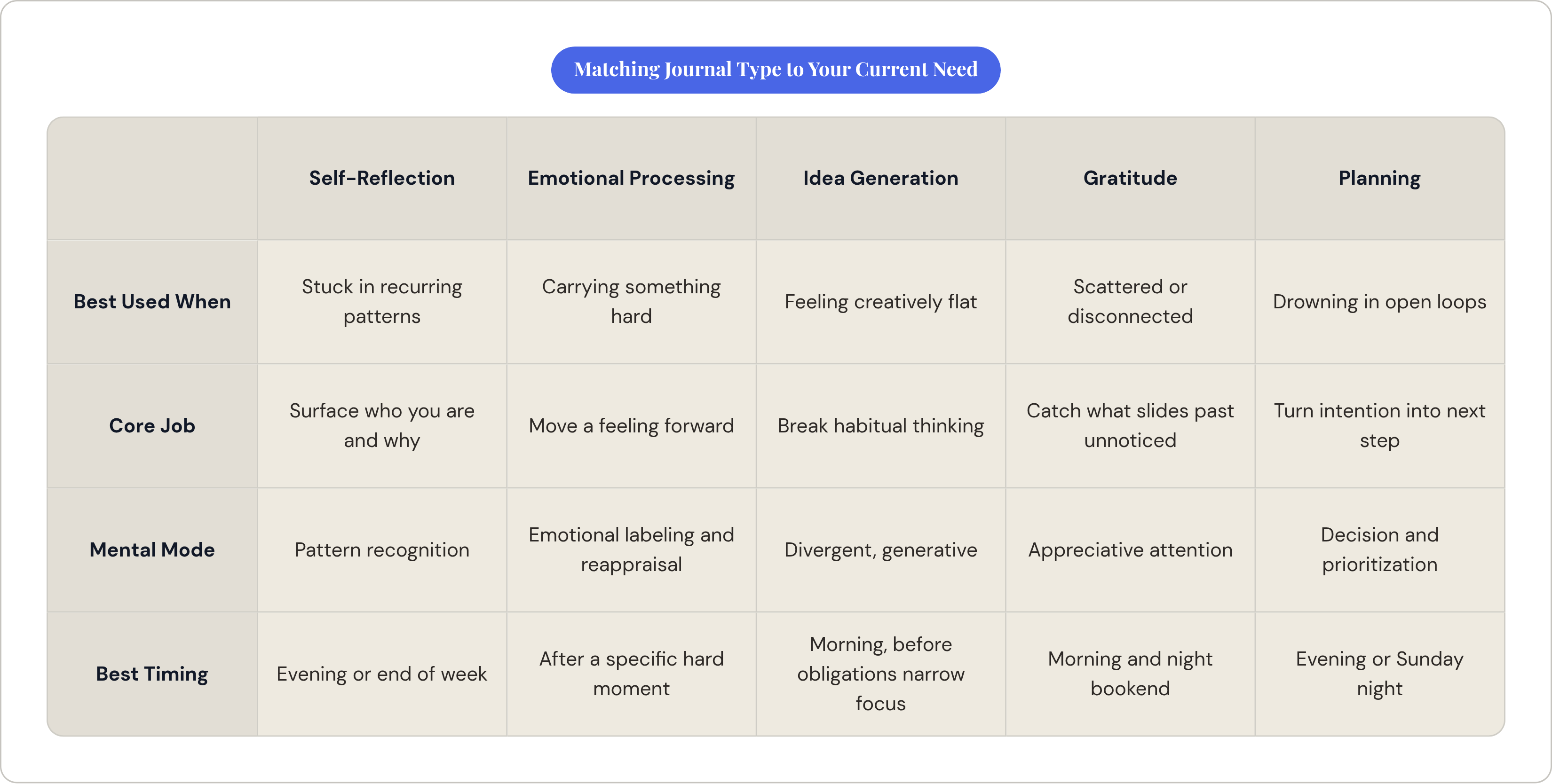
None of the five categories above are meant to be sampled all at once, and starting with whichever one matches your actual, current need beats rotating through all five hoping something sticks.
A few honest questions, in place of a quiz: feeling stuck, or making the same choice over and over for reasons you can't quite name? Self-reflection territory. Something hard happened recently and you're still carrying it around? Emotional processing. Working on something creative and feeling flat? Idea generation. Feeling scattered, or oddly disconnected from things you know you should appreciate? Gratitude. Drowning in open loops with no idea what to actually do next? Planning.
Once one category becomes a real habit, adding a second tends to happen on its own instead of by force. Gratitude in the morning paired with self-reflection at night is a common combination; planning on Sunday paired with emotional processing as needed is another. Neither is a rule. They're just what tends to stick once the first habit has actually taken.
Format matters less than people assume, and that's worth saying plainly. Written, typed, spoken into a phone mid-dog-walk, all of it counts, and the right format is whichever one removes friction instead of adding more of it. For people who think better out loud than on paper, or who find the blank page itself to be the obstacle, voice journaling tools like Joice let you talk through these same prompts instead of staring down an empty box. The prompt still does its job either way; it's just meeting you where you already do your thinking.