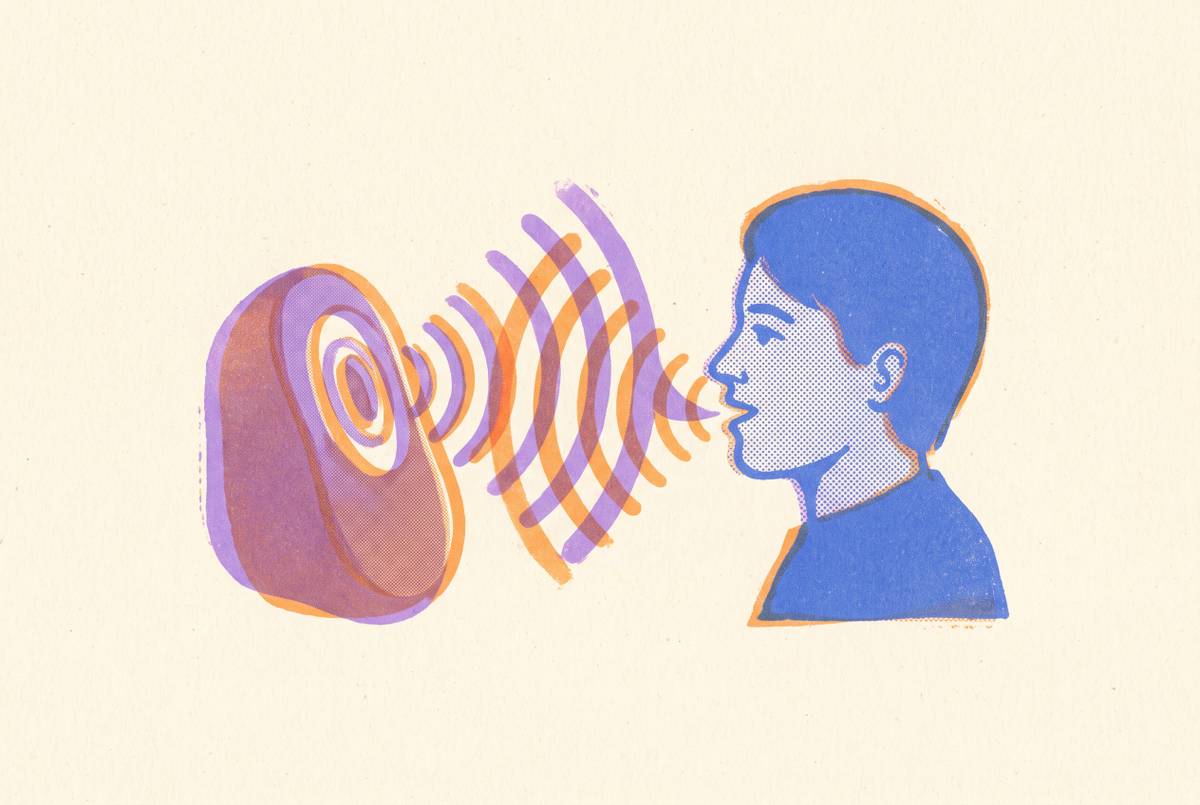
Speaking Your Worries Out Loud Into an App Is Not the Same as Talking to Yourself
Structured prompts turn anxious rambling into actual emotional processing.
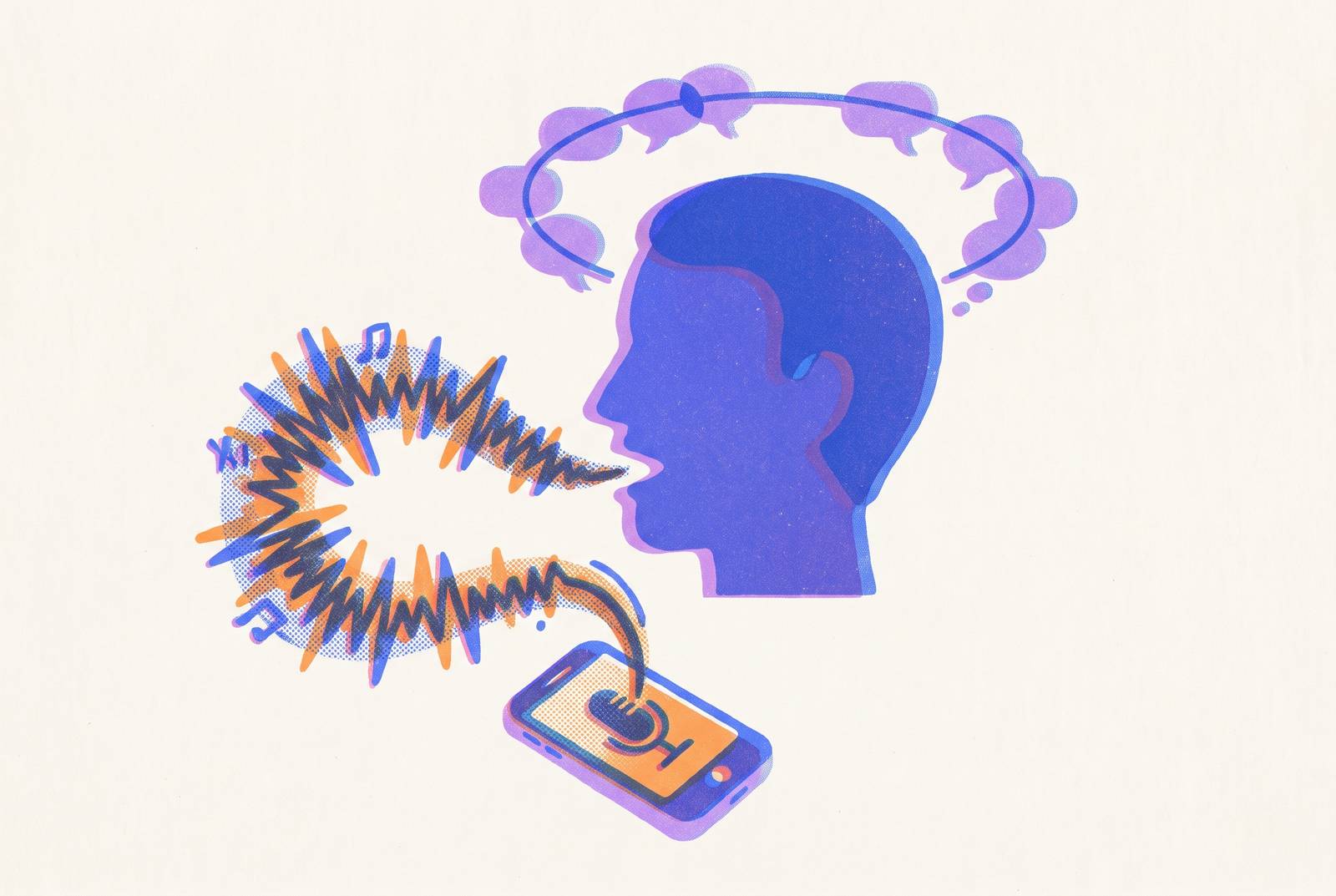
For anxiety and overthinking without typing, a voice journaling app should offer prompts, a saved record, and a way to replay or read entries. Speaking into that structure differs from talking to yourself because it asks you to organize a worry.
Why talking to yourself about a worry rarely makes it better
Someone paces the room, muttering through a worry. Each pass sounds slightly different, but the thought returns to the same unresolved point. Psychologists call this kind of thinking rumination when the thoughts that keep coming back are negative.
The brain’s default mode network, or DMN, is involved in self-referential thinking. When that thinking becomes repetitive and unresolved, attention keeps returning to the worry instead of organizing it into something that can be examined. The network itself is not the enemy. Without an external constraint, the loop keeps the same worry in working memory with no clear place to stop.
Speaking freely does not necessarily supply that constraint. Tone, pace, and self-interruption can become additional things for an anxious person to fixate on, feeding the cycle. A worried voice can become another reason to worry. That explains why vocalizing a concern requires additional structure. Something must change how the thought is handled.
What the brain does differently when it has to put an emotion into words
Affect labeling means putting an emotion into words. Matthew Lieberman’s work at UCLA found that affect labeling reduced amygdala activation and increased activation in the right ventrolateral prefrontal cortex. That region is involved in inhibitory control and the linguistic processing of emotion. Naming is therefore not merely reporting a feeling. It can change how the brain responds to it, bringing language and regulation into an experience that might otherwise remain reactive.
But how is that different from saying something anxious aloud? The distinction lies in the work of choosing words and committing to a representation of the feeling. Deliberate articulation requires selection, while unconstrained speech can keep circling without settling on what the experience means. Writing engages the prefrontal cortex, hippocampus, and language centers in organizing scattered thoughts into structured representations.
A second mechanism, cognitive offloading, explains a different kind of relief. Ramirez and Beilock’s 2011 study found that a brief period of writing freed working memory from anxiety and improved subsequent performance. Here, the record provides an external place for the concern, reducing the burden of keeping it active internally. This differs from changing the emotional response itself.
What Pennebaker's expressive writing research revealed about structure as the active ingredient
Pennebaker’s expressive writing research complicates the appealing idea that emotional relief comes from letting everything out. Students felt worse while they were writing but got better afterward. That arc suggests a distinction between the discomfort of engaging with an experience and the later benefit of processing it. A session can feel difficult without being unproductive, just as an emotionally intense session need not produce lasting change.
Pennebaker’s analysis using the LIWC text analysis tool found that health improvements tracked increasing use of causal and insight words. Causal words included “because,” “reason,” and “why,” while insight words included “understand,” “realize,” and “meaning.” These words signaled an emerging explanatory framework. Writers were doing more than describing how strongly they felt. They were connecting what happened with an account of why it affected them and what they understood about it.
Writers who shared strong feelings across all four days without building narrative structure saw little benefit to their health. Writers also did better as their perspective changed, including when they used less first-person singular language and more third-person and first-person plural language. Those changes suggested distance from the experience. The vocabulary pattern matters for the cognitive work it reflects.
Is this evidence about writing alone, then, with little relevance to a microphone? The research supports narrative construction as the active ingredient. It does not establish that every spoken format reproduces the same outcomes. Instead, it gives the comparison a more precise basis. A voice tool can help when it lets someone build an account of an experience as well as keep a record of their outpouring of feelings.
Why speaking into a structured app is closer to expressive writing than to talking to yourself
A structured voice app changes the task through prompts, capture, and the expectation of review. The speaker has something specific to address, somewhere to put the response, and a reason to make it understandable later. The microphone is only the entrance to the process.
Prompts narrow attention to aspects of an experience that might otherwise remain tangled together. Questions about what led to a feeling or what the experience reveals invite causal and insight language. A useful prompt asks for a connection. In this respect, it serves a function similar to expressive writing instructions, giving the speaker a task that goes beyond emotional discharge. Its value lies in what it asks the person to do.
A recording or transcript provides an external record, which is the feature relevant to cognitive offloading. Unrecorded self-talk leaves no such store to return to. Knowing that the words will be reviewed can also encourage more careful organization during speech, approximating some of the editorial filtering that writing imposes. These features explain why structured voice journaling is plausibly closer to expressive writing, without proving that an app automatically produces the same psychological outcomes.
The honest case for voice over writing: what speed and lower effort actually buy you
Voice is faster than writing and usually asks less effort at the point of entry. A journaling method cannot support repeated processing if the person abandons it, and lower perceived effort supports consistency. For someone who freezes when faced with writing about anxiety, speaking can make beginning more manageable. A structured voice session is more useful than a writing habit that never happens.
Speech also preserves emotional prosody, including tone, pace, and a catch in the voice. Text cannot fully retain those signals. When the goal is to surface what someone feels, that extra information can be useful. The same feature that may feed an unstructured anxious loop can become material for later review within a more deliberate session. Its usefulness depends on the task around it.
Writing, by contrast, slows people down and makes them choose their words more carefully, which tends to lead to deeper processing. Speed is not the same as depth. Even so, writing more slowly does not make it the best choice for every person or goal. Voice’s strongest case is that it lowers the cost of participating while retaining emotional information, especially when prompts and review give that participation direction.
How to choose a modality and structure that matches what you are actually trying to do
For someone choosing a voice journaling app for anxiety and overthinking without typing, the first distinction is between processing a feeling and storing a thought. Working through a feeling calls for affect labeling and narrative construction, so prompts should ask about causes and insight as well as what happened. Speaking with prompts and a way to replay the speech or turn it into text fits that purpose, as does Pennebaker-style free writing with clear prompts.
For cognitive offloading, the record needs to last. A written list, typed note, or transcribed voice entry can give an unresolved concern a place outside working memory. When someone wants to stop holding every open loop in their head, they need capture more than a complex tool for conversation. A tool that invites speech but leaves nothing available for review does not meet that particular need.
For deeper emotional processing over time, access to earlier entries becomes more important. Pennebaker’s findings about shifts in perspective give a reason to revisit earlier language and notice what has changed. A person can encounter an earlier account from a different position instead of relying only on how the concern feels today. Replay and readable transcripts therefore serve more than archival convenience.
What, then, is best for someone who freezes when trying to journal about anxiety? The strongest fit is a low-effort voice format that supplies a starting prompt, preserves the response, and allows review without requiring typing. The label alone is not enough to choose. An app designed chiefly to capture thoughts serves a different purpose from one that also asks follow-up questions about causes and meaning. Choosing by those functions is more precise than declaring either speaking or writing universally superior.
Where AI-generated prompts help and where they risk short-circuiting the process
MindTailor, a framework published in June 2026, generates personalized emotional support by constructing a case formulation from a seeker’s post history. It refines responses through collaborative critique among agents grounded in distinct counseling strategies. Its evaluations found improvements over baselines in empathy, personalization, and understanding, with the highest overall preference. History-aware support can therefore extend beyond a single message. That is relevant to journaling because earlier entries can provide context that an isolated account cannot.
The framework illustrates the promise of using history to shape a response, but it does not establish the effects of AI-assisted voice journaling. In journaling, AI could use past entries to surface patterns and ask more focused follow-up questions. Such support can extend the structure available to the speaker. It remains supportive when the person still has to name the feeling, consider the connection, and construct the account.
The risk appears when assistance becomes substitution. If AI labels every emotion, supplies the explanation, and presents a polished narrative, it may remove precisely the work that affect labeling and narrative construction ask the person to perform. A persuasive summary is not evidence of personal processing. Receiving an account and building one are different cognitive acts. An emotionally fluent response can blur that distinction.
AI that generates prompts, surfaces patterns, and asks follow-up questions that leave the user responsible for making sense of the experience should be favored. That is scaffolding rather than a replacement author. It preserves the role of deliberate articulation while reducing the difficulty of getting started or finding a useful direction. This claim about cognitive mechanisms leaves an app’s therapeutic effects unproven. Research has yet to establish whether increasingly capable AI helps people do more of that work, or makes it easier to accept an explanation without doing it.
Sources
- MindTailor: Personalized Emotional Support via Post History-Grounded Case Formulation and Collaborative Refinement
- Rumination Out Loud? Linguistic, Neural, and Psychophysiological Correlates of the Think‐Aloud Paradigm - PMC
- Affect labeling down-regulates amygdala only in a dominant native language
- Pennebaker, J. W., & Chung, C. K. (in press). Expressive
- Examining Input Modalities and Visual Feedback Designs in Mobile Expressive Writing
- Two Modes of Reflection: How Temporal, Spatial, and Social Distances Affect Reflective Writing in Family Caregiving
- Expression Modalities: How Speaking Versus Writing Shapes Word of Mouth