Why Talking Through Your Feelings Out Loud Finally Clicks When an App Is Actually Listening
Naming emotions out loud to a responsive app can rewire how your brain processes feelings.
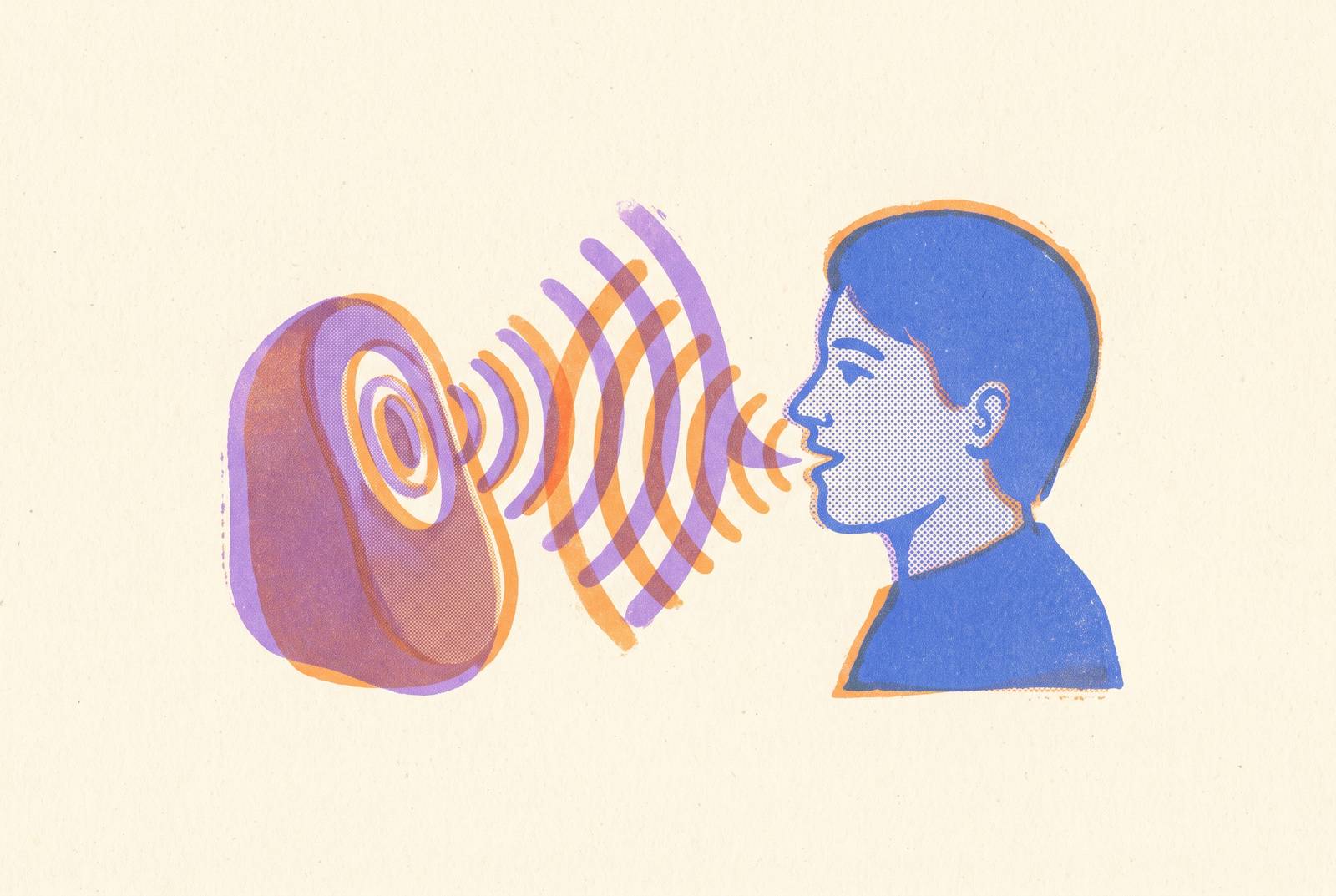
Voice journaling is a natural fit for people who think better out loud because naming feelings activates emotional regulation without requiring a written entry. A responsive app can make that practice easier to sustain by giving spoken thoughts somewhere to land. The key distinction is not simply speaking instead of typing, but having enough feedback to keep finding words for what you feel.
Why naming a feeling quiets the brain's alarm signal
An emotion feels hot and immediate, then the word “angry” gives it a name. In the brain, that small act can accompany a measurable change. The amygdala’s alarm response becomes less active as a region involved in regulation becomes more active. The feeling has not necessarily disappeared or been resolved. But putting it into language changes how the brain handles it.
Matthew Lieberman’s UCLA fMRI research identified this process as affect labeling, finding decreased amygdala activation and increased activity in the right ventrolateral prefrontal cortex when people named emotions. The proposed regulatory pathway involves that region, with secondary input from Broca’s area, dampening amygdala activity through the medial prefrontal cortex. The essential act is finding words for feelings. It is not the movement of a pen, the pressure of a key, or the existence of a permanent record.
Speaking an emotion is not merely describing a process that happens elsewhere, after the journal entry is finished. The act of naming is part of the process. This does not mean that any speech is equally useful for emotional regulation, or that a label solves the situation that produced the feeling. It means that turning an indistinct emotional experience into language gives regulation something to work with.
Cognition and Emotion’s 2025 special issue on the language–emotion interplay places this finding within a broader understanding of language as something that communicates, shapes, and regulates emotion. The Nature Portfolio “Emotion and language” collection, spanning 2024–2026, brings together related research across psychology, neuroscience, and psycholinguistics. The relationship extends beyond a single journaling method. That leaves a practical question about access to the mechanism, namely which way of finding words feels easiest to begin and repeat.
Why speaking feelings out loud can activate affect labeling more readily than writing them down
For people who think better out loud, writing can add a task before they begin to process their feelings. A thought that arrives through speech must first become a sentence suitable for a page. Grammar, order, and presentation can start competing with the feeling itself. Speech removes some of that editorial distance. The mouth can get going before the inner critic has finished arranging its stationery.
This is why voice is more than a substitute for people who dislike typing. Verbal processors can use the form in which their thoughts naturally take shape, rather than translate them into a more linear account. Hesitation and revision become part of the entry. A sentence can begin with one emotional label and arrive at a more precise one.
Speech also preserves tone, pace, and hesitation that typed text leaves out. Those features carry feelings that the words alone leave out. A spoken sentence cannot be silently deleted halfway through, as text can, so it is harder to edit away an uncomfortable thought before admitting it is there. This need not make speaking more revealing every time. It does let some raw thoughts get past the self-censorship that can come with a blank page.
What about the distinctive benefits of handwriting? EEG work links pen-on-paper activity to connectivity patterns not seen in typewriting, and handwriting has advantages for memory encoding and recall. Those are real benefits, but they answer a different question. Affect labeling depends on finding words for an emotion, regardless of the motor pathway used. For someone who readily speaks but repeatedly avoids writing, voice preserves that regulatory opportunity while lowering the effort required to start.
Why speaking into silence has always felt strange — and why it stopped the practice before it started
A person can understand all of this, open a recorder, and still feel faintly ridiculous after the first sentence. The room remains quiet. There is no acknowledgment, no follow-up, and no sign that the expression has reached anyone. The recording may work just as it should while the exchange feels unfinished.
Speech normally has a destination, even when its purpose is simply to think something through. Human speech grew out of life with other people, and everyday conversation teaches people to expect someone to hear them. Someone listens, responds, or leaves space for the next thought. A private written journal does not violate that expectation in the same way. Writing alone is familiar, while speaking to nobody can feel like rehearsing for a performance that has no audience and no opening night.
A voice memo preserves the words but does little to resolve this awkwardness. It records without reflecting anything back. After an emotionally charged sentence, the speaker must supply both the next thought and the reason to continue. For some people, that freedom is welcome. For others, the absence of a conversational cue makes the pause feel less like thinking and more like evidence that the whole exercise is strange.
A method can bring real relief in one session yet feel too uncomfortable to use day after day. Even when people know journaling helps, they can still find it hard to start again. The barrier can lie in the structure of the interaction itself, specifically the absence of an interlocutor who gives speech somewhere to go.
Easier capture addresses the work of recording an entry, but not the social friction of producing one. The two barriers are distinct. A responsive app attempts to address the second by creating a recognizable rhythm of expression and acknowledgment.
What a listening app actually does differently from a blank recording
A listening app can turn a spoken entry into visible text, identify emotional themes, and offer a response. Each function changes a different part of the experience. Transcription lets the speaker return to the words and recognize them after having put them into words aloud. The record is therefore not just storage, but another way of attending to what was said.
Responsive prompting adds the conversational cue that a blank recording lacks. An app may follow up on an emotionally charged passage, probe a one-word answer, or reflect a recurring theme. There is something concrete to respond to. Instead of inventing a fresh starting point after every pause, the speaker can continue from the prompt. The resulting rhythm of speaking, receiving a response, and speaking again can help sustain the search for emotional language.
The Imperial College / NUS embodied empathy study found that personalised avatars and text-to-speech output strengthened emotional bonding and perceived empathy in a multimodal AR and LLM-powered system. Its findings support a narrower point than the claim that an app understands someone as a person would. How an interface responds can shape whether someone feels heard. They do not establish that every voice journal produces the same experience, since the system studied was not simply a journaling recorder.
Dimitri Chubinidze, Catherine Perry, and Kate Tchanturia’s 2025 Neuropsychiatr study offers related, but also limited, evidence about expression with AI tools. Their therapist-led work with people with anorexia nervosa used AI-assisted visual elicitation and guided exploration of emotions. The co-creative process helped participants externalize emotions and supported a greater sense of agency. This suggests that an AI tool can participate in emotional expression alongside human support.
Responsiveness can reduce the feeling of talking into a void and provide reasons to keep naming what comes up. Over time, pattern recognition can also bring recurring emotional themes and sentiment shifts back into view. The app supplies prompts and feedback. The person still has to find the words.
What’s the best journaling app if you hate writing but love talking through your thoughts?
The best fit depends on what matters most to the person: emotional feedback, private transcription, or avoiding the effort of opening an app. A service that responds to emotional themes offers something different from a recorder that keeps every word on the device. A phone-based journal also changes how a session starts. Entries, Whisper Notes, and Claire each take one of these approaches.
Entries is an option for iOS users who want transcription with emotional analysis. Entries’ App Store listing describes OpenAI’s Whisper for transcription and GPT-4 for emotional analysis, including emotional themes, recurring patterns, and suggested follow-up reflections. It is available free with an optional monthly or annual Premium subscription.
Whisper Notes is the privacy-maximalist option for users unwilling to send voice data to a server. It transcribes voice entries entirely offline on iPhone using OpenAI’s Whisper model, with nothing leaving the device and no internet required. It covers 100+ languages and is a one-time purchase. The emphasis here is private capture. Its listed features give people a reason to choose it for offline transcription, but give no reason to assume it has the emotional analysis or responsive prompting described for other approaches.
Claire suits people who find that the hardest part is remembering or choosing to open a journal. It calls the user’s actual phone number. Optional two-way texting takes place through the user’s regular messaging app, and pricing is on a monthly subscription basis. The journal comes to the user, changing the routine without requiring the user to adopt a new place for every interaction.
Privacy remains a separate decision from convenience. Voice journals can hold deeply personal thoughts, and people using server-side services have more to consider than how well those services respond. To keep access to their entries, users depend on the company staying in business and allowing data export. Before choosing a cloud-based service, users should check that they can export their entries.
How to make spoken emotional processing a habit that actually holds
Once the tool fits, the practical lesson is to make the session easy to return to tomorrow. A rich entry has limited value as a habit if producing it makes the next one feel burdensome. Phillippa Lally’s University College London habit research found that automaticity takes many weeks to develop, and the time it takes varies widely with how complex the behavior is. There is no single timetable for everyone. The first two months are therefore better treated as a period for reducing friction than as a deadline for effortless consistency.
To give the practice a reliable place, anchor it to something that already happens, such as morning coffee, a commute, or the period before sleep. B.J. Fogg’s Behavior Design model supports attaching a tiny new behavior to an existing routine and then celebrating it. The existing action becomes the cue. This avoids making every session a freestanding decision about when journaling should happen. Voice already removes the blank page and the demand for correct grammar, so the routine can stay similarly undemanding.
Start with three to five minutes rather than an expectation of a complete account of the day. Name what happened and how it felt. Notice what the body registered. That gives the session a small, concrete shape. In the first weeks, the goal is consistency rather than depth, and casual speech is enough. An entry can have a real moment of affect labeling even if its ending is rough.
Use the app’s responsiveness as the reward. A follow-up question, a reflected pattern, or a transcribed phrase can make the effect of speaking perceptible. Something came back from the act of putting experience into words. That acknowledgment gives the next session a reason to happen, without turning the journal into another document that must be made impressive.
The accumulating benefit is not simply a longer archive. Each time a feeling acquires a name, language gives the brain another chance to shift from alarm toward regulation. A responsive app makes room for that moment to happen again.