Why You Think Better Out Loud Than on Paper
Speaking engages more of your brain, producing faster clarity than writing can.
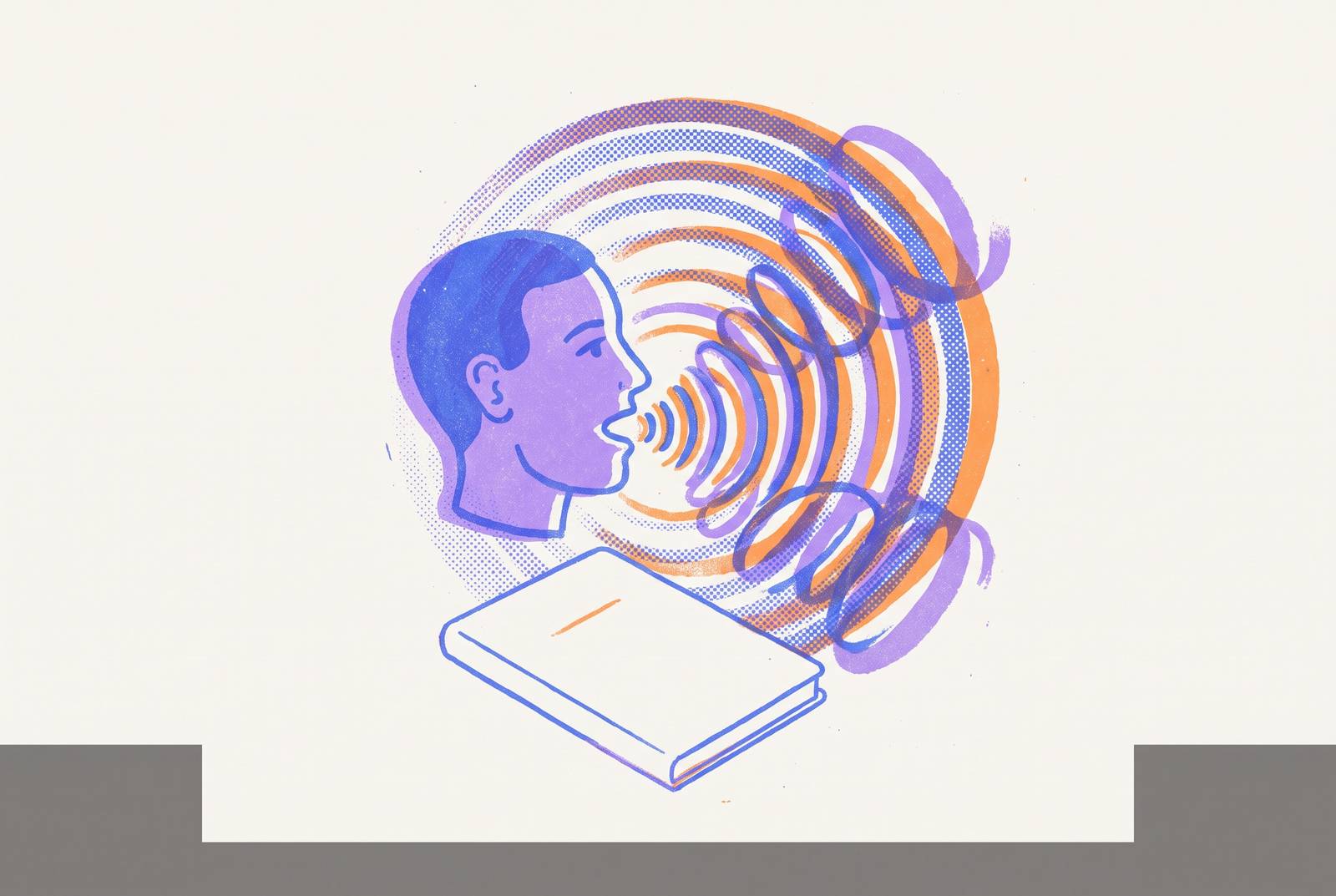
Speaking a thought out loud and writing it down are two different cognitive events, but the objection that voice lacks the evidentiary base of written expressive writing holds: there are no large-scale randomized controlled trials directly comparing the two with matched protocols. The person pacing a hallway who suddenly says "wait" out loud and knows the fix isn't having a lucky moment. Something measurable happened in the brain that would not have happened if they'd stayed quiet and typed it instead.
Most people treat speaking versus writing as a matter of mood or convenience: some days you feel like typing, some days you'd rather talk it out. What is actually different about the neural event of speaking, and why does it so often produce clarity that sitting down to write about the same problem doesn't? For most of human history, knowledge moved through dialogue, argument, and repetition. Speaking wasn't a lesser cousin of thinking, it was the mechanism of thinking itself, and treating written output as the gold standard of intelligence is a comparatively recent habit. The rest of this piece explains the mechanism behind the walk-and-talk epiphany.
The neural difference between speaking and thinking silently
Silent thinking is a fairly contained affair. It runs mostly through language processing and executive control regions, the parts of the brain that hold a thought and manipulate it in the abstract. Speaking recruits more of the building. It brings in the motor cortex, which has to coordinate the physical choreography of producing sound, the auditory processing centers that receive the sound once it exists, the somatosensory cortex registering the physical sensation of speech, and the cerebellum, which handles the timing so the words come out in the right order at the right pace.
That matters for a simple reason: a thought spoken aloud gets encoded with more handles attached to it. It's not just a linguistic string anymore. It has a motor signature, an auditory echo, and a physical sensation riding alongside it, and each of those is a separate route back to the same idea later. There's also a live feedback loop that silent thought doesn't have. Speaking lets a person hear whether a sentence holds together in the moment they're saying it, catching the logical gap or the false note before it fully forms.
Psychologist Alan Baddeley's model of working memory identifies the phonological loop as one of its core components. Speaking activates that loop directly, which offloads some of the storage burden onto the auditory system and frees up working memory capacity for the actual reasoning. Practically, that means a person trying to sort through a tangle of half-formed thoughts is not fighting to hold every piece in mind at once. Voice does some of the holding, so the mind is left to do the sorting.
Lev Vygotsky's research on private speech adds a developmental wrinkle. Children talk through problems out loud constantly, and most adults eventually internalize that habit into silent inner speech. Under real cognitive load, though, adults revert to audible self-talk, and their problem-solving improves when they do. Internalizing speech buys efficiency. It appears to cost some of the effectiveness that made the habit useful in the first place, and the trade is strongest exactly when the audible version returns.
The speed gap between speaking and writing
There's a mundane fact hiding a much bigger consequence: people speak at roughly 150 words per minute, while even fast typing tops out around 40. That's not just an inconvenience for anyone trying to get thoughts onto a page quickly. At writing speed, a thinker has to hold the front of a thought in mind while their hands catch up, which leaves less working memory available for wherever the thought was actually headed. The thought risks losing its own ending before the hand finishes writing its beginning.
Speaking closes most of that gap. Because verbal output moves at close to the speed thought is generated, speaking preserves full sequences, the emotional charge attached to them, and the associative leaps that tend to get edited out when there's time to reconsider each word, a match between speaking speed and thought generation speed that Lound (2025) credits with preserving full thought sequences, emotional authenticity, and natural associations. Cognitive flow research backs this up from another angle: once concentration breaks, it takes real time to rebuild, and writing's slower pace creates more opportunities for that break than speaking does.
None of this means slowness is worthless. Slowness has its own uses, and the next section takes that argument seriously rather than waving it off. But the practical effect for something like journaling is direct: a voice session can capture in five minutes roughly what a fifteen-minute writing session would, and the content tends to arrive less filtered. Writing's slowness leaves room to edit a thought before it's even down on paper, while voice tends to catch the version that hasn't been cleaned up yet, which is frequently the truer one.
What writing does that speaking cannot
Writing does real cognitive work here, just work of a different shape. The friction that makes writing slow forces structure onto thought that would otherwise wander without direction. Choosing a word takes time, and that time is doing something: evaluating, sorting, deciding how one idea connects to the next, all of it happening in the gap between the thought and its transcription.
James Pennebaker's research on expressive writing found that certain linguistic markers, causal words like "because," insight words like "realize," predict therapeutic benefit from the writing itself. Writing's slower pace may raise the frequency of those markers. Handwriting in particular activates a wider network of motor, sensory, and cognitive regions than typing does, and its slower pace tends to support more reflective, deliberate thought, useful for creativity and for critical analysis in a way that typing, being faster but often more passively engaged, doesn't match as reliably. So the interesting split isn't only speaking versus writing. Handwriting versus typing carries its own distinct cognitive signature.
Pennebaker's own research suggests something that reframes the entire comparison: talking about an experience produces benefits comparable to writing about it, provided the disclosure is structured, sustained, and private. The active ingredient is honest, continuous expression.
That claim deserves an honest caveat rather than a shrug. There is no large body of randomized controlled trials comparing spoken and written expressive processing under matched conditions, so the case for voice rests on mechanism and adjacent findings rather than a direct head-to-head trial. A 2022 meta-analysis in Psychotherapy Research flagged a dropout problem in written journaling programs. The most rigorously studied method isn't automatically the most effective one for a given person if that person quits using it after a week, and that single fact does more to balance the ledger than any lab result could.
How speaking aloud changes emotional processing
Naming a feeling out loud appears to do something structurally different from naming it on paper or simply noticing it silently. UCLA neuroscientist Matthew Lieberman's 2007 fMRI research found that verbally labeling an emotion reduced activity in the amygdala while increasing activity in the prefrontal cortex, a shift from reactive emotional processing toward more deliberate, analytical handling of the same feeling. Putting a name to a feeling out loud nudges some of its processing away from the brain's reactive centers and toward the systems responsible for regulation and executive control.
Neuroscientist Charles Fernyhough's work adds a related angle: describing your own state in the second or third person creates a kind of psychological distance from it. Saying "you're anxious" instead of "I'm anxious" pulls in more perspective-taking and executive control rather than plugging directly into the emotional centers doing the feeling. Research from the University of Michigan lines up with this, finding that people who narrate their experiences out loud tend to use more of that reflective, third-person language, and that the habit correlates with better emotional regulation overall. That kind of self-distancing is a fairly natural thing to do mid-sentence when speaking. It's considerably harder to pull off inside a silent internal monologue that never has to commit to a pronoun out loud.
Psychology Today, published January 30, 2026, adds a related finding: verbally processing feelings, turning chaos into narrative, produces shorter emotional episodes and faster recovery than silent suffering, because the voice turns formless feelings into a story and the story creates understanding. Voice takes something formless and gives it a shape, and the shape is what makes the feeling legible enough to actually understand. None of this is a therapeutic promise. It's evidence about how processing shifts, not a guarantee about outcomes, and the distinction matters.
How speaking out loud sharpens problem-solving
Verbalizing a problem, even to an empty room, tends to expose the assumptions holding it together, and those assumptions often don't survive being said out loud. A 2012 study in Cognitive Psychology found that people who talked through problems aloud identified their own flawed assumptions roughly 40 percent faster than people working silently, and they generated more alternative solutions along the way. Speaking forces a slower, more systematic pass through the problem, and an assumption that slides by unnoticed in silent thought tends to snag the moment it has to be said out loud.
There's a related effect among people who are genuinely expert at something: much of what they know operates automatically, below conscious inspection. Verbalizing it converts "knowing how" into "knowing that," making implicit expertise explicit and therefore examinable.
Rubber duck debugging, the practice of explaining a broken piece of code out loud to an inanimate object until the bug reveals itself, runs on this mechanism. It's a working technique observed widely among engineers at Google. The imagined listener the speaker conjures, even a plastic duck, gives them an external vantage point from which to question their own reasoning, a mechanism Psychology Today traced back to Nana Ariel's work at Tel Aviv University. Neuroscience researcher Kyle Cox found a related pattern in ordinary task performance: people who narrate what they're doing as they do it finish faster and make fewer errors than people working silently, because the narration builds a feedback loop that catches mistakes as they happen and keeps attention locked on the task. That's the self-explanation effect in practice: explaining an idea out loud, even with nobody listening, sharpens understanding and improves problem-solving on its own.
Who benefits most from thinking out loud
None of this lands the same way for everyone, and treating it as though it did would undercut the whole argument. Some people are external processors by nature. They need to get a thought outside their own head before they can actually examine it, and speaking gives them that exit route the way silent reflection serves an internal processor. Research cited in the brief suggests that roughly 75 percent of people with ADHD fall into the verbal-processor camp and see substantial benefit from talking things out.
But that same population, along with people managing high anxiety, often gets real value from paper's other property: a quiet, tactile, distraction-free surface that voice can't quite replicate. The right tool depends on the goal in front of someone, not on which method is trending. Psychology Today frames the habit of talking to oneself as a form of cognitive upgrade rather than an odd tic, tied to better problem-solving, sharper memory, and stronger self-control.
So the person who seems to think better out loud hasn't stumbled onto a life hack. Their natural cognitive style has simply found the channel that was already built for it. The flip side holds too: someone who thinks best through the structure writing imposes may gain little from being pushed to talk instead. The claim on the table is that anyone who already finds clarity by talking has a real, documented reason why, and a good case for leaning into it rather than second-guessing it.
Putting speaking to use as a deliberate thinking tool
The benefits described across this piece are not automatic. They occur when speaking is structured and sustained, not in the incidental mutter of thinking out loud while looking for car keys. Vygotsky's research is instructive here again: the gains from audible speech were strongest under real cognitive load, when the thinking mattered, not during idle chatter.
That points toward a fairly specific practice. Talking through a problem works best with something at stake, a decision to make, a knot to untangle, an emotion to name, rather than as background noise. It helps to treat the session the way a written journal entry gets treated, with a beginning, a real question to work through, and enough time for the sentence structure that speaking naturally imposes to surface what's actually being assumed.
Voice journaling is the structured version of everything this piece has walked through, drawing on multi-system encoding, the phonological loop's memory offload, the emotional distance that comes from naming a feeling instead of just feeling it, and the self-explanation effect turning implicit hunches into explicit, checkable claims. None of it requires expensive equipment or a particular app. Joice, a conversational journaling app where you speak your thoughts aloud and it responds in real time, is one tool built specifically around that practice. It requires treating a spoken sentence as seriously as a written one, and letting the mouth get there first.
Sources
- Talking Out Loud to Yourself Isn’t Weird—It’s Advantageous | Psychology Today
- The Neuroscience Behind Writing: Handwriting vs. Typing—Who Wins the Battle? - PMC
- Why Speaking Out Loud Helps You Think | Lound Blog
- Inner Voice vs Outer Voice: Which Helps You Think? | Lound Blog
- Why Talking Through Problems Can Make You Smarter | Psychology Today
- Talking to Yourself Out Loud May Be a Sign of Higher Intelligence, Find Researchers - Big Think
- Why Thinking Out Loud Could Help You Become a More Efficient Practicer | Bulletproof Musician