Journaling Technique Comparison for Different Personality Types
Narrative construction beats venting: choose a journaling method that matches your thinking style.

The foundational work here comes from James Pennebaker, whose studies on expressive writing produced a finding that still catches people off guard: those who simply vented on paper showed no measurable benefit, while those who constructed a narrative around the same experience did. Venting is discharge. Narrative is integration. The brain treats them as categorically different operations, and the distinction carries real physiological weight.
Reflective writing reduces amygdala reactivity while engaging the prefrontal cortex, the region responsible for reasoning and emotional regulation. Research from Michigan State University found that expressive writing can free up working memory by offloading worry. You haven't solved the problem; you've externalized it somewhere the brain isn't compulsively returning to. That's not a small thing.
But most journaling advice treats the practice as monolithic, as though any writing in any format delivers the same underlying benefit. It doesn't. A stream-of-consciousness dump and a structured prompt journal both involve putting words somewhere, but they recruit distinct cognitive resources and suit distinct processing styles. Whether the neurological and emotional benefits actually land depends, in part, on whether the method matches how a given person's mind actually works. That's the argument here, and it's one the journaling industry, which has largely staked its future on aesthetic differentiation, has little financial incentive to make.
The Personality Dimensions That Predict Journaling Fit
Resist the temptation toward formal typology. MBTI certification is not the goal. Four practical dimensions do most of the predictive work, and the honest answer to each is usually somewhere in the middle.
First, how do you process information: sequentially and with structure, or associatively, following the thread wherever it leads? Second, how do you relate to your own emotional life: do you want to analyze feelings from a safe distance, or move through them directly, even when that's uncomfortable? Third, what actually sustains your consistency over time: visible progress and external scaffolding, or creative latitude and intrinsic curiosity? Fourth, where is your attention naturally oriented: reckoning with what happened, or scripting what comes next?
These are not clean categories. Most people sit somewhere in the middle of each spectrum, and the more interesting journaling methods deliberately bridge types. But core cognitive style is relatively stable, and that stability is what should anchor the selection of a primary practice. The failure mode isn't choosing the wrong method; it's assuming that persistence alone will compensate for a fundamental mismatch.
Bullet Journaling Suits the Analytical, Systems-Minded Thinker
Instagram distorted bullet journaling to the point where most people's first association is hand-lettered spreads and color-coded habit trackers more beautiful than any habit they've ever actually maintained. The original system, designed by Ryder Carroll, is considerably more austere: rapid logging with task migration, built-in review cycles, and a flexible index structure. The decorative layer is an aesthetic choice, not the method.
The logic at the system's center is psychologically astute in a way that isn't immediately obvious. Uncompleted tasks migrate forward rather than accumulating as evidence of personal failure. For the perfectionist who typically abandons a planner the moment it falls behind, this reframing changes the valence of incompletion. An unfinished task isn't a mark against you; it's a candidate for reconsideration. That's a different relationship to the to-do list — like finally realizing your inbox is a suggestion box, not a sentence.
Bullet journaling suits people who think in lists and categories, feel anxious without an organizing system, and process emotion through action rather than narrative. For this profile, the system's demands are a feature. For everyone else, they're a barrier, and it's worth being clear-eyed about which camp you're in before you invest in a second notebook and a new set of fine-tip pens.
Where it breaks down: emotional processors and creative thinkers frequently find the structure sterile. The scaffolding that reassures an analytical mind can feel like a cage to a divergent one. Bullet journaling is fundamentally a self-organization tool, not an emotional processing instrument, and expecting it to do both jobs is a category error. When it fails to deliver emotional insight, that failure tends to get attributed to the person. It's usually the format.
Morning Pages and Stream-of-Consciousness Writing Fit the Creative, Divergent Thinker
Julia Cameron's instruction in "The Artist's Way" was beautifully blunt: three pages, first thing in the morning, no editing, no agenda. The quantity is a container more than a target. The real goal is to outrun the inner critic before it has fully woken up and started curating what you're allowed to think.
Stream-of-consciousness journaling is the same impulse without the morning-and-quantity framing: write whatever surfaces, follow associations, don't self-edit. Both suit people who think by writing toward a conclusion rather than from one. Highly associative thinkers, people for whom a blank page feels like permission rather than paralysis, find this format generative in a way that structured methods never quite are. The blank page, for them, is not an abyss — it's a runway.
But what about people already prone to anxiety? For them, the absence of any container can turn journaling into a rumination loop rather than a resolution. A single orienting question, even a loose one, can redirect the spiral without closing down the essential openness of the format. The method is flexible enough to absorb that modification without becoming something else entirely.
Voice journaling is the natural extension for people who think out loud rather than on the page. Speaking captures the same unfiltered associative flow without requiring the physical act of writing. Joice is a prompt-guided voice journaling tool that turns verbal processing into reflective practice. For the divergent thinker who has resisted writing but never stops talking through problems anyway, switching mediums can be the thing that finally makes the practice stick.
Reflective and Expressive Journaling Suit the Emotionally Curious, Introspective Type
Pennebaker's expressive writing protocol is the most studied version of reflective journaling: four consecutive days, roughly twenty minutes each, writing about a difficult or emotionally significant experience. The outcomes are measurable and reproducible. Improved immune markers, reduced rumination, fewer medical visits in the following months. These are not soft metrics, and the replication record is better than most psychological interventions of similar simplicity.
The mechanism, crucially, is narrative construction rather than emotional release. You're not just getting it out; you're building a coherent account of what happened and what it means. That's a cognitively demanding task, and it requires a different kind of attention than venting. Most people who try expressive journaling and abandon it are doing the venting version without realizing it.
This method fits people who are emotionally curious rather than emotionally avoidant, who want to understand their patterns rather than simply log their moods. Unsent letter journaling belongs here too: writing to someone you can't or won't address directly, externalizing relational emotion without social risk. It's reflective writing with a structural trick at its center that is, in practice, more useful than it sounds.
Where it breaks down: action-oriented personalities find reflective journaling maddening because the output is insight rather than a plan. And reflective journaling is not a substitute for therapy when the material is clinically significant. That distinction is worth sitting with before you decide what you're actually trying to do.
Gratitude and Structured Prompt Journaling Suit the Habit-Builder Who Needs Low Friction
In its simplest form, gratitude journaling asks you to write three to five things you're grateful for each day. Multiple studies in positive psychology link regular gratitude practice to reduced stress, lower depression scores, and stronger relational outcomes. Formats like "The Five Minute Journal" extend this into a fixed set of morning and evening prompts totaling under five minutes. The appeal is structural rather than philosophical.
That raises an important question: if the content is fairly predictable, why does it work? Because these formats remove the daily decision of what to write, and decision fatigue is a well-documented saboteur of habit formation. The moment a journaling session requires a creative judgment call before it begins, many people quietly close the notebook and do something easier. Structured prompts eliminate that particular friction point entirely, which turns out to matter more than the content itself.
This format suits beginners, busy people who journal in short windows, and anyone whose previous attempts stalled at the blankness of an open page. It shouldn't be dismissed for being accessible. The caveat is that the same mechanical quality that makes it sustainable at the start can eventually feel like going through the motions. Knowing the difference between a useful routine and an empty ritual is a useful skill.
For people who find even structured writing prompts too effortful in a given window, speaking answers through guided prompts removes the last remaining friction. Prompt-guided voice journaling works well here: the prompts do the orienting work, and speaking through them demands no more effort than thinking out loud.
Future-Self and Visualization Journaling Fit the Goal-Oriented, Forward-Looking Personality
The premise is deceptively simple: write from the perspective of the person you intend to become, describing daily life and decisions as though they already exist. The entry point is typically one year out or five, but the instruction is the same: make it narrative, make it specific, resist the vague and aspirational.
Distinguishing this from affirmations matters, because the distinction is not cosmetic. Declarative statements assert. Scripting narrates. "I am confident and successful" is an affirmation. "It's a Tuesday, three years from now, and I turned down the meeting that would have compromised the project because I finally know what my priorities are" is scripting. The narrative specificity engages the brain's reward circuitry in ways that research on mental simulation, including Gabriele Oettingen's work on mental contrasting, suggests can make abstract future goals feel more proximate and therefore more actionable.
This method suits achievement-oriented personalities motivated by vision rather than by processing what's already happened. It pairs naturally with habit-tracking formats: the scripted future provides the rationale, the tracker provides daily evidence that movement toward it is real.
One structural blind spot: future-self journaling can function as avoidance for people who need to process present emotional reality before they're ready to project forward. For personalities that are emotionally driven and present-focused, scripting an idealized future can feel, at some unexamined level, like lying to themselves. That feeling is worth following before writing through it.
Shadow Work and Art Journaling Serve Personalities That Need Non-Linear or Non-Verbal Processing
Shadow work journaling is rooted in Jungian psychology. The premise is that the psyche contains suppressed aspects of the self, collectively the "shadow," and that bringing these into conscious awareness is integrative rather than destructive. The journal becomes a space where nothing has to be edited for an audience. The goal is not to eliminate these traits but to understand what they're doing and why they've been kept quiet.
Think of shadow work as archaeology for the self: you're not demolishing the ruins, you're brushing them off carefully to see what's actually there. This suits psychologically curious, introspective people who have already exhausted surface-level reflection and want to go somewhere that actually costs something. It pairs well as a private complement to therapeutic work, and knowing when to bring a practitioner into the process is not weakness. It's discernment, which the Jungian tradition would probably appreciate as a virtue.
Art journaling operates on a different channel entirely. The page is primarily visual: collage, color, image, sketch, with words optional or secondary. Research on art therapy, including studies involving counseling students specifically trained in verbal expression, found that visual journaling reduced stress even in that population, suggesting the modality taps something language-based formats cannot fully reach. Words are useful, but they're one codec for experience. For people whose emotions arrive as fragments, images, or contradictions too layered for sentences to hold, the insistence on prose on a ruled page was always the wrong premise.
How to Choose a Starting Method and Know When to Switch
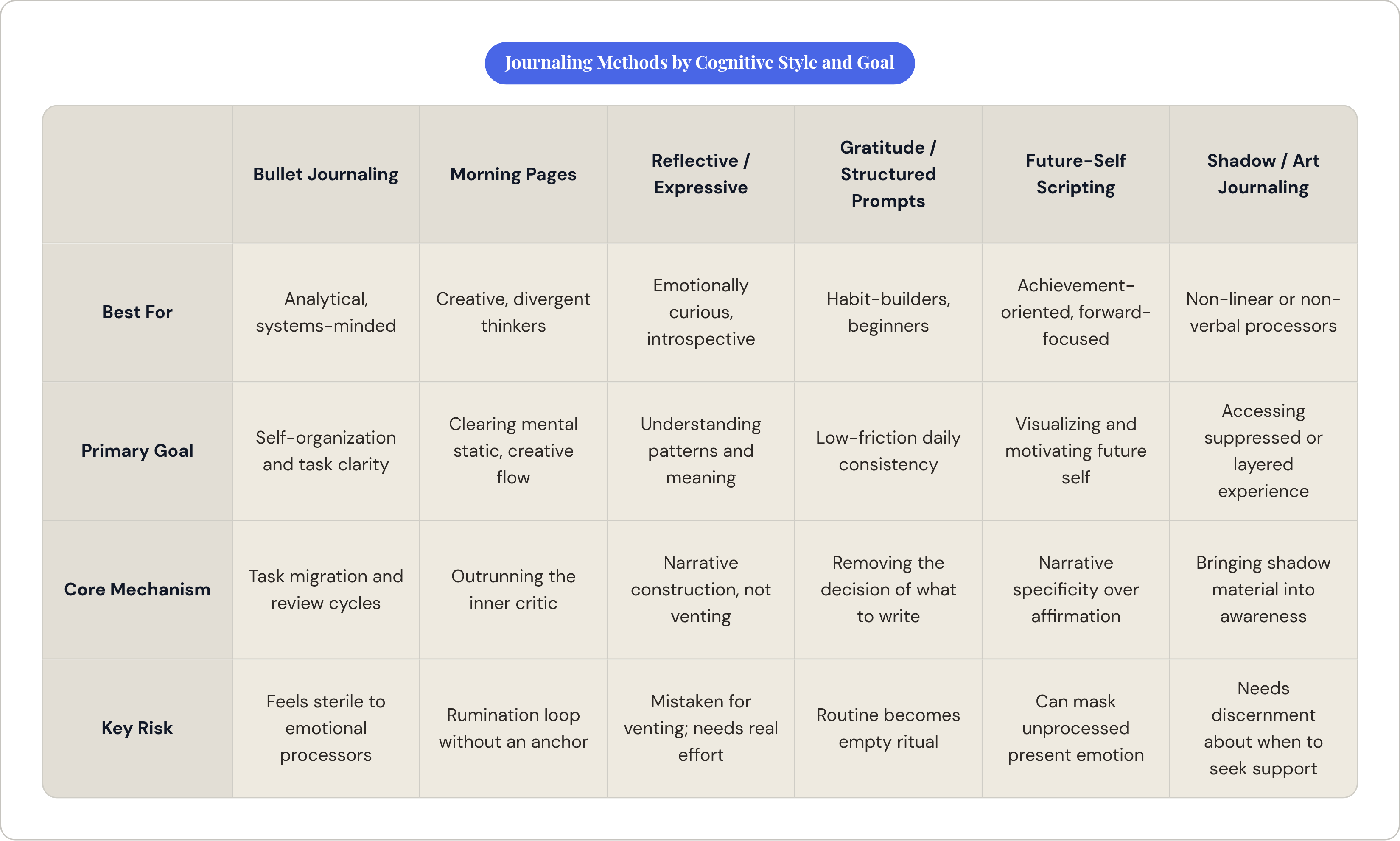
Two questions do most of the sorting work. First: are you trying to process something that happened, plan something ahead, or simply clear mental static? Second: do you think more clearly with structure, meaning prompts, categories, and systems, or with open space, meaning blank pages and free association?
Mapping those answers roughly: processing with structure points toward Pennebaker-style reflective journaling. Processing with open space suggests stream-of-consciousness or unsent letter writing. Planning with structure points to bullet journaling or structured prompt formats. Planning with open space suggests future-self scripting. Clearing your head, with either orientation, points to morning pages or voice journaling. These aren't rigid assignments. They're entry points.
Signs a method isn't working are worth distinguishing from ordinary early resistance. Friction in the first few weeks is expected; any new cognitive habit requires adjustment. Genuine mismatch has a different texture: dread rather than neutral reluctance, sessions that reliably end with more agitation than they began, consistent avoidance after several weeks of honest effort. That pattern is a signal to recalibrate, not to push harder on something that isn't working.
Signs it is working are also distinct, and more important to recognize. A session occasionally runs longer than planned because you weren't actually finished. Ideas surface that wouldn't have occurred to you otherwise. The practice becomes a reference point you return to in daily thinking rather than a box to tick. When the journal starts showing up in how you make decisions, rather than sitting in a drawer, something real is happening.
And sometimes the issue isn't the method at all. Some apparent method mismatch is actually a medium mismatch: the right technique in the wrong format, writing when you think better out loud, or typing when you need the deceleration of a pen. Most committed journalers eventually develop a primary practice and a secondary one for different moods or contexts. That's not inconsistency. That's just knowing yourself, which is, perhaps not coincidentally, the whole point of doing this in the first place.
Format and Tool Choices That Support the Method Rather Than Fight It
The best journaling tool is the one that removes the most distance between the intention to journal and the act of doing it. Everything else is negotiable, and the market's obsession with beautiful tools is a reliable predictor of abandoned practices.
Paper slows the hand and reduces distraction, which benefits reflective and expressive writing where the deceleration is itself part of what makes the thinking useful. Digital formats enable search, tagging, and portability, which suits structured and goal-oriented methods where pattern recognition across time is part of the value. Neither is categorically superior. They're suited to different work, and treating them as competitors is a product category argument, not a psychological one.
Voice journaling occupies its own category. It captures the unfiltered, real-time quality of stream-of-consciousness writing without the physical act of writing, which makes it natural for people who think out loud and useful for capture in moments when a notebook is impractical. Prompt-guided voice journaling tools turn verbal processing into reflective practice, removing the blank-page problem that stops many people before the first sentence forms.
A few features worth matching to method when evaluating any tool: structured prompt libraries serve gratitude, reflective, and future-self practitioners who benefit from orientation before they begin. Tagging and search serve analytical thinkers who want to review patterns across months. Voice-to-reflection formats serve stream-of-consciousness thinkers and anyone building a habit in short windows. Offline capability is a practical signal that the tool was designed for a practice rather than for engagement metrics.
The method and the tool should both be chosen for fit, not for what's trending or which app has the best onboarding sequence. The practice most likely to last is the one with the least friction between who you actually are and how you show up when the page, or the microphone, is open.