Journal Prompts for Self-Discovery After Major Life Changes
Tailored prompts help you process the specific grief of each major life disruption.

A job breaks identity, a breakup breaks belonging, a move breaks routine, and a death breaks continuity. A health crisis breaks the basic trust you had in your own body, and that's the whole argument here: the prompt that gets you through one of these does almost nothing for another, so lumping them all under "journaling for hard times" is like prescribing the same cast for a broken wrist and a broken ankle. Bruce Feiler counted 36 major disruptors and 3 to 5 identity-shaking "lifequakes" across an average lifetime, so whatever you're going through right now, you're not new to disruption in general. The specific shape of this one is what's new, and generic advice keeps missing that.
What the research says about why prompts work better than freewriting during a crisis
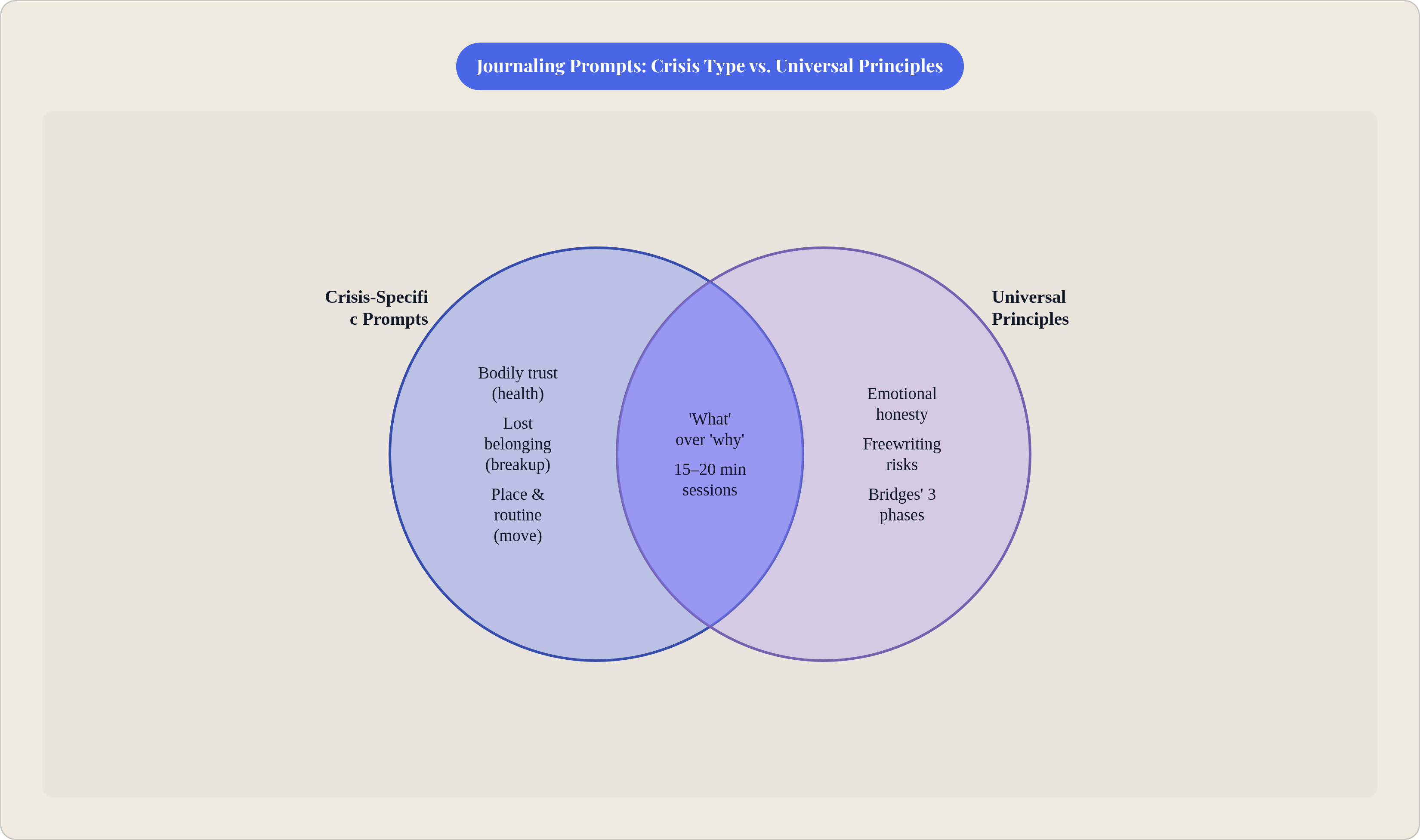
Open a blank page in the middle of a crisis and watch what happens. For most people it's the same three memories on a loop, which feels like progress but isn't. There's a real difference between expressive processing, which moves you somewhere, and rumination, which just replays the pain without changing your relationship to it. A 2025 meta-analysis on grief journaling found directed prompts beat freeform writing, and prompts matched to the actual type of loss beat generic ones handed out regardless of what happened to the writer.
Pennebaker's original studies, the ones half this field still runs on, landed on 15 to 20 minutes per session, long enough to hit something real but short enough to keep the exercise contained. People often feel worse right after a session, uncomfortable proof that something actually happened in there.
Here's a subtler piece. Tasha Eurich's research on self-reflection, published through Harvard Business Review, found "why" questions increase reactivity and defensiveness, while "what" questions produce cleaner insight. Ask yourself why you're anxious and you'll generate a justification for being anxious, but ask what you're feeling and what you actually want, and you tend to land somewhere truer. Grammar doing psychological work, basically, which is part of why so many prompts below lean on "what."
UCLA neuroscientist Matthew Lieberman's work on affect labeling found that naming an emotion measurably lowers its intensity in the brain, the actual mechanism behind "if you can name it, you can tame it." So when a prompt asks what you're feeling right now, that's the exercise itself, not a warm-up. Pennebaker also found grammar, spelling, and coherence had nothing to do with the benefit. Emotional honesty is the active ingredient, and polish can sit beside it or work against it, depending on whether the polish is covering for honesty.
When a job ends and the self that was built around it has to be rebuilt
Losing a job costs more than income, sure, but money is rarely what actually knocks people flat. It's the 7am alarm that no longer means anything, and the Tuesday lunch crew you'll never see again. It's the three seconds of silence after someone asks "so what do you do?" at a party, a question that used to have an easy answer and now just sits there.
Nobody warns you how much of your identity was job-shaped until the job disappears, and the title was doing quiet structural work you never noticed, work that only becomes visible once it's gone. Research on laid-off professionals found something concrete: people who wrote about the job loss found new employment faster than people who didn't, a hiring outcome tied to a writing habit that's worth pausing on.
The prompts below separate what the job was providing from who the person actually is, since those two things fuse under pressure and need prying apart on the page.
- "Before this job, what did you believe you were good at? Does losing it change that belief, or just reveal it?"
- "What part of your daily routine are you actually mourning: the work, the structure, or the people?"
- "What would you do with your time if status and income were already solved?"
- "Who were you in that role that you want to carry forward, and who were you that you're willing to leave behind?"
- "Write the version of this story where the loss turns out to have been necessary."
For someone whose self-worth got tangled up in sounding articulate and competent, writing can feel like an audition even when nobody's grading it. Speaking these prompts aloud into a voice journaling app, Joice for instance, sidesteps that pressure, since spoken thought carries less expectation of arriving pre-edited.
After a breakup or divorce, prompts that address lost belonging, not just lost love
The person is gone, obviously, but so is the future you'd quietly built around them without ever noticing you were building it. That's what catches people off guard: they think they're grieving a relationship, and they're actually grieving a life that never got the chance to happen. The apartment you were going to get, the trip half-planned for next spring, none of it was ever real, technically, and somehow it still needs mourning.
One useful early prompt: "Write about the life you imagined having with this person. What are you actually mourning?" It tends to surface the gap between the real relationship and the imagined future, and that gap is usually where most of the pain lives. A second, later prompt works differently: "Who are you when you're not in this relationship?" That one opens the door to everything you quietly shelved while you were part of a "we."
- "Which friendships or communities faded when you were in this relationship? What would it take to return to them?"
- "What did you stop doing because it didn't fit the relationship, and do you want it back?"
- "Write about a moment when you felt most like yourself inside that relationship. What does that tell you about what you need?"
- "What story about yourself did this relationship confirm? Was that story even true?"
- "Write a permission slip to yourself for what comes next."
Skip anything that pushes toward forgiveness or closure too fast. The research supports leaving days between sessions, letting the writing settle instead of forcing a tidy ending onto something that isn't tidy yet, since grief on a deadline reads as performance.
After a move, prompts that surface what routine and place were actually providing
Relocation gets filed under "good news" by almost everyone around you, which is exactly what makes the disorientation so hard to explain out loud. Nobody sends a sympathy card for a new job in a new city, and yet the barista who knew your order, the walk to the train, the neighbor who waved from his porch every morning, all of it was quietly organizing your sense of self, and none of it made the move with you.
That's the hidden grief in relocation: the ambient stuff, the infrastructure of ordinary life you never registered as infrastructure until it vanished. The prompts here need to reach somewhere the job-loss and breakup prompts don't bother with, because displacement often shows up in the body before it shows up as a coherent thought. "Where do you feel the displacement in your body right now?" works as a legitimate diagnostic question.
- "Describe your old daily route in detail. What did it give you besides transportation?"
- "What habit or ritual from your old life are you most determined to recreate here, and what would you be willing to let go of?"
- "What does 'home' mean to you that has nothing to do with a location?"
- "Who did you become in that place? Is that someone you want to keep being?"
- "What do you want this new place to eventually mean to you? Write the version of yourself who has made it home."
That last one leans on future-self journaling, writing forward from a disoriented present toward a version of you that's actually settled somewhere. It works especially well here, since relocation is one of the few transitions where the destination already physically exists, and you're just not there yet, psychologically speaking.
After a death, prompts that hold grief without pushing toward resolution
Death disrupts something the other transitions barely touch: continuity. Someone who knew the long version of your story, who remembered you at nine years old or during your worst decade, is gone, and the story loses its witness. The assumed future changes shape too, from Sunday phone calls to holiday routines to the small habits organized around a person who no longer answers.
This is where rumination risk climbs highest. Daily, unstructured grief journaling can slide from processing into replaying, and the research mentioned earlier specifically supports spacing sessions out with directed prompts rather than open freewriting, particularly here. The research-supported cadence runs three to four sessions a week, 15 to 20 minutes each, a rhythm meant to avoid the kind of nightly ritual that balloons into a two-hour spiral, with more sessions generally producing stronger effects than fewer. Treat a daily habit that starts feeling compulsive rather than useful as a signal, not a personal failing.
- "What did this person know about you that no one else did? How do you carry that forward?"
- "Write about a moment with them that you return to most. What does returning to it tell you about what you valued?"
- "What were you in the middle of becoming when this happened? Does the loss change that, or clarify it?"
- "Where do you feel this grief in your body today?"
- "What do you want to keep from the life you had with them: a value, a habit, a way of seeing?"
The research on meaning-making in grief is some of the strongest in the whole field: people who eventually built a coherent narrative around the loss, using positive emotion words alongside the negative ones, showed better health outcomes over time. None of these prompts demand that narrative show up on schedule, but they leave the door open. Skip anything asking for forgiveness, silver linings, or "moving on," since pushing for resolution before grief is ready tends to backfire, sometimes badly.
After a health crisis, prompts that address the loss of bodily trust and control
A diagnosis or a serious health event breaks something oddly specific: trust in your own body, the basic assumption that the machine you live inside keeps doing what it's always done. That assumption is invisible until it isn't, and once it cracks, the question underneath is different from every other transition here: who am I now that my body works differently, or might not work at all?
There's a physiological angle too. Writing about a stressful experience can help process what the nervous system has been holding since a scary appointment or a scarier diagnosis, the same system still humming in the background since the news first landed.
- "What does your body need from you right now that you haven't been giving it?"
- "Write about a time before this when your body surprised you with what it could do. What does that tell you about resilience?"
- "What part of who you are has nothing to do with your physical condition?"
- "What would it mean to be kind to your body rather than angry at it?"
- "What do you want the next chapter to look like? Write it without any health assumptions in the way."
Research on ego identity formation fits here in a way it doesn't quite fit elsewhere: expressive writing has been linked to supporting coherence between who you were and who you're becoming, and a health crisis breaks that coherence about as cleanly as anything can. These prompts try to re-stitch it, gradually, one session at a time, letting a fuller picture emerge instead of forcing a happy ending onto a body still figuring out what it can do.
How to use these prompts across the arc of a transition, not just at the acute moment
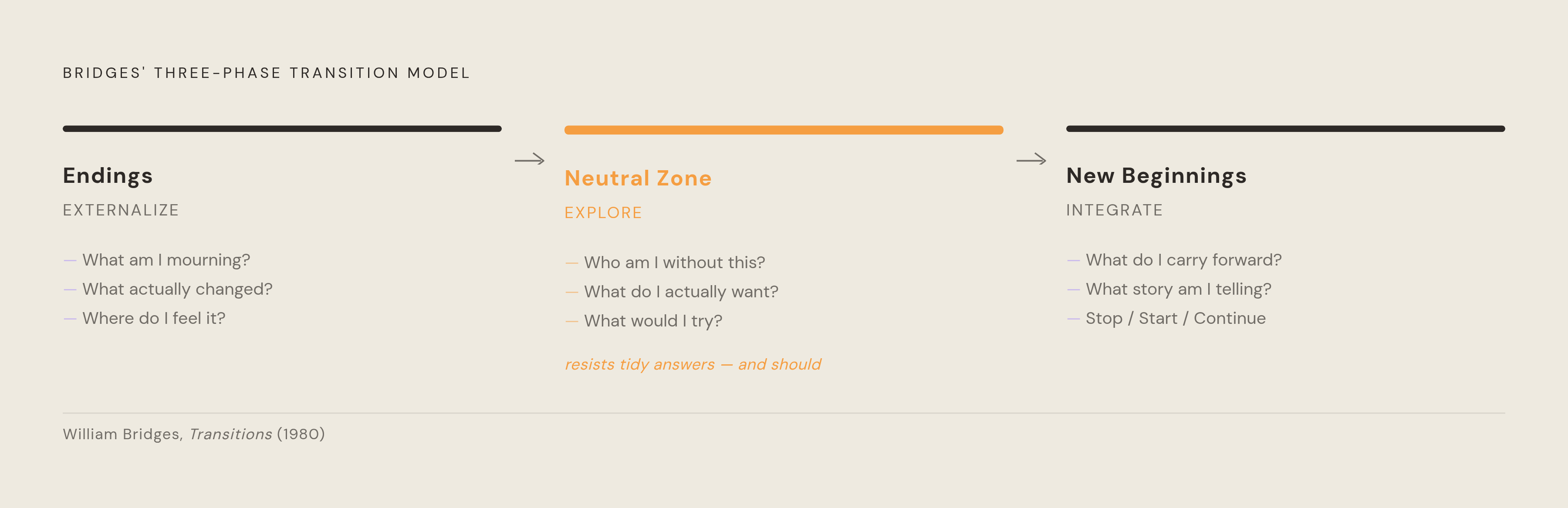
None of this works as a one-time exercise you file away and forget. William Bridges' three-phase model, Endings, the Neutral Zone, and New Beginnings, gives a useful map for when to reach for which kind of prompt. A question that helps in week one can feel hollow by month six, and the reverse holds just as true.
In the Endings phase, right after the loss, prompts should name and externalize: what am I mourning, what actually changed, where do I feel it in my body. This is acute-phase work, mostly about moving the feeling out of your chest and onto a page where you can actually look at it. In the Neutral Zone, the messy middle where the old identity is gone and the new one hasn't shown up yet, prompts should explore identity and possibility without forcing conclusions: who am I without this, what do I actually want, what would I try if the outcome weren't guaranteed. This phase resists tidy answers, and it should.
By New Beginnings, prompts shift toward integration: what do I carry forward, what story am I telling about this now, what does the next version of this life actually look like. A Stop/Start/Continue format, borrowed from workplace retrospectives but useful for a life too, fits well here: what do I stop doing, what do I start, what do I keep going. It turns reflection into three short decisions, which suits the later stage of a transition better than another blank page would.
"What" over "why" holds across all three phases, a structural choice that keeps every prompt in this piece pointed toward insight rather than defensiveness. So does the cadence: three to four sessions a week, 15 to 20 minutes, a manageable rhythm rather than a daily marathon that turns reflection into one more chore on the list. For anyone who finds the blank page itself the real obstacle, whether that's a writing habit that never sticks or just a preference for thinking out loud, speaking these prompts into a voice journaling app keeps the structure intact while removing the friction of staring at an empty document. Whether that trade-off is worth it depends on whether your resistance is to writing itself or to the blank page as an object, and either way, the prompt still does its job, spoken aloud or typed onto a page.