End-of-Day Reflection Prompts for Better Tomorrows
Structured questions unlock reflection's neurological benefits better than vague journaling.

End-of-day reflection works best when each prompt has a single job to do: draining what wore you down, surfacing what actually went right, and pointing tomorrow in one direction instead of leaving it to chance. Most people skip that structure entirely and just ask themselves "how was your day?" which is a bit like asking a doctor "how's my health?" and expecting a diagnosis back. You get a vague answer, forgotten by the time you brush your teeth, because the question never told your brain what to look for.
That's the real problem with reflection as most people practice it: no job, no direction, so the mind just defaults to whatever's loudest. Sometimes that's the argument you had with a coworker at 2pm. Sometimes it's the fact you still haven't done your taxes. Neither is particularly useful to replay at 11pm with the lights off. A 2023 OnePoll survey found only 16% of people journal regularly, and I think that's a design problem: the tools people are handed don't have a job description.
What the brain is actually doing during end-of-day reflection
Here's the mechanism, and it's worth understanding before you touch a single prompt. When you put a feeling into words, activity in the amygdala, the brain's alarm system, actually drops, while the prefrontal cortex, the part responsible for planning and judgment, picks up the slack. UCLA neuroscientist Matthew Lieberman summed this up as "if you can name it, you can tame it," and the phrase has stuck around because it's mechanistically accurate.
Writing (or speaking, more on that later) recruits Broca's and Wernicke's areas, the language centers, and forces raw emotional experience through a kind of translation process. That translation produces the benefit: you're journaling to force an experience through a part of your brain that can actually do something with it.
This is why prompt wording matters more than people assume. "What am I most aware of right now?" activates labeling. "What happened today?" activates narrative recall. Those are different cognitive tasks, even though they feel similarly reflective from the outside. Cognitive reappraisal, the technical term for reframing a situation so it stops gripping you emotionally, happens when the prefrontal cortex is engaged. Structured prompts get you there faster than staring at a blank page hoping insight arrives on its own.
Left unstructured, the mind tends to loop: same complaint, same scene, same unresolved irritation, replayed with slightly different lighting each time. A 2014 study by Francesca Gino and colleagues at Wipro found that employees who spent just 15 minutes a day on deliberate reflection saw a 23% boost in performance compared to those who didn't. The mechanism was consolidation, the brain filing information instead of just spinning it.
The three jobs that end-of-day reflection actually needs to do
So if naming does the neurological work, what should you actually be naming? Three things, and they don't overlap as much as people assume.
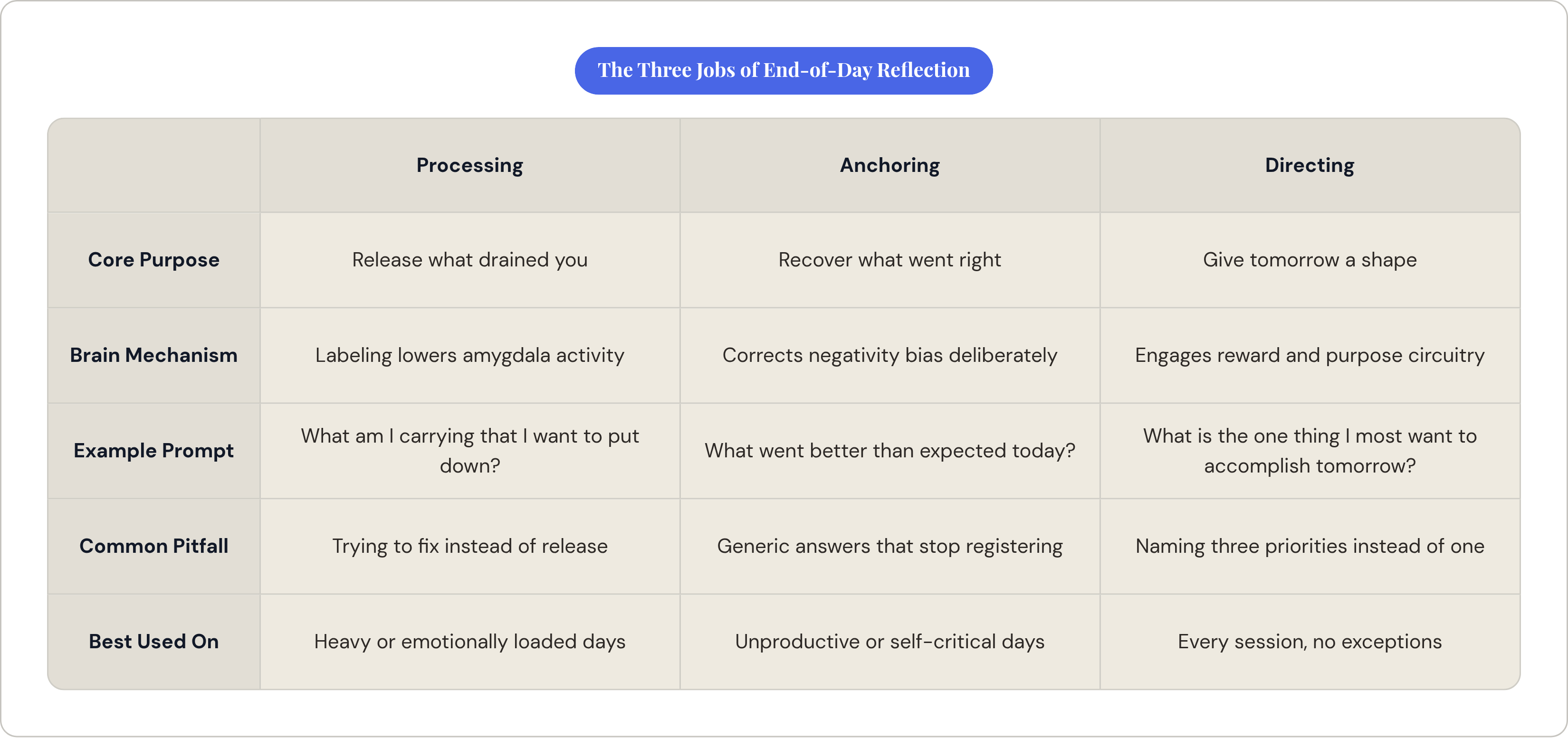
First, processing: releasing whatever drained you so it doesn't quietly ride shotgun into tomorrow's mood. Second, anchoring: naming what went well, because the brain has a default habit of grading the whole day by its worst five minutes. Third, directing: picking one clear intention so tomorrow starts with a shape instead of just a to-do list and a shrug.
These map onto research that's been around for decades. James Pennebaker's expressive writing studies cover processing. Gratitude research covers anchoring. The Stoic evening review, the one Marcus Aurelius supposedly ran himself through before bed, and the U.S. Army's After Action Review methodology both close with a commitment that shapes the next effort. None of these traditions asked one question to do all three jobs. That's the part most people get wrong when they adopt a single go-to prompt and wonder why it stops working after a few weeks.
Fifteen to twenty minutes total, split across the three, is enough. Pennebaker's original protocol used sessions in that range and still found measurable effects. Three questions, each asked for a reason, do more work than one question asked repeatedly.
Prompts for processing: draining what the day left behind
The job here is labeling and release, not problem-solving. This trips people up constantly: they sit down to process a bad day and end up trying to fix it instead, a different task entirely and, frankly, the wrong one for 10pm.
A few that do the labeling work directly: "What emotion am I most aware of right now, and what triggered it?" is about as blunt as it gets, and blunt is the point. "What's one thing I'm carrying from today that I want to put down before sleep?" frames release as a choice you're making, rather than something you're hoping happens passively while you sleep it off. For people who find naming emotions directly difficult, there's a workaround: "if today were a color or weather pattern, what would it be, and why?" Metaphor lowers the barrier for folks who freeze up at "how do you feel."
And for the guilt-flavored days: "where did I act against my own values today, and what drove that?" This one surfaces the actual friction point instead of leaving you with a vague, formless bad feeling that just sort of hangs around.
Reach for a processing prompt when the day felt heavy, or something keeps replaying uninvited. One caution worth flagging: processing prompts without a closing move can deepen rumination rather than resolve it, so pair them with a directing prompt to actually shut the loop. If writing feels like too much effort by the end of the day, and honestly, some nights it is, speaking the answer out loud works too. Voice journaling still routes through the same language centers; it just skips the part where your hand has to move.
Prompts for anchoring: recovering what went right
Negativity bias is wiring, not a personality flaw: the brain evolved to overweight threats and friction because missing a predator was more costly than missing a nice sunset. That wiring is still running, uselessly, when the only threat that day was a slow Wi-Fi connection. Anchoring prompts exist to correct that tilt on purpose, because it will not correct itself.
Generic gratitude wears out fast. "I'm grateful for my family" is true every single day, which is exactly why it stops registering after the fourth repetition. Specificity is what keeps the mechanism alive. "What is one small thing that went better than expected today?" works because it doesn't demand a big win, just a delta from expectation. "What did I do today that I'm proud of, even slightly?" shifts the lens from outcome to agency, which matters on days where nothing outward went particularly well but you still, say, didn't yell at anyone in a meeting that deserved it.
"What moment today, however brief, felt easiest or most alive?" is quietly useful for a different reason: it's diagnostic. Do this enough nights and you start noticing patterns about when you actually do your best work. And the structured version, list three specific things, people, places, or situations, you're grateful for from today, works precisely because "specific" is doing all the heavy lifting in that sentence.
Reach for anchoring exactly when it feels hardest to: unproductive days, self-critical days, the ones where your brain insists there's nothing worth noting. That resistance is the signal, not a reason to skip it. Multiple clinical studies on structured reflective journaling report reductions in anxiety and depression symptoms in the 20 to 45% range, and anchoring is generally the component doing the most work in those programs. One practical note: keep answers short here. A single precise sentence per item beats a paragraph; less pressure on length actually produces more honesty.
Prompts for directing: giving tomorrow a shape tonight
This is the step that turns reflection from an emotional-hygiene habit into an actual performance tool. Skip it, and you've had a nice therapeutic evening, but tomorrow still starts from zero.
The lineage here runs through the Stoic evening review and the After Action Review framework the U.S. Army built for high-stakes debriefs. Both end the same way: with a commitment. "What is the single most important thing I want to accomplish tomorrow?" only works if you actually pick one thing. Naming three priorities is the same as naming none, because they'll cannibalize each other by 10am.
"What will I let go of tonight so I can start fresh tomorrow?" bridges directly out of the processing step, turning a vague hope of sleeping it off into an actual decision. "What would I do differently if I could replay one moment from today?" targets a specific behavior, not a vague outcome; that specificity is what makes it actionable instead of just wistful. And there's a longer-range version worth sitting with: think of your future self, the person you're actually trying to become. What did today's actions say about that person? This one activates something closer to identity and purpose, and purpose-driven reflection tends to produce more follow-through, likely because it engages reward circuitry tied to meaning rather than just task completion.
Directing belongs in every session, full stop, even on nights dominated by processing or anchoring. Research on goal-setting is fairly consistent on this point: specificity and singularity predict follow-through far better than broad ambition ever does. If you want a compact frame for the whole thing, the AAR structure works as a mini-container on its own: what did I intend, what actually happened, what will I do differently. Three questions, one motion.
Matching prompts to the kind of day you actually had
None of this is a sequence you're obligated to run in full every night. It's a toolkit, and which tool you reach for depends entirely on what kind of day you just had.
Rough day, emotionally loaded? Lead with processing, close with directing, and let anchoring be brief or skip it; forcing gratitude onto a genuinely bad day tends to feel hollow and can backfire. Low-energy, unproductive day? Lead with anchoring first, before self-criticism gets a foothold, then close with a modest, achievable directing prompt, not an ambitious one that sets you up to disappoint yourself again tomorrow. Busy, successful day? Anchoring and directing do most of the work; there's often not much to process because nothing was actually draining.
Then there's the flat day, the one where nothing happened, nothing hurt, nothing stood out. This is the hardest case, oddly enough, and "what moment felt easiest or most alive?" tends to surface more than you'd expect on exactly these days. Directing becomes the most valuable move here, since a day with no shape of its own needs one imposed from outside.
If you think better out loud, and plenty of people genuinely do, voice journaling removes the blank-page friction while keeping the same mechanism intact; apps like Joice, where you talk through your thoughts and it responds in real time, let talking through a prompt still trigger naming and reappraisal without ever touching the keyboard. If you're more of a checklist thinker, the After Action Review format works as a single container that hits all three jobs in one pass. And if you're brand new to any of this, don't try to run all three tonight. Pick one prompt, from any category, and just do that one consistently. Completeness can wait; consistency can't.
Making the practice sustainable past the first week
Sixteen percent regular adoption, from that OnePoll data, tells you the obstacle was never awareness. Everyone's heard journaling is good for you. The obstacle is friction, and it shows up in three specific spots.
Timing is the first one: evening is the day's lowest fuel-tank moment, and anything that requires effort is competing directly with the couch. Format is the second: an open blank page, or a vague "how was your day" prompt, is cognitively expensive exactly when you have the least capacity to pay for it. Prompts remove that cost by doing the deciding for you. Perfectionism is the third, and it's sneaky: people start treating the entry like an essay that needs good sentences, stall out on phrasing, and quietly give up. Nobody's grading it.
What actually keeps the habit alive past week one is boring, and that's sort of the point. Same time, same place, every night, because environmental cues do more of the lifting than willpower ever will. A fixed short duration, capped at 15 minutes, since Pennebaker's data shows that's enough for measurable benefit and a short session beats a skipped one every time. A pre-chosen prompt rather than a blank page, so you're not making a selection decision at the exact moment you have the least mental bandwidth to make one. And a format that fits the night, meaning if typing feels like too much, talk it out instead.
A journal handed a specific job, process today, anchor a win, point tomorrow somewhere, is a tool with an actual return on the ten minutes it costs you. A journal used as a vague nightly check-in becomes one more thing you feel guilty about abandoning. The real measure isn't how many words you wrote tonight. It's whether tomorrow starts with more clarity than today ended with, and that's a test you can actually run, one evening at a time.