Why Scrolling Back Through Voice Memos Is the Wrong Way to Find What You Actually Keep Saying
Automatic transcription and pattern comparison reveal what repeated listening alone cannot.
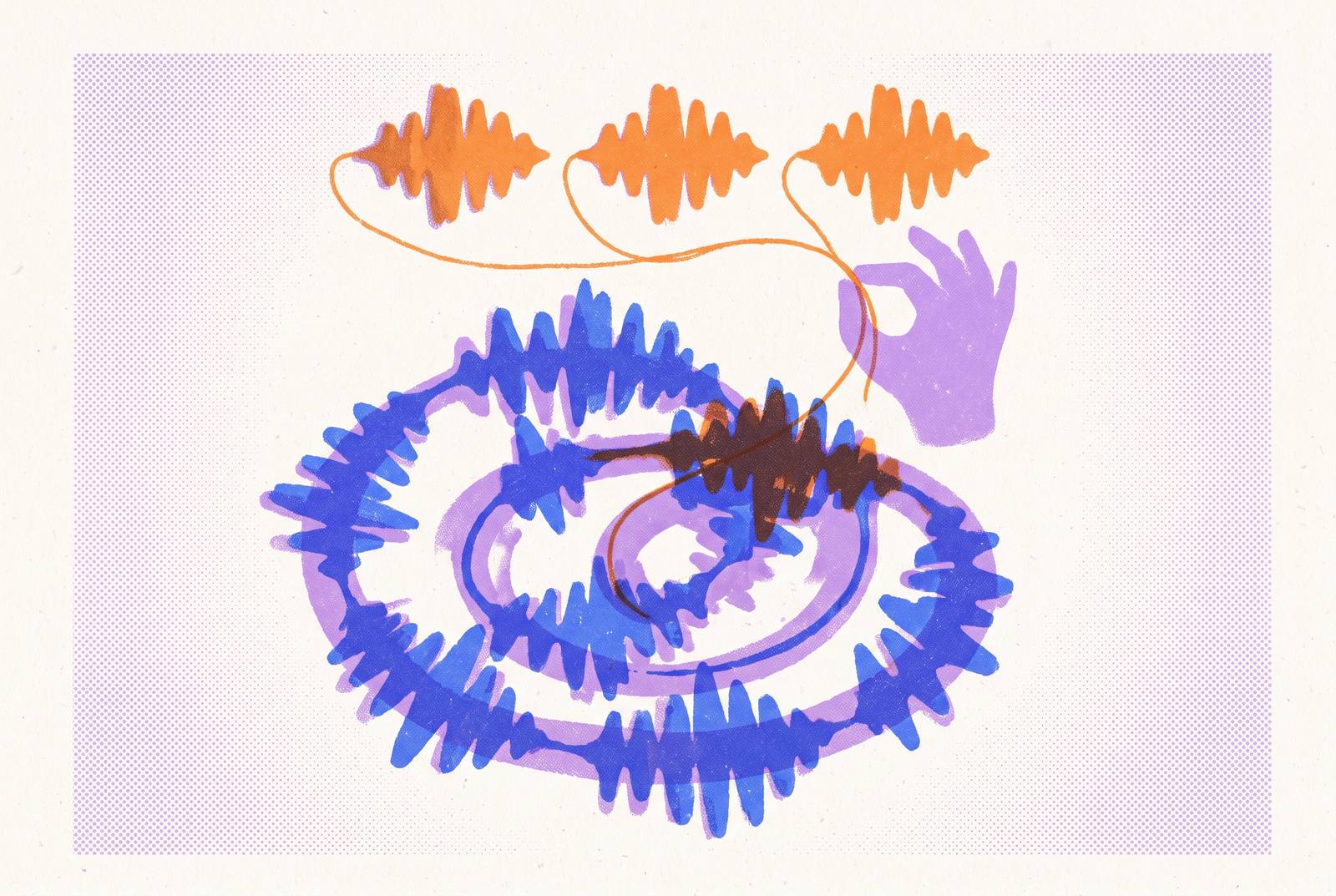
For a voice journaling app with entry pattern recognition and weekly reflections, the key is what happens after recording. It takes automatic transcription, a way to compare past entries, and a weekly look at what keeps coming up. Scrolling back through voice memos cannot do that work by itself, because playback preserves the sequence of a thought rather than revealing its relationship to other thoughts.
Why audio playback fails as a self-knowledge tool
A folder of timestamped recordings can contain months of candid thought and still tell you very little at a glance. The filenames show when something was said, while the recurrence of a worry remains unmarked. Finding out requires opening files and listening. This difficulty reflects a mismatch between a format built to capture speech and a task that requires comparing ideas.
Audio unfolds in time, with each sentence arriving after the one before it. A reader can pause over a phrase, skim what they already know, or move between two passages without reading everything in between. A listener can pause or seek, but finding a passage takes work when they do not know where it is. Each time, the listener has to take in the speech again while keeping in mind what might connect to other recordings.
Long recordings make that harder because attention can drift before the passage the listener needs comes along. Even attentive listening leaves the comparison largely in working memory. They have to keep what sounded important in one file in mind while another plays. For self-knowledge, however, the central question is often not what happened on a particular day. It is what keeps happening even when the days look different.
How speaking and writing use different parts of the brain, and why that gap matters for retrieval
Johns Hopkins cognitive neuroscientist Brenda Rapp’s research established that speaking and writing can fail independently. Someone may be able to say a grammatically correct sentence they cannot write. The distinction is deeper than personal preference. Spoken and written language depend on partly distinct cognitive systems, so ease in one does not imply the same capacities in the other. That finding supports a distinction between the activities, though it does not by itself establish how well someone will review a journal.
Speaking draws on procedural processing and automaticity, allowing well-practiced language patterns to unfold without deliberate control. That fluency makes recording an accessible way to catch a thought before it disappears. Ease has a trade-off, however. Producing language automatically does not necessarily organize it into material that can be compared later. The sentence that comes naturally is not always the sentence that makes its underlying assumption visible.
Introspective journaling engages the default mode network, a set of brain regions associated with self-referential thought and autobiographical memory. Passive listening does not reliably engage that network in the same way. Speaking, listening, and reflecting are therefore not interchangeable activities. A recording can preserve what someone said without recreating the mental work needed to examine it. The relevant gap is between producing an account and deliberately investigating it.
What a pile of unreviewed recordings actually costs
The practical cost appears when a concern returns in different disguises. The same anxiety, aspiration, or self-criticism may appear in several recordings, though their timestamps give no hint that they are linked. Each file contains an episode. Recognizing recurrence requires comparing entries.
Written entries move thoughts out of working memory and onto a surface where they can be examined together. Raw audio stores those thoughts too, but it does not automatically make them available for simultaneous comparison. A full archive can still leave someone repeatedly rediscovering the same concern.
For anxious users, replay can also bring emotional re-immersion. Pitch, pace, and self-interruption may give someone new details to fixate on instead of helping them step back from what they feel. The voice can pull attention back into the moment. A 2025 pilot study found a delayed reduction in rumination following expressive writing, while a 2025 PLOS ONE systematic review noted reductions associated with positive expressive writing. Neither compared writing with self-talk, so neither establishes that speaking is inferior. Organizing thoughts can support a different relationship to them, while unconnected recordings leave their repetition difficult to see.
The strongest case for voice journaling, stated fairly
Voice journaling deserves more than a concession that it is convenient. Research building on James Pennebaker’s foundational work found that spoken emotional disclosure can produce similar, and in some studies stronger, effects on emotional regulation and stress reduction than written disclosure. Externalizing internal experience is an important ingredient. Someone who feels better after speaking into a recorder may be receiving a real benefit, even if the file is never opened again.
Speech also preserves information that transcription flattens. Pitch, pace, and hesitation can reveal emotional texture that the same words on a page do not reproduce. A pause is not merely missing text. For someone trying to revisit how an experience felt, the sound of the entry can be valuable in its own right.
University of Michigan research linked silent contemplation using third-person language with better emotional regulation, which suggests that the perspective someone takes also matters. So why not just listen again if speech already helps? Sometimes replay serves the purpose perfectly well, especially when the purpose is revisiting a particular moment. But relief, emotional recall, and recognition of recurring beliefs are different goals. Capture is not the problem, and occasional playback is not the enemy. The limitation is treating unprocessed audio as the final format for understanding what repeats.
What happens when speech is turned into something you can read, scan, and compare
Transcription changes the retrieval task by turning a time-locked sequence into a visible surface. A passage can be scanned in seconds, a recurring phrase located, and entries from different days placed beside one another. The words gain an address on the page. The reader can move straight between the passages they want to compare without having to hold a whole spoken account in mind while another plays. That makes comparison less dependent on memory.
Apple Voice Memos offers transcription in iOS 18 and later, providing a first step from recorded speech to readable entries. It does not remove the need to identify patterns across those entries. The Plaud NotePin records and transcribes automatically and can generate summaries, with a free monthly allowance before a subscription is required. These functions make captured material easier to revisit. A summary of one recording answers what was said in that entry.
A 2025 ACM study found that grounding AI suggestions in historical journal entries over three weeks significantly enhanced the self-awareness of its single first-person account author. Its scope was narrow. A single researcher’s self-study cannot establish a broad effect for all journalers, but it illustrates why access to accumulated entries is central to this approach. The useful shift was from responding to an isolated account to interpreting it against a history. Readable text provides the material for that comparison, while structure determines what the comparison looks for.
How structured writing frameworks surface the patterns audio buries
A transcript makes thoughts accessible, but it does not automatically explain them. Structure supplies a consistent question that can be asked of different entries. The circumstances may change while the answer recurs. A prompt such as “what thought kept returning today?” directs attention toward recurring automatic thoughts. Using it across days gives someone entries they can compare instead of a series of accounts with no link between them.
CBT’s downward-arrow technique probes beneath a surface automatic thought such as “I always mess up” toward the core belief underneath it. It is distinct from thought records. Its value here is the direction of inquiry, from what appeared in consciousness to the assumption that gives it force. When someone reads entries in order, those questions can help them see a belief that shows up in several different concerns. Replaying each account in isolation does not supply that probing structure.
Tasha Eurich’s seven-pillar self-awareness framework offers other axes of comparison, including values, passions, aspirations, fit, patterns, reactions, and impact. Those categories help distinguish what a person wants from how they respond and how that response affects others. Different questions reveal different forms of recurrence. A 2022 meta-analysis in Psychotherapy Research found consistent positive effects of expressive writing interventions on psychological well-being across dozens of studies, while also flagging high dropout rates. That qualification brings the argument back to practice. A weekly review of transcripts is the minimal version of this approach, providing a window broad enough for repetition to become visible.
Why the habit collapses at the review step, and how to stop it collapsing there
Saving a voice memo completes an obvious action, while reviewing it leaves another action undefined. The file does not itself prompt rereading, comparison, or an examination of recurring themes. The archive grows because recording has a clear starting point, while returning to it remains something to do later.
Lally and colleagues’ 2009 UCL study found that habit formation took a median of weeks, with a range extending well beyond that. Automaticity does not arrive on demand. Consistent short entries and a place for review in an existing routine can help sustain the habit. Morning coffee, a commute, or brushing teeth can serve as an anchor. Review also needs an anchor in the routine.
For entry creation, a fixed opening prompt such as “what’s on my mind right now?” makes it easier to begin writing and gives successive entries a shared starting point. For comparison, a weekly cadence is useful. These serve different purposes. A daily ritual can give the weekly review a place in the routine without someone having to search for patterns every day. A voice-first tool that transcribes automatically and surfaces recurring themes can reduce the friction further by keeping recording and review in the same place. Along with fewer steps, this gives someone a clear way back from the speech they saved to thinking it through.
What app lets you talk through your thoughts and see patterns over time?
The deciding criteria are automatic transcription, comparison across historical entries, and a weekly review process. They describe different jobs. Transcription makes an entry readable, a summary condenses it, and cross-entry analysis looks for recurrence. Weekly review then gives someone time to think through those connections. A tool that offers only the first two should not be mistaken for a complete pattern-recognition system, however useful it is for capture.
For recording on a phone, Voice Memos has recording and transcription on iOS 18 and later. For hands-free, always-on recording, the NotePin serves a different capture preference and offers up to 300 free minutes per month, with a subscription beyond that allowance. A transcript or a summary of one entry gives no reason to choose either tool in the belief that it will find recurring themes on its own. The products described here establish capture options.
Freewrite Traveler has a physical keyboard and E Ink display, with no apps or browser, and syncs drafts to the cloud. Analog notebooks from Moleskine, Leuchtturm1917, and Rhodia offer handwriting without digital distraction, batteries, or sync. These choices support focused entry creation. The decision rule is therefore practical. If the current setup produces entries that are never revisited, the next improvement belongs at the return step, whether that means a weekly transcript review or a tool that surfaces what recurs. The useful journal is not merely the one easiest to fill, but the one whose contents become available for thought.