Gratitude Journal Setup for Beginners
Writing gratitude down rewires your brain more effectively than thinking it.

The obvious question is why the physical act of writing matters at all. Surely thinking about gratitude produces the same result. It doesn't, and the reason is neurological rather than sentimental, which is either reassuring or deflating depending on how you feel about neuroscience colonizing everything.
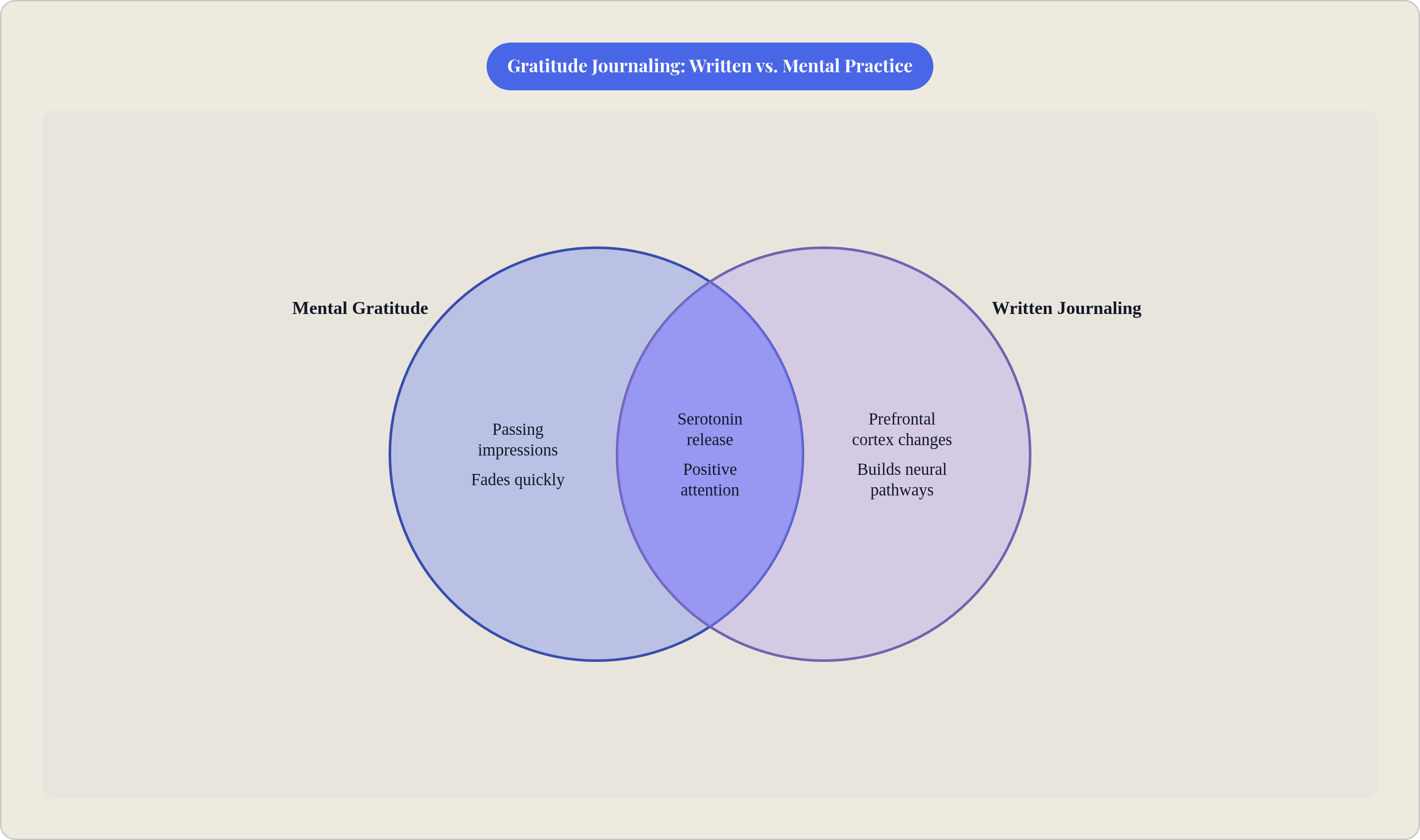
Translating a thought into concrete language forces a commitment. Research from UC Berkeley's Greater Good Science Center indicates that this translation process sharpens awareness of what one is actually feeling and amplifies the emotional weight of the recognition. When you think "I'm grateful for my friend," the thought can dissolve before you've finished the sentence. When you write it out with specifics, the brain treats it as something other than a passing impression. The record changes the experience of the thing being recorded.
The neurological layer is more interesting than most wellness writers admit, possibly because admitting it undermines their brand of mystical self-improvement. Gratitude practice activates the medial prefrontal cortex, the region involved in emotional regulation and social cognition. Gratitude letter-writing interventions, in particular, have produced lasting changes in prefrontal cortex sensitivity, measurable weeks after the intervention ended. The associated releases of serotonin and dopamine are documented biological responses, not motivational-poster metaphors.
But the deeper mechanism is neuroplasticity. Repeated attention to positive experiences trains the brain to notice them more readily over time. This is the cumulative argument for the habit, not the in-the-moment argument. The journal isn't useful because of what it produces on day three. It's useful because of what day three, day seventeen, and day forty-one are building together, and that distinction matters when the practice starts feeling like a chore around day nine.
The brain is not a neutral recorder. It is asymmetric by design: a compliment fades, an insult calcifies. Emmons and McCullough's work established that gratitude journaling directly counteracts this asymmetry, operating at a level below conscious awareness. The brain's default is pessimistic accounting. The journal is a deliberate audit, which, now that I write it out, is perhaps the least romantic description of the practice imaginable and also the most accurate one.
One specificity point deserves space here because it is so frequently botched. Entries that push for reflection on why a good thing happened, not merely cataloguing what the good thing was, have been shown to enhance happiness and well-being more than vague listing. "I'm grateful for my friends" and "I'm grateful that my friend drove forty minutes to bring me dinner when I was sick, because I realized she'd do that without thinking twice" are not equivalent entries. The second one does something the first one doesn't. The cause is where the gratitude actually lives.
What the Research Actually Promises, and When
Here is where intellectual honesty matters more than enthusiasm. Gratitude journaling has a genuine evidence base, but the effect sizes are modest, not miraculous, and a beginner deserves to know both before they buy a leather-bound notebook and rearrange their morning.
A meta-analysis of twenty peer-reviewed randomized controlled trials on journaling interventions found a statistically significant clinical benefit, with a Cohen's d of 0.2 to 0.5. That range is meaningful: real improvement in mood, anxiety, and subjective well-being, comparable to other behavioral interventions. It is also not a substitute for clinical care, and anyone representing it as such is overstating the evidence by a considerable margin.
The frequency findings are worth sitting with. In Emmons and McCullough's own studies, participants who journaled weekly for ten weeks, or daily for two weeks, reported more gratitude, greater optimism, and better sleep compared to those who journaled about daily hassles during the same period. Specific, replicable, and more useful than the vague "journal more" advice that circulates in popular wellness writing.
The longer-term signals are more recent and harder to interpret cleanly. A 2024 study published in JAMA Psychiatry by Chen et al. found that respondents with gratitude scores in the highest third at the study's outset showed a 9% lower risk of dying over the subsequent four years compared to those in the bottom third. That is a population-level finding and a significant one. It does not prove that journaling alone extends life, and anyone who tells you it does is writing a newsletter, not a paper. Gratitude as a dispositional trait and gratitude journaling as a behavioral intervention are related but distinct. What the finding suggests is that the underlying psychological orientation matters at a scale we are only beginning to measure.
That raises an important question: does the practice generalize, or does it work primarily for a certain kind of person? The evidence suggests it generalizes more broadly than intuition would predict. Research has documented benefits across adults with neuromuscular diseases and early adolescents. A twenty-eight-week Clemson University study found measurable effects in first-graders through simple ten-to-fifteen-minute daily practices. The mechanism does not appear to require sophisticated verbal facility or a particularly reflective personality.
One honest caveat: meta-analyses show mixed effects, and the degree of benefit appears contingent on how well the method matches the individual. That is not a reason for skepticism. It is precisely why every setup decision ahead actually matters.
Choosing a Format Before the First Entry
Structured or freeform. This is the first real decision, and it is worth making before writing a single word, because choosing wrong is the most common reason a journaling practice dies quietly in a drawer.
One argument holds that flexibility is preferable, especially for beginners who don't yet know what they need. But the research doesn't support that intuition cleanly. Directed gratitude practice has demonstrated stronger effects on mood and anxiety than freeform journaling alone. For someone starting from scratch, the blank page isn't freedom; it's the first obstacle.
The high-structure option, best represented by the Five Minute Journal format, uses fixed morning prompts: three things you're grateful for, what would make today great, a daily affirmation. An evening reflection follows. The design removes the blank-page problem entirely and directs cognitive energy toward the practice rather than toward figuring out what to write. Known limitation: fixed prompts can become mechanical over time, which is a signal to evolve the format, not abandon the practice.
The freeform option, a blank notebook with no imposed structure, works well for people who resist constraint or who want gratitude folded into a broader reflective practice. Its main failure mode is that beginners who struggle with open-ended prompts often abandon it within days. The blank page rewards self-direction. Most beginners haven't built it yet.
A hybrid resolves much of this tension practically: structured prompts on busy weekdays, a longer freeform session once a week for deeper reflection. This suits people who want both discipline and room to move, and it maps naturally to how cognitive energy fluctuates across a week. Most people have met their own patterns by the time they're considering a gratitude practice; they already know which type they are.
The practical heuristic: if you've abandoned journaling before, start structured. If structure has felt suffocating before, start freeform with a single anchor prompt. The goal isn't the objectively best format. It's the one you'll still be using in three weeks.
How Often to Write, and When
Is more journaling reliably better? Intuitively, yes. In practice, no.
Some evidence suggests that weekly journaling produces more sustained psychological benefit than daily journaling. Daily writing can paradoxically reduce the practice's impact by converting it into a low-attention task, a box to check rather than a moment to inhabit. Frequency without presence is just record-keeping, and the research does not appear to reward record-keeping.
What the evidence actually supports is consistency over intensity. Three to four sessions per week is a defensible starting point: frequent enough to begin building the habit neurologically, spaced enough that each session retains some deliberateness. The cumulative neural effect depends on returning to the practice repeatedly, not on writing at length every day.
Timing is a matter of what the session is being asked to do. Morning sessions prime attentional focus for the day ahead; evening sessions allow reflection on what actually happened. Both are valid. Which one fits the reader's natural rhythm matters more than which one is theoretically optimal. The best time to write is the one that doesn't require negotiating with yourself about it every morning, because that negotiation is usually what the habit loses.
The stronger tactical suggestion is to anchor the practice to something already present in the day: morning coffee, the fifteen minutes before sleep, the commute. Attaching a new behavior to an existing one removes the activation cost of deciding when, which is, quietly, where most habits die.
Session length should be shorter than most people expect. Five to ten minutes is sufficient. Gratitude journaling is not expressive journaling. The entries are brief by design and by intent.
Prompts That Produce Genuine Reflection Instead of Rote Listing
Vague gratitude is a conclusion without evidence. The brain doesn't engage with conclusions the same way it engages with scenes.
"I'm grateful for my coworkers" is inert. "I'm grateful that my coworker brought me soup when I was sick on Tuesday" has a subject, a moment, and, implicitly, a reason. That is where the emotional weight lives, and the journal earns its keep or doesn't in that gap between those two sentences.
The most effective structural move for beginners is the "because" construction: "Today I'm grateful for ______ because ______." The second clause forces an emotional connection that list-making skips entirely. The cause is the mechanism. Most people write the conclusion and stop there.
Prompts worth keeping accessible:
What is one small thing that went well today, specifically? Write about a person you're grateful for and something they did recently, in enough detail to reconstruct the moment. What skill or ability do you take for granted that actually shapes your daily life? What's something about a current difficulty that has produced unexpected value? How is your life concretely different from a year ago, and what positive change do you almost never acknowledge?
Category rotation prevents the narrowing that causes repetitive entries. Cycling through domains, including relationships, work, physical health, home environment, past experiences, keeps the practice from defaulting to the same three items every session. It also keeps the entries honest.
For hard days, the subtraction method outperforms forced positivity. Instead of manufacturing gratitude, imagine your life without something you currently value. Loss aversion often unlocks genuine feeling that positive framing can't reach. The absence of a good thing is sometimes more vivid than its presence.
One anti-pattern worth naming: writing the same three things every day without variation is a warning sign. It means the practice has become a checkbox. That's not the practice failing; it's the prompt failing. Change the prompt.
Analog or Digital: What the Choice Actually Changes
No medium is universally superior, and anyone who tells you otherwise is selling something. The right choice is the one the reader will actually return to. That said, the mediums do differ in ways that matter, and the differences are not primarily aesthetic.
Handwriting slows the writer down. That isn't inefficiency; it's processing time. The physical act of forming words by hand deepens engagement with the content, and a physical notebook has no notifications, no lock screen, no adjacent apps competing for the same two minutes. The environment is entirely contained, which is not a trivial advantage when the practice requires a brief, deliberate pause.
Digital has real advantages for people with dense mobile lives: portability, searchability, accessibility across devices, lower friction for fast typists. An app that syncs reliably and works offline is a serious option — Joice, for instance, is built around offline-first design for exactly this reason. The offline capability matters more than most feature lists suggest: a tool that requires a live connection fails precisely in the moments, early morning, travel, low-connectivity environments, when the habit is most vulnerable to skipping.
Pre-formatted gratitude journals, whether physical or digital, serve the same function as structured apps: they remove the blank-page problem and provide scaffolding that keeps early habits alive. The format choice and the medium choice are separate decisions; structured prompts can be analog or digital, and conflating the two adds unnecessary complexity to a simple setup question.
What to avoid is choosing a tool for its feature set rather than its fit. Photo attachments, mood trackers, and streak counters are useful for people who find them motivating; they're friction for people who don't. The question is not which tool has the most features. The question is which tool disappears into the background and makes the habit the variable. For undecided beginners, a cheap notebook and pen removes all software friction. If the practice works, the tool question can be revisited later with better information.
The First Two Weeks: A Concrete Starting Routine
Week one has one goal: consistency, not depth. The neurological benefit accumulates through repetition. No single session's quality matters as much as the practice's continuity, and the beginner who writes three honest sentences three times a week will outperform the one who writes two paragraphs twice and then disappears.
The structure for week one: pick one time of day and anchor it to an existing habit. Use the "grateful for X because Y" construction for every session. Aim for three sessions, not seven. An every-other-day rhythm is more sustainable for most beginners and sidesteps the frequency problem that daily journaling creates. Keep each session under ten minutes.
Week two introduces one variation. Try the subtraction method on one session. Use a category you haven't written about yet on another. This is the moment the practice begins to deepen rather than repeat.
The most common abandonment pattern is predictable: the journal feels meaningful for the first few days, then begins to feel like a task. This is not the practice failing. It is the novelty effect wearing off, and it arrives on schedule for almost everyone. The feeling of obligation is a sign the habit is normalizing, not breaking.
What to do when a session produces nothing genuine: write one specific, small thing. A meal, a piece of weather, a brief exchange. Keep the session brief and don't force it. The physical act of writing keeps the neural pathway active even when motivation is absent. Showing up for a flat session is still showing up.
When the prompts start feeling mechanical after several weeks, that's the signal to evolve. Introduce category rotation. Try a hybrid freeform session once a week. Add a new prompt type. The structure was never the destination; it was the scaffolding. At that point, the beginner is no longer a beginner, and the setup decisions made at the start have done exactly what they were supposed to do.