Journaling Methods for Goal Setting
Personality and goal type matter more than the journaling method itself.

Why does a journaling method work beautifully for one person and feel like mandatory homework for another? A 2019 study in Behavior Modification found that participants matched with journaling styles aligned to their personality traits showed significantly greater psychological benefits than those assigned a method at random. The match mattered more than the habit. Most productivity advice skips straight to the method.
Two dimensions do most of the sorting work. The first is goal type: outcome goals, a specific result to hit, versus process goals, a behavior to sustain. Process-oriented journaling builds more durable consistency, because it keeps attention on what is actually within daily control. The second is working style: structured thinkers who want external scaffolding versus reflective thinkers who need open-ended space before they can plan anything coherently.
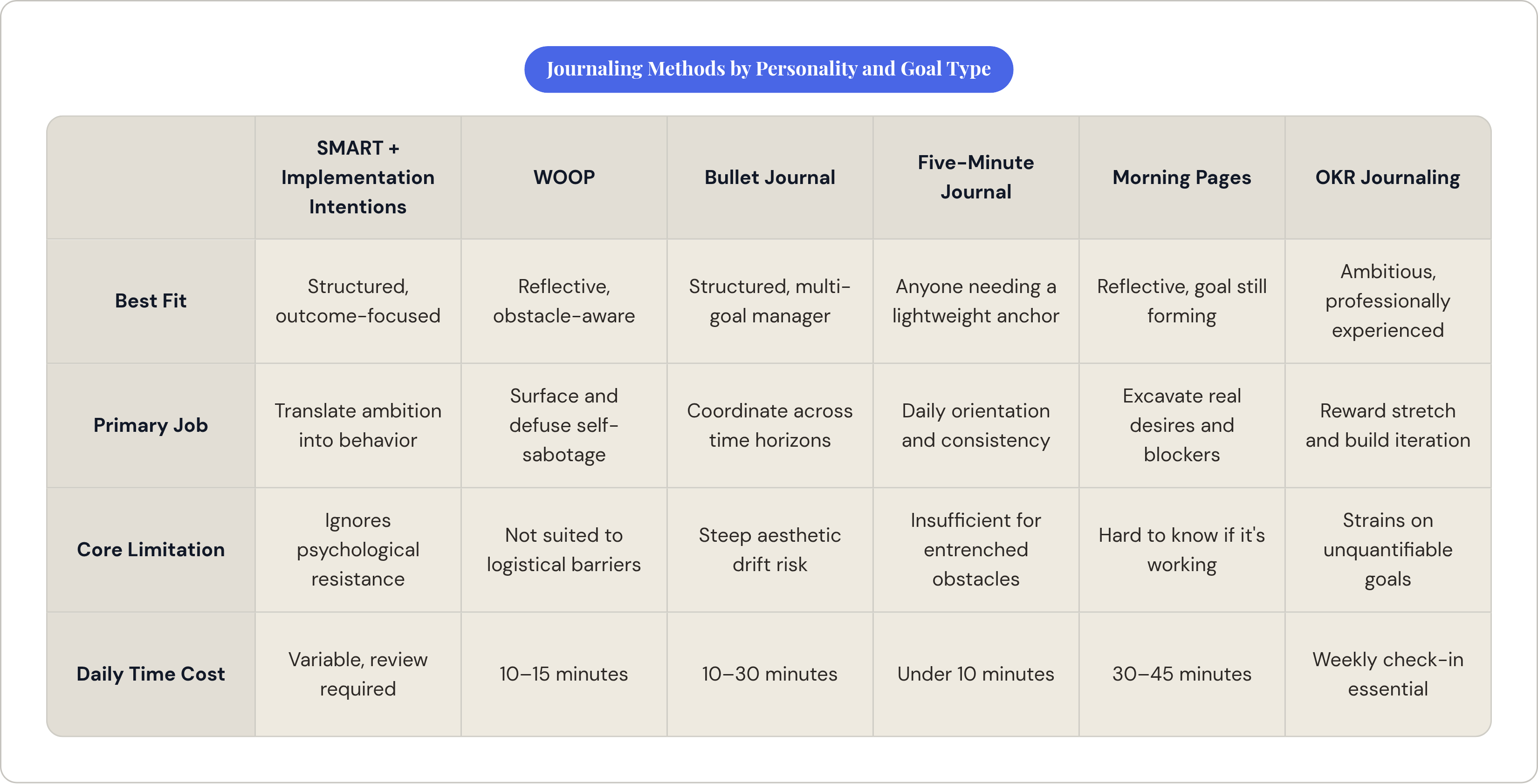
These two axes produce a rough map. Structured thinkers chasing outcome goals respond well to SMART prompts and OKR journaling. Structured thinkers focused on process often do better with the Bullet Journal. Reflective thinkers who are obstacle-aware get disproportionate mileage from WOOP. Reflective thinkers still excavating what they actually want find Morning Pages more generative than any structured framework.
Most experienced journalers eventually combine two or three methods. What follows is a menu, not a prescription. The right item on that menu is whichever one you will actually execute on a mediocre Wednesday when you are tired and mildly annoyed at something unrelated. Choosing the wrong method for your personality is like trying to unlock a door with a perfectly good key that just doesn't fit the lock — the tool isn't broken, it's simply the wrong one.
SMART Prompts and Implementation Intentions: Turning a Vague Goal into a Written Plan
SMART criteria need almost no introduction. The framework has been reproduced in nearly every productivity book since roughly 1981 and stapled inside countless corporate onboarding binders. Its familiarity is almost a liability. People breeze through the acronym, write a well-formed goal statement, and stop there, which is precisely where SMART journaling stalls. The goal exists on paper. No behavior is wired to it.
I know this particular failure mode well. For several years I wrote SMART goals with genuine care and zero follow-through. The goals were specific, measurable, time-bound, all of it. What they lacked was any mechanical connection to Tuesday morning. They were declarations, not plans, and declarations age poorly in a desk drawer.
Implementation intentions close that gap. The format, developed by psychologist Peter Gollwitzer, is deceptively simple: "If situation Y, then I will do X." Pre-deciding the when, where, and how of an action removes the moment of deliberation where follow-through most often dies. Gollwitzer and Sheeran's 2006 meta-analysis in Advances in Experimental Social Psychology, drawing on 94 independent tests, found that implementation intentions produced a medium-to-large positive effect on goal attainment (d =.65). That is not a marginal improvement; it is a structurally different outcome.
A complete SMART journaling entry, then, includes the five criteria, one to three if-then trigger statements for the first action steps, a progress tracker if the goal spans weeks, and a scheduled review date. The review date is not optional. Without it, the entry becomes an artifact rather than an instrument.
This method works well for people who already know what they want and need to translate ambition into behavior. Its limitation is significant: SMART with implementation intentions does essentially nothing to address psychological resistance or the internal patterns that make certain goals keep appearing on the same list, year after year. That is a different problem requiring a different tool.
WOOP: Why Obstacle Thinking Outperforms Pure Positive Visualization
Consider one set of numbers before anything else. In a randomized trial of 34 anesthesiology residents, the group using WOOP, a structured method developed by psychologist Gabriele Oettingen, spent a median of 4.3 hours studying toward their goals in the weeks that followed. The control group, using goal-setting without obstacle thinking, spent a median of 1.5 hours. Same wish. Nearly triple the effort.
Why does pure positive visualization fail? Vividly imagining a desired outcome without also imagining the obstacles reduces the psychological tension that drives effort. The brain partially registers the goal as already achieved, which relaxes motivation rather than mobilizing it. This explains why vision boards are popular and often inert.
WOOP addresses this directly. Wish: name one meaningful goal. Outcome: vividly imagine the best result of achieving it. Obstacle: identify the internal barrier most likely to derail the effort. Plan: write an if-then statement linking that obstacle to a concrete response.
The critical step is the third one, and it is the one most people soften or skip entirely. Glossing over the Obstacle collapses the whole exercise back into wishful thinking. The practice has one job at that stage: force genuine specificity about what, internally, typically derails this kind of effort. Not "I get busy." What specifically happens? When? Triggered by what? The discomfort of answering honestly is not incidental to the method; it is the method.
Oettingen's evidence base spans more than two decades. A meta-analysis across 24 trials found that mental contrasting combined with if-then planning produced a small-to-medium gain in goal attainment over control conditions (g = 0.34). The effect size is modest but consistent, and the method requires 10 to 15 minutes without demanding a dedicated system or a particular notebook.
WOOP is best suited to goals where motivation or self-sabotage is the real barrier. Behavior change goals in health, relationships, and creative work respond especially well. It is not the right tool for a goal where the primary obstacle is logistics or information; SMART handles that more efficiently.
The Bullet Journal as a Goal-Tracking Operating System
Ryder Carroll created the Bullet Journal to manage his own attention difficulties. It was designed for ruthless simplicity. What it became, on social media, is something rather different, and worth addressing directly before getting to what makes the system genuinely useful.
The architecture matters far more than the aesthetic, and the two are frequently confused. The Future Log parks goals and milestones three to six months out, keeping ambitious targets visible without cluttering daily pages. The Monthly Log is the checkpoint where future items migrate into the current period. The Daily Log uses rapid logging: a dot for tasks, a circle for events, a dash for notes. Quick capture that does not interrupt the day's momentum.
The migration ritual is where the accountability actually lives. At month's end, incomplete items are reviewed and either moved forward or deliberately dropped. That decision point, done honestly, prevents the system from becoming a graveyard of re-copied aspirations. It forces a judgment every month: does this item still deserve space? That is not organizational housekeeping. That is the whole thing.
By 2024, approximately 92 million users globally had adopted the format. That scale signals genuine utility, but also an enormous range in how faithfully the method is applied. Anyone who has lost a Sunday to hand-lettered monthly spreads already understands the drift. Time spent creating elaborate layouts is not time spent tracking; the relationship between those two activities is, in practice, inverse.
The Bullet Journal works best for people managing multiple goals across different time horizons who need a single system that holds everything. It pairs naturally with WOOP for weekly review: the BuJo handles logistics, WOOP handles psychology. Daily time investment runs 10 to 30 minutes, with a real learning curve in the first few weeks.
Shorter Formats: The Five-Minute Journal and What Brevity Actually Accomplishes
The Five-Minute Journal format is almost aggressively simple. Each morning: three things you are grateful for, three intentions for the day, one affirmation. Each evening: three highlights, one thing you could have done better. Total investment is under ten minutes. Over three million people use it.
The theoretical grounding is legitimate. The gratitude prompts draw on Emmons and McCullough's 2003 research associating daily gratitude practice with measurable improvements in wellbeing and goal-directed behavior. The morning intention prompt is a compressed implementation intention: it connects the day's actions to something larger without requiring a full planning session.
What it does not do: surface obstacles, track metrics, or build a coherent picture across weeks. The evening "one thing to improve" is the only genuinely reflective element, and it is easy to answer glibly if you are tired.
Whether the brevity is a limitation depends on what you actually need from the practice. For some people, showing up daily and briefly connecting to what matters is the foundation on which everything else is built. For others, it becomes the whole structure, which is insufficient if the goals are ambitious or the obstacles are genuinely entrenched.
The Five-Minute Journal is best understood as a daily orientation tool, not a strategic planning system. It excels at maintaining consistency when energy is limited and at giving people who have abandoned longer practices a sustainable re-entry point. It stacks well with a monthly WOOP session or a Bullet Journal review; the jobs are complementary rather than redundant.
Morning Pages and Expressive Writing: When Open-Ended Reflection Serves Goal Work
Julia Cameron's Morning Pages are an exercise in productive mess. Three longhand pages immediately on waking, no editing, no stopping, no topic requirement: complaints, half-formed plans, free-floating anxiety, whatever surfaces. The explicit goal in Cameron's framing is emptying, not planning. You are not building anything; you are clearing the pipe.
Where does this serve goal-setting? It serves it when the stated goal is not the real goal. People who keep setting the same intention and abandoning it, or who genuinely cannot decide what they want, often find that unfiltered writing surfaces the actual obstacle or the actual desire underneath the performative one. You cannot SMART-goal your way out of not knowing what you want. You can, sometimes, write your way toward it, though the process is slower and less legible than any structured framework.
James Pennebaker's expressive writing protocol offers a more structured variation: focused writing about a difficult or meaningful experience for 15 to 30 minutes across four sessions. The associated research includes measurable reductions in anxiety and improvements in sleep. Sonja Lyubomirsky's Best Possible Self variation, imagining and writing in detail about your ideal future self, boosts positive affect and motivation in ways that complement structured planning rather than substituting for it.
The time cost is the real obstacle. Morning Pages runs 30 to 45 minutes, the highest investment of any method here, and produces the least structural output. It is not well-suited to concrete, metrics-driven goals or to anyone who needs external accountability to function. For creative goals, or goals blocked by unresolved emotional resistance, it reaches something no framework-based method easily touches. The difficulty is that it is genuinely hard to know whether it is working, which is either fine or maddening depending on your tolerance for ambiguity.
OKR Journaling for Personal Goals: What the Corporate Framework Offers and Where It Strains
OKRs originated at Intel, were famously adopted at Google, and are now being retrofitted for personal use by people who find SMART goals too static. The structure: one ambitious Objective paired with two to five measurable Key Results.
What makes OKRs structurally distinct is their explicit design for stretch. Reaching 70 percent of a key result is often considered success rather than failure. That recalibration meaningfully reduces the psychological cost of setting ambitious targets, because imperfect achievement is built into the design rather than treated as evidence of personal inadequacy. For people who chronically set modest goals to guarantee completion, this is a genuinely useful corrective.
The personal OKR rhythm runs on quarterly goal-setting with weekly check-in entries. The weekly review is where the system earns its keep. Skip it for two weeks and the OKRs become SMART goals with different vocabulary: static artifacts rather than adaptive instruments.
That raises an important question: what happens when a personal goal does not decompose neatly into measurable key results? Relationships, creative growth, emotional health: these categories resist quantification, and most honest practitioners will admit the framework strains at this boundary. "Build a stronger marriage" is a legitimate objective. Defining two to five key results for it without reducing the relationship to a performance scorecard is genuinely difficult, and the attempt is reductive in a way that quietly undermines the goal itself. The framework was designed for product teams, and that heritage shows.
OKR journaling is best for people with professional goal-setting experience who want a framework that rewards ambition and builds iteration into the design. Career and project goals with measurable outputs are the natural home. It requires no specialized tooling; a section inside a Bullet Journal or a simple spreadsheet works fine.
Paper, App, or Both: How Medium Affects Consistency and Depth
The market is not resolving this question in any clear direction. The Digital Journal Apps Market grew from $5.1 billion in 2024 to $5.69 billion in 2025, projected to reach $8.69 billion by 2029. Simultaneously, roughly 64 percent of global consumers continue using physical planners despite fully viable digital alternatives. Many people are running both in parallel, which is either evidence of sophisticated tool-matching or an inability to commit, depending on who you ask.
The case for handwriting is not nostalgic. Mueller and Oppenheimer's 2014 data established that writing by hand creates a stronger memory trace and greater conceptual engagement than typing. Studies indicate that 64 percent of users retain tasks better when writing manually, and 58 percent perceive reduced stress with handwritten planning. The slower pace forces processing rather than transcription. That friction is a feature, not a bug.
Digital tools have genuine advantages that are not cosmetic. Searchability, habit-tracking graphs, reminders, cross-device access: these reduce the friction that kills consistency in paper systems. For someone whose past journals are inaccessible artifacts in a desk drawer, the search function alone changes the practical utility of the entire practice. Joice, for instance, is a journaling app built around talking rather than typing, you speak, it responds in real time, and every session becomes a searchable transcript.
Approximately 41 percent of users maintain both systems in parallel. A workable hybrid: a physical notebook for WOOP sessions and weekly reflection, a digital app for daily Five-Minute Journal entries and habit tracking. The former benefits from handwriting's slower, more deliberative pace; the latter benefits from the app's consistency features.
The medium should follow the method. A preference for beautiful notebooks is not a problem unless it steers someone toward Morning Pages when what they actually need is a metrics dashboard. The aesthetic becomes the point. The goal becomes the backdrop. At that point the journal is no longer a tool; it is a hobby, and there is nothing wrong with hobbies, as long as you know that is what you are doing.