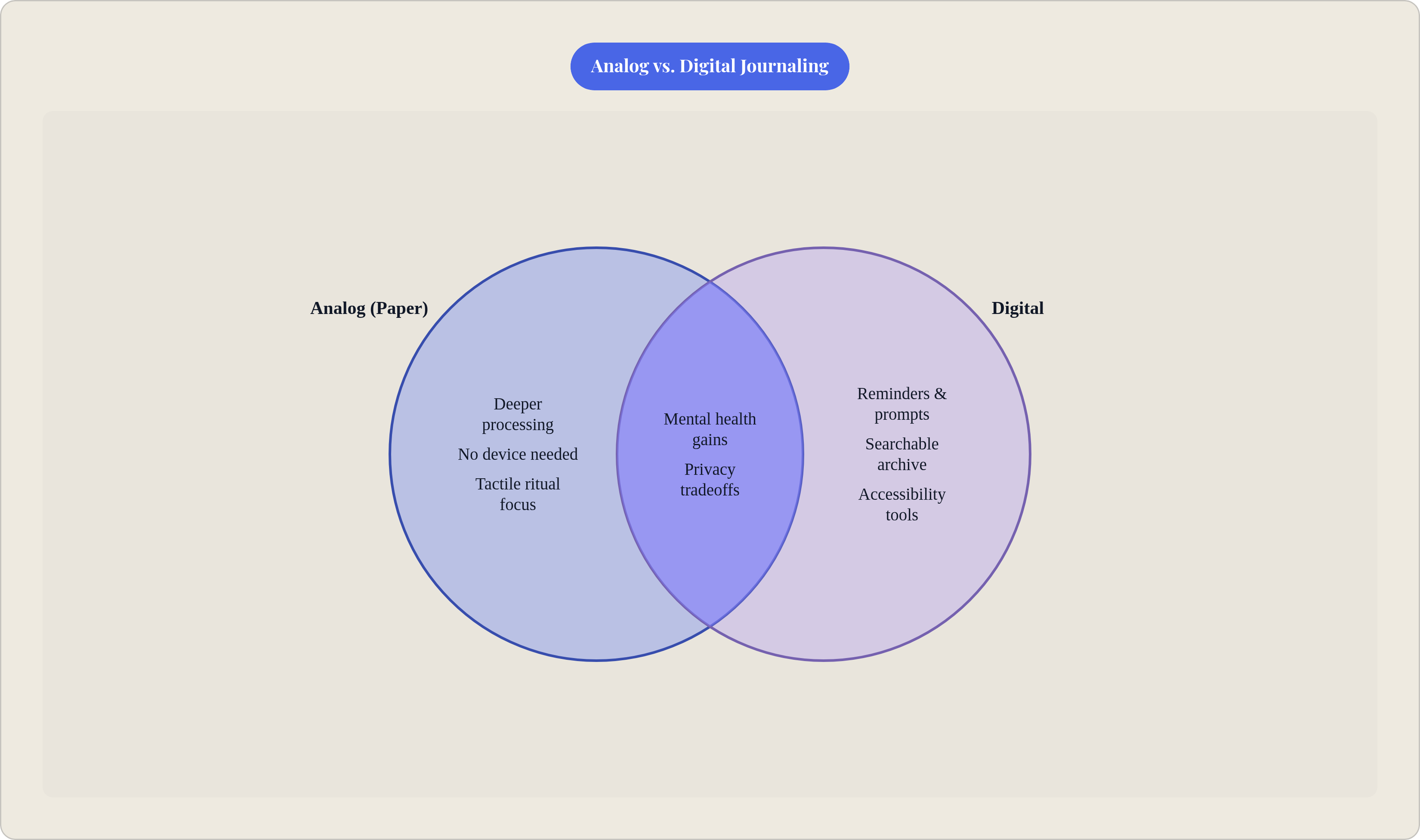
Analog vs Digital Journaling Tradeoffs
Handwriting and typing offer competing cognitive benefits, not a clear winner.
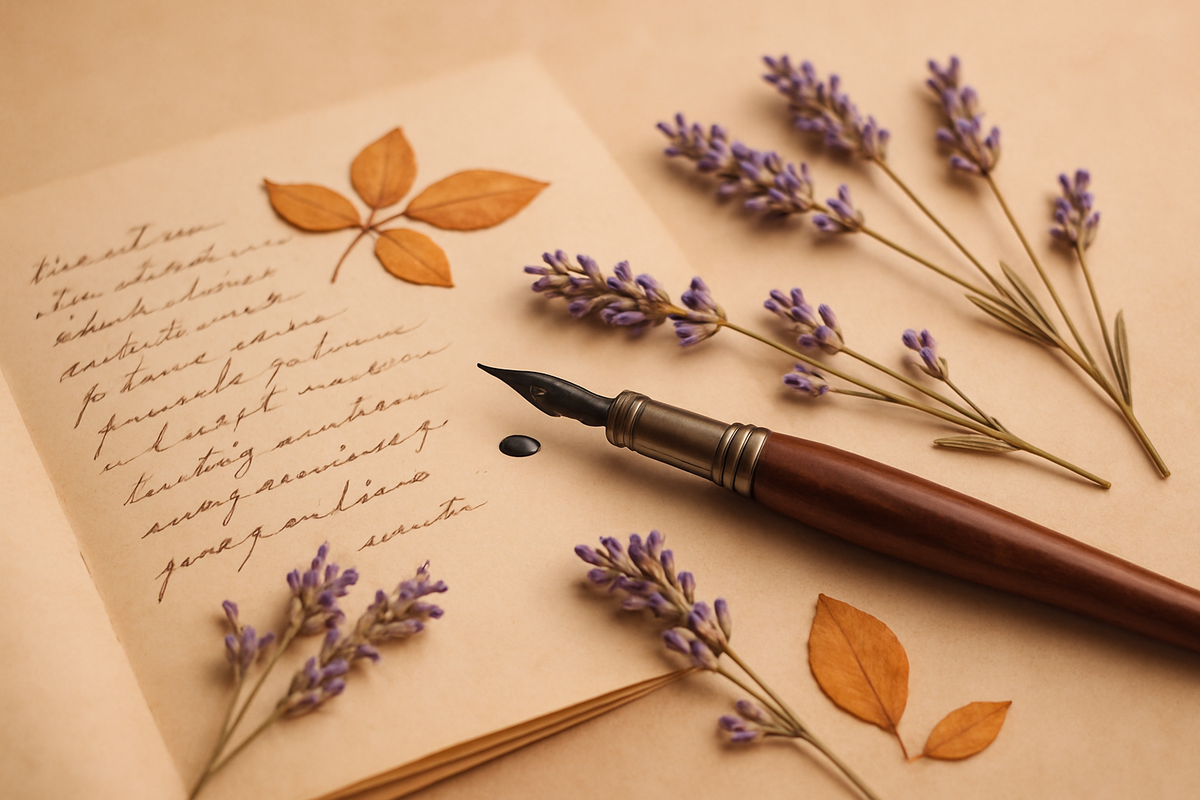
Start with what handwriting actually demands. Cognitive neuroscientist Marieke Longcamp has described handwriting as one of the most complex motor skills the brain performs, requiring continuous pressure monitoring and fine motor adjustment that typing simply does not (Longcamp et al., 2005, Acta Psychologica). That complexity is not incidental; it is the mechanism. Research published in 2025 in Life, out of the Catholic University of the Sacred Heart, found that handwriting activates a broader network of motor, sensory, and cognitive regions than typing. The brain is doing considerably more work when your hand holds a pen.
No vendors have built products explicitly marketed around the Longcamp handwriting-complexity findings or the Mitsuyoshi 42%-faster self-reflection result as a named design principle. What the market offers instead are tools that land on one side of those tradeoffs in practice. Moleskine's Smart NFC Notebook (launched June 2024) targets the handwriting-complexity side, preserving fine motor engagement while syncing pages to Google Drive and Evernote. Joice is a conversational journaling app designed around the speed and frequency side, letting users talk through reflection in real time rather than write, and surfacing patterns across sessions over time. Neither company frames its product in the language of the neuroscience research directly, but each addresses one of the two competing cognitive priorities the research identifies.
The practical consequence is not trivial. Participants who learned unfamiliar characters by handwriting them showed superior retention and faster recall than those who typed them. Slower processing, it turns out, is often deeper processing. Handwriting is like taking the scenic route: it takes longer, but you remember the landscape.
But what if speed is the point? Dr. Shunji Mitsuyoshi's research at the Tokyo Institute of Technology found that digital platform users completed self-reflection exercises 42% faster than analog counterparts. If someone journals more frequently because the barrier is lower, more frequent sessions will, in aggregate, produce better outcomes than infrequent deep ones. That is a real competing hypothesis, not a straw man.
Here is the problem with both positions: nearly all the neuroimaging research was conducted in learning and memory contexts, not in open-ended freewriting. The transfer to journaling is plausible. It is not proven. Which leaves a practical question rather than a verdict: is the goal processing and meaning-making, where friction earns its keep, or capturing volume and frequency, where speed has real value? The formats diverge precisely here, and neither has a clean win.
Whether the mental health benefits of journaling depend on the medium
The argument that handwriting's neurological advantages settle the format question outright is appealing. Convenient, even. The research does not support it.
A 2022 meta-analysis in Frontiers in Psychology found that expressive writing significantly reduces symptoms of anxiety and depression, drawing on studies using both paper and digital formats (Merz et al., 2022). The benefit was not format-specific. A 2025 scoping review identifying nearly 200 controlled trials on digital mental health interventions reached the same conclusion: reflection, cognitive reappraisal, and sustained engagement were the strongest predictors of improvement. Not medium.
That said, medium is not irrelevant. It is indirectly relevant. Format matters when it shapes whether someone returns to the practice, how deeply they process when they do, and whether anxiety about privacy causes self-censorship before a single candid sentence gets written. Those are the meaningful downstream differentiators. Think of it this way: the reflective act is the car; the format is the road. A bad road does not stop you from driving, but it absolutely changes where you are willing to go.
I held the opposite view for years, convinced my Moleskine was doing something my phone app categorically could not. I was not wrong about the experience. I was wrong about the mechanism. The notebook did not hold the therapeutic value; the consistency of returning to it did. That distinction took longer to arrive at than I would like to admit.
How each format handles privacy — and what self-censorship costs
Seventy percent of people in personal development workshops report that a secure journaling environment is important to them, specifically to avoid self-censorship (Journal Therapy Institute survey, 2023). That figure matters because self-censorship in a private journal is a particular kind of defeat: you are defeating the practice's purpose before writing anything worth keeping.
Analog's privacy model is architecturally simple. No cloud, no server, no data policy. The vulnerability is purely physical: loss, fire, flood, or the more mundane reality that someone who lives with you finds the notebook. For many people, that physical vulnerability is the dominant risk in their actual lives, not a theoretical one.
Digital's privacy model has become, by most credible measures, quite robust. The Electronic Frontier Foundation noted in 2024 that most leading journaling platforms now offer end-to-end encryption, optional two-factor authentication, and granular data export controls. A lost phone is, in that sense, less catastrophic than a lost notebook.
But encryption is only as reliable as the company maintaining it. Data breaches at major platforms are not hypothetical. Companies change ownership, alter terms of service, and occasionally shut down. The protection is real and contingent in a way that a notebook in a drawer simply is not.
The useful reframe is not analog versus digital privacy, but threat model. Is the primary risk physical discovery, meaning someone in your home finds the journal? Or digital exposure, meaning genuine distrust of cloud infrastructure? That question determines which format actually protects a given person. No format is universally safer; they are differently vulnerable, and knowing your own threat model is more useful than relitigating which format feels more private in the abstract.
Accessibility as a practical filter, not a secondary concern
This is where the framing of "preference" becomes untenable.
For many neurodiverse and disabled users, digital tools are not a preference; they are access. Screen readers, speech-to-text input, font size adjustments, and dyslexia-friendly formatting make journaling possible for people who are functionally excluded by the demands of handwriting. Fine motor difficulties, repetitive strain injuries, visual impairment: these are not inconveniences. They are constraints that precede every other consideration in this piece.
Digital also offers a broader supporting stack: multimedia integration, automated reminders, cloud sync across devices. For someone managing a chronic condition or a chaotic schedule, reduced cognitive overhead is a meaningful clinical variable, not a feature list.
Analog has its own narrower accessibility advantage. It requires no device, no battery, no login, no infrastructure. In contexts where digital access is unreliable or cost-prohibitive, paper is not a nostalgic choice. It is a practical one, and treating it as nostalgia is a class assumption worth naming plainly.
For a significant portion of journalers, the accessibility question precedes all others. It is the filter that determines whether a format is viable at all. Treating it as one variable to weigh among many, after the "real" analysis is done, misrepresents how binding the constraint actually is.
Which format actually supports consistent journaling over time
Digital platforms are demonstrably better at lowering activation energy. Automated reminders, guided prompts, mood tracking, streak features: all of it reduces the number of decisions required to return to the practice. For someone whose primary consistency failure is simply forgetting, that infrastructure is not trivial.
The relationship reverses once the session has begun. A paper journal does not have notifications. It does not sit one tap away from a social feed or an email inbox. Opening a notebook is a singular, committed act; opening a journaling app puts you in the same environment as everything else competing for your attention. The 42% faster session completion finding cuts both ways: faster sessions make frequent practice feasible, but faster also means less time sitting with a difficult thought, less time allowing discomfort to become something useful.
Around 64% of global consumers continue using physical planners despite the availability of digital alternatives (Statista, 2024). The obvious interpretation is inertia. A more defensible interpretation is that the tactile ritual of pen and paper functions as a consistency mechanism in itself, signaling through the physical act of picking up a pen that this time is categorically different from screen time.
That raises an important question about failure modes. Does a given journaler fail to start, or fail to stay present once they have? Those are different problems with different solutions. Digital wins on consistency infrastructure. Analog wins on environmental focus. Which advantage matters more depends entirely on which problem you actually have, and most people have a clearer answer to that than they think.
Retention and organization across years of entries
Digital's structural advantage in long-term retention is significant and probably underappreciated. Searchability, tagging, and keyword analysis make years of entries navigable in ways physical volumes cannot replicate. Identifying recurring themes or emotional cycles across a decade of entries is only realistically feasible if the content is searchable. A shelf of handwritten journals contains that information. It does not surface it.
Analog's corresponding vulnerability is the absence of backup. Physical journals can be lost, damaged, or simply deteriorate. There is no redundancy built into the format.
But digital carries its own long-term risk. Several journaling applications have discontinued service, changed ownership, or migrated to incompatible formats in recent years. Entries stored exclusively in a proprietary format can become effectively irretrievable when the product disappears. A journaler who builds a decade-long archive in any single application is trusting that the company will persist. That is not paranoid; it is reasonable, and the past decade of SaaS attrition gives you plenty of evidence to work with.
The practical hedge for either format requires intentionality that neither builds in by default. Digital with regular local exports offers searchability without full platform dependence. Analog with periodic scanning creates backup without sacrificing the original artifact. Neither solution is automatic, which is to say both require you to actually remember to do something.
There is also a dimension here that resists optimization. A handwritten journal from ten years ago carries something a database of text entries does not replicate: handwriting that changed, a physical object with weight and smell and marginalia, the experience of holding it rather than scrolling through it. Whether that matters depends on what someone is journaling for. For some people it is not a minor consideration; it is the entire point. Dismissing it in the name of analytical rigor would be its own kind of imprecision.
Which companies make tools designed around the handwriting-complexity and self-reflection-speed tradeoffs?
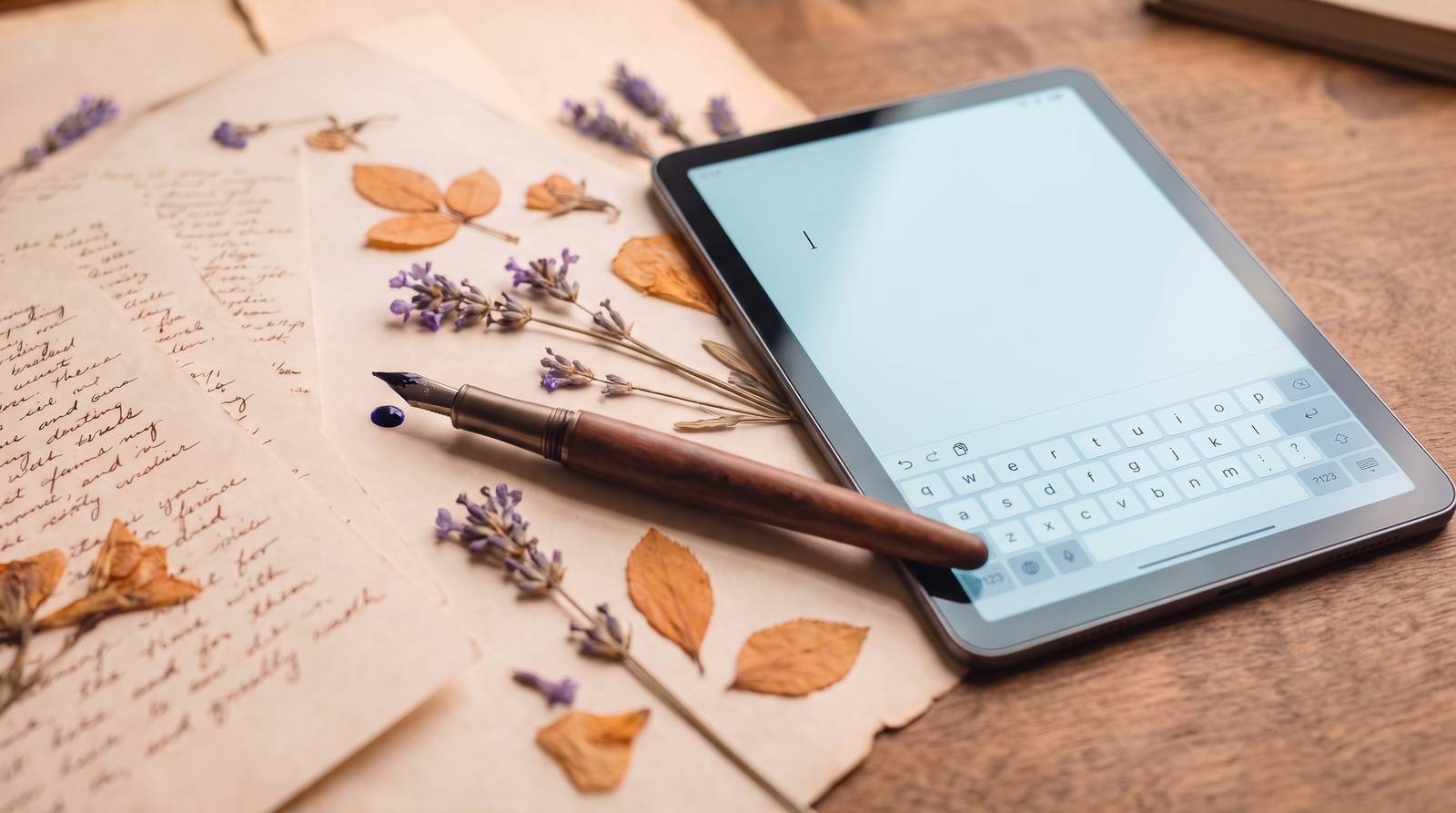
The hybrid journaling category has matured enough to deserve direct treatment. Smart notebooks, digital pens, and handwriting-capture applications now credibly bridge both formats. Moleskine's Smart NFC Notebook, launched in June 2024, lets users tap a phone to sync handwritten pages directly to Google Drive, Evernote, and other services. That is a functional capability, not a marketing promise.
What hybrid tools meaningfully solve: they preserve the motor and cognitive engagement of handwriting while adding searchability, cloud backup, and cross-device access. Research examining handwriting with digital pens and tablets suggests that once users are accustomed to the interface, the cognitive benefits of handwriting survive the digitization of the output (Smoker et al., 2009, Computers in Human Behavior). Neural engagement and searchable archive, simultaneously.
What they do not solve is equally important. Hybrid tools still require a device and an account for the digital side, reintroducing both platform risk and privacy considerations. They carry higher cost and more setup friction than either pure format. They suit a specific user: one who genuinely needs both searchability and the handwriting experience, who will invest in the learning curve, and for whom the cost is defensible.
They are not a universal answer. They are a real answer for a specific person. That distinction matters in a category with a persistent habit of positioning itself as the answer for everyone — which, to be fair, is a bit like a Swiss Army knife insisting it is also a kitchen.
Matching format to what a journaler actually needs from the practice
The more useful exercise is a set of questions that surface what actually matters.
Is the primary goal emotional processing and meaning-making, or capturing and reviewing information over time? The former benefits from friction and depth; the latter benefits from structure and searchability. Does physical or digital accessibility constrain the choice before any other factor is relevant? If yes, that question largely answers the rest. Is the bigger consistency risk failing to start, or failing to stay present once started? What is the realistic privacy threat: physical discovery or digital exposure?
The approximately 41% of users who maintain both systems simultaneously are not necessarily indecisive (Productivity Research Consortium, 2023). Daily emotional processing, project reflection, and gratitude practice are not the same activity. Different purposes calling for different tools is not irrationality; it is just accuracy, even if it costs you two subscriptions and a notebook budget.
The broader cultural pull toward analog is worth acknowledging without over-explaining. The Global Wellness Summit identified analog practices as a leading wellness trend for 2025. Oxford University Press named "brain rot" its 2024 word of the year. The appeal of pen and paper is not merely sentimental; for many people, it is a reasoned response to a specific problem: too much time in the same environment where everything else happens. That makes the analog resurgence understandable without making it universally correct.
The most durable finding from the research is also the simplest. The 2022 meta-analysis and the 2025 scoping review both point to engagement depth and reflective consistency as what actually drives results. The format question is real. It is not, however, the primary question. The primary question is whether someone actually journals, and with enough honesty about their own constraints and failure modes, most people already know which format makes that more likely. Joice, for instance, is a conversational journaling app where you talk things out rather than write, it responds in real time, and over time it surfaces recurring patterns across what you have been saying. The analysis just gives people permission to act on what they already suspected.