Gratitude Journaling Prompts Beyond Listing Three Things
Weekly reflection with specific detail beats daily gratitude lists that fade into routine.

Hedonic adaptation is the brain's most efficient and least appreciated sabotage mechanism. Repeat a positive experience often enough and the brain reclassifies it from bonus to baseline, stops allocating attention, and moves on. The practice continues; the benefit does not.
Sonja Lyubomirsky's research found that writing about gratitude weekly lifted well-being more than writing daily. Daily practice became rote. Robert Emmons has a term for the endpoint: gratitude fatigue, where the practice becomes a checkbox rather than a moment of genuine attention. What feels like discipline (showing up every single day) can be the very thing killing the effect.
Vagueness compounds this. "I'm grateful for my family" written nightly becomes wallpaper. The brain stops processing it as meaningful information because it contains no new information. Lyubomirsky also flags inauthenticity as a distinct threat: going through the motions without engagement produces none of the neurological benefit. The ritual survives; the function evaporates.
The list has two failure modes operating simultaneously. It normalizes through repetition, and it generalizes through vagueness. Both disable the same mechanism the practice was supposed to activate.
That raises an obvious question. If the list works well enough to prove the mechanism is real, why abandon it? Robert Emmons and Michael McCullough's 2003 study remains the landmark: participants assigned to write weekly about things they were grateful for reported being 25% happier than those writing about neutral events and exercised nearly ninety minutes more per week. The list is the entrance ramp, not the highway. The question is what gets you further once you have learned to notice.
What the Research Says Reflection, Not Listing, Actually Changes in the Brain
Gratitude writing done with full engagement activates the prefrontal cortex (the region responsible for emotional regulation and decision-making) while moderating amygdala reactivity (which governs fear and threat response). One gratitude letter-writing intervention produced measurable increases in prefrontal cortex sensitivity that outlasted the exercise itself. The brain was durably changed, rather than just temporarily soothed.
A 2025 meta-analysis published in PNAS synthesized 145 studies, 727 effect sizes, and data from 24,804 participants across 28 countries. The overall effect on well-being was real but modest: Hedges' g = 0.19. Gratitude practice is meaningful, not miraculous. But the same analysis found that interventions combining multiple gratitude methods, and those targeting positive emotions specifically, showed stronger effects. Depth and variety of method matter. Single-format, single-frequency practice hits a ceiling, and that ceiling is not inherent to gratitude; it is inherent to the method.
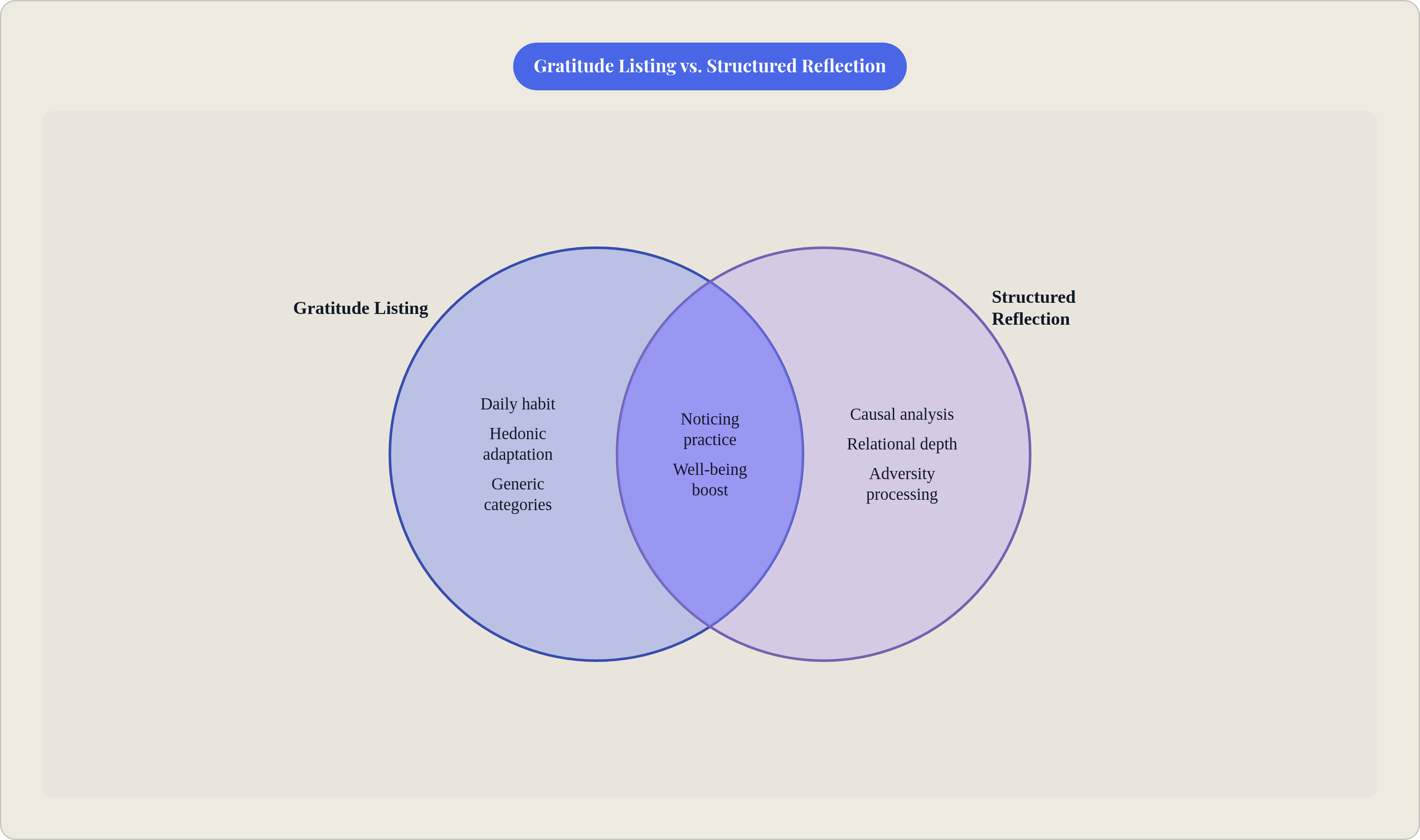
Here is the distinction that actually matters: listing recruits attention; structured reflection recruits the networks that reprocess experience. Those are different cognitive operations producing categorically different outcomes. One trains you to notice; the other trains you to understand what you noticed. Conflating the two is how people spend years journaling and end up in the same emotional register they started in.
The Structural Moves That Turn a Gratitude Entry Into Genuine Reflection
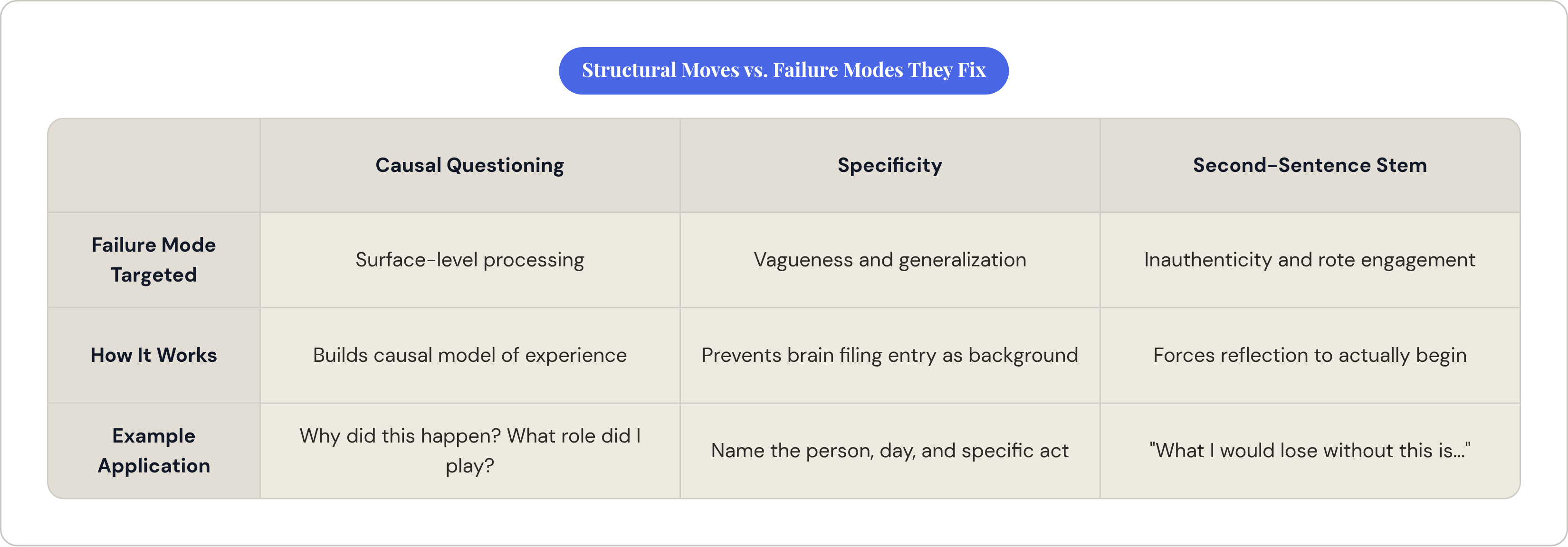
Martin Seligman's "Three Good Things" exercise is frequently cited and almost as frequently mangled. The entry-level version (name three things that went well) is the part people remember. The critical addition is two follow-on questions: why did this happen, and what role did I play? Those questions are not ornamental. They shift the exercise from cataloguing to causal analysis, requiring the writer to build a small explanatory model of their own life. Most people skip them, and most people also wonder why the exercise loses its edge after six weeks.
Berkeley's Greater Good Science Center offers a complementary test for specificity. "I'm grateful my coworker brought me soup when I was sick on Tuesday" works differently in the brain than "I'm grateful for my coworkers." Precision prevents adaptation because the brain cannot file a specific memory as background noise the way it can a generic category. Specificity is not a stylistic preference; it is a functional requirement.
A depth-over-quantity protocol follows naturally from both findings: one thing, written fully, with a forced second sentence using a stem like "This matters to me because..." or "What I would lose without this is..." The second sentence is where reflection actually begins. The first sentence is still just noticing.
Each structural move targets a specific failure mode. Causal questioning addresses surface-level processing. Specificity addresses vagueness. The second-sentence stem addresses inauthenticity. These are surgical responses to known problems, not interchangeable improvements.
Prompts That Work Through People, Not Things
Berkeley's Greater Good Science Center has found that focusing gratitude on people produces stronger impact than focusing on things. That is a direct challenge to the standard "things I'm grateful for" framing, and an important one. People are cognitively complex; they carry histories, motivations, and specific gestures that resist reduction into a recurring category. You can habituate to "my comfortable home." It is much harder to habituate to a specific person's specific act.
Relational prompts worth using:
- Name someone who made a positive difference this week. What specifically did they do, and what does that tell you about what you actually need?
- Describe someone you have never formally thanked. What would you say if you had to say it now, in writing, in detail?
- Think of a difficult person in your life. What have they taught you, however unintentionally?
The gratitude letter deserves its own mention. Writing a detailed, roughly one-page letter to someone who changed your life but was never properly thanked is one of the most robustly studied positive psychology exercises in the literature. Lyubomirsky found it produced one of the largest single-session boosts to well-being of any method tested. The effect holds even when the letter is never sent. The reconstruction of the relationship and the moment is the mechanism, not the delivery.
This category resists adaptation because it requires rebuilding a specific relational memory from scratch each time. Routine cannot take hold here.
Prompts Built on Imagining Loss Rather Than Cataloguing Gain
Berkeley's Greater Good Science Center calls this "subtraction, not just addition." The logic is Stoic in origin: negative visualization (deliberately imagining the absence of something present) defamiliarizes the familiar and forces genuine attention where repetition has created blindness. Marcus Aurelius practiced it. Epictetus taught it. It also happens to be neurologically defensible.
Prompts in this category:
- Pick one ordinary thing you rely on every day. Write what your morning would look like if it were gone.
- What negative outcome did you avoid this week, something you never noticed because it didn't happen?
- Describe a difficulty from your past. What did you build because of it that you would not have built otherwise?
You cannot habituate to an absence you have to actively construct. Each imagined scenario registers as new information because the brain is building something that does not exist. The freshness is structural, not incidental.
But what if someone uses this framing to paper over genuine pain? Lyubomirsky and Alex Wood's research addresses this directly. Forced reframing of active distress edges toward toxic positivity, suppressing rather than processing. These prompts are for the examined past and the unnoticed present, not for wounds still open. That distinction determines whether the exercise helps or makes things worse.
Prompts That Use Surprise and the Unexpected as an Entry Point
Berkeley's Greater Good Science Center recommends recording events that were unexpected or surprising, specifically because they produce stronger gratitude responses. The neurological reason is concrete: the brain's reward system responds more vigorously to unpredicted positive events. The dopamine signal is larger for the unexpected. This is why a spontaneous compliment lands harder than a scheduled one, and why a birthday message from someone who clearly remembered on their own feels qualitatively different from one prompted by an algorithm.
Prompts built on this:
- What happened today that you didn't see coming (something small that landed better than expected)?
- Describe a moment this week when someone exceeded what you expected of them.
- What's something you've had for a long time that you noticed differently today?
The noticing habit developed by the three-things list becomes genuinely useful here. You have trained your attention to scan for the positive; these prompts redirect that scan toward the novel rather than the familiar. The exception, not the norm, is where fresh emotional signal lives.
Prompts That Bring Adversity and Growth Into the Same Entry
This is where gratitude journaling either earns its depth or exposes its limits. The risk is real: a practice used to bypass rather than process difficult emotion becomes a suppression tool. Alex Wood and colleagues have noted this explicitly. Gratitude journaling is inappropriate as a substitute for addressing genuine distress.
But what if the sequencing, rather than the content, is the actual variable? The fix is not avoidance; it is order. Acknowledge the difficulty fully first, then look for what it opened. That sequencing is a meaningful distinction, not a semantic trick. It is the difference between reframing and excavation.
Prompts in this category:
- Describe something hard that happened recently. What did you find out about yourself in how you handled it?
- What's a belief or habit you had to give up this year? What has the space made room for?
- Think of a period you'd never choose to repeat. What do you carry from it that you wouldn't trade?
James Pennebaker's expressive writing research is the model here. Fifteen to twenty minutes of structured writing about difficult events, sustained over several sessions, produces measurable improvements in both mood and physical health markers. These prompts do not ask you to be grateful for the difficulty. They ask what the difficulty made visible that would otherwise have remained hidden. One is reframing; the other is excavation.
How Often to Use These Prompts, and How to Stop This Practice From Going Stale Too
Lyubomirsky's frequency finding is direct: two to three times per week outperforms daily practice. The gap between sessions preserves the sense that something worth noticing actually happened. Berkeley's Greater Good Science Center aligns on this, recommending roughly fifteen minutes, a few times per week.
Frequency is only one variable, though. Rotating prompt categories across sessions is the structural protection against adaptation. Use a relational prompt one session, a subtractive prompt the next, an adversity-focused prompt when something difficult is present. Variety is a design principle, not a fallback. The prompts above exist across different cognitive registers precisely because hitting the same register repeatedly reactivates the habituating dynamic you were trying to escape.
Timing carries its own logic. Gratitude writing before sleep has been shown to reduce pre-sleep cognitive arousal by displacing ruminative thought. The same prompts applied at a different hour serve a different purpose. The prompt is not the whole tool; when you reach for it is part of the design.
The adaptation signal to watch for: when an entry feels like filling in a form rather than discovering something. That is not a discipline failure. That is information. The prompt has been exhausted, and the appropriate response is to change the tool, not push harder on the same one.
How Voice Journaling Changes What These Prompts Can Do
The blank-page problem is especially acute with reflective prompts. A prompt like "what would your life look like without this person" demands actual thinking, and sitting down to compose a structured written response introduces its own friction: the drafting layer, the editing impulse, the formatting instinct. Writing imposes an editorial filter between thought and language. For reflective work, that filter is often the problem, not the solution.
Speaking to a prompt removes it. Thought goes directly into language, closer to the texture of actual thinking, which is what reflection requires. One answer surfaces another question; that question becomes the next prompt. The linearity of writing works against this kind of associative unfolding. Speech does not.
Joice is built around this approach: voice-driven, prompt-guided journaling that takes conversational thinking seriously as a reflective medium. For people who find writing-as-task aversive (and that population is considerable), voice removes a specific barrier without changing what the prompts ask of you.
One qualifier: the quality of the prompt still determines the quality of the reflection. A shallow prompt spoken aloud is still shallow. Specificity, relational depth, subtractive thinking, sequenced adversity processing. These are features of careful attention to experience, which is the actual point regardless of whether you are speaking or writing.