Daily Journal Prompts for Building a Consistent Writing Habit
Writing organizes mental chaos into clarity—and the right prompt makes the difference.

Writing is not recording. The moment you treat journaling as transcription, you've misunderstood why it works.
Forming sentences forces the prefrontal cortex to organize ambient mental noise. Thoughts, unwritten, are associative and circular. Sentences impose linearity: one idea must precede another, causality must be named, emotion must be located in time. This isn't a metaphor for clarity. It is, structurally, what clarity is.
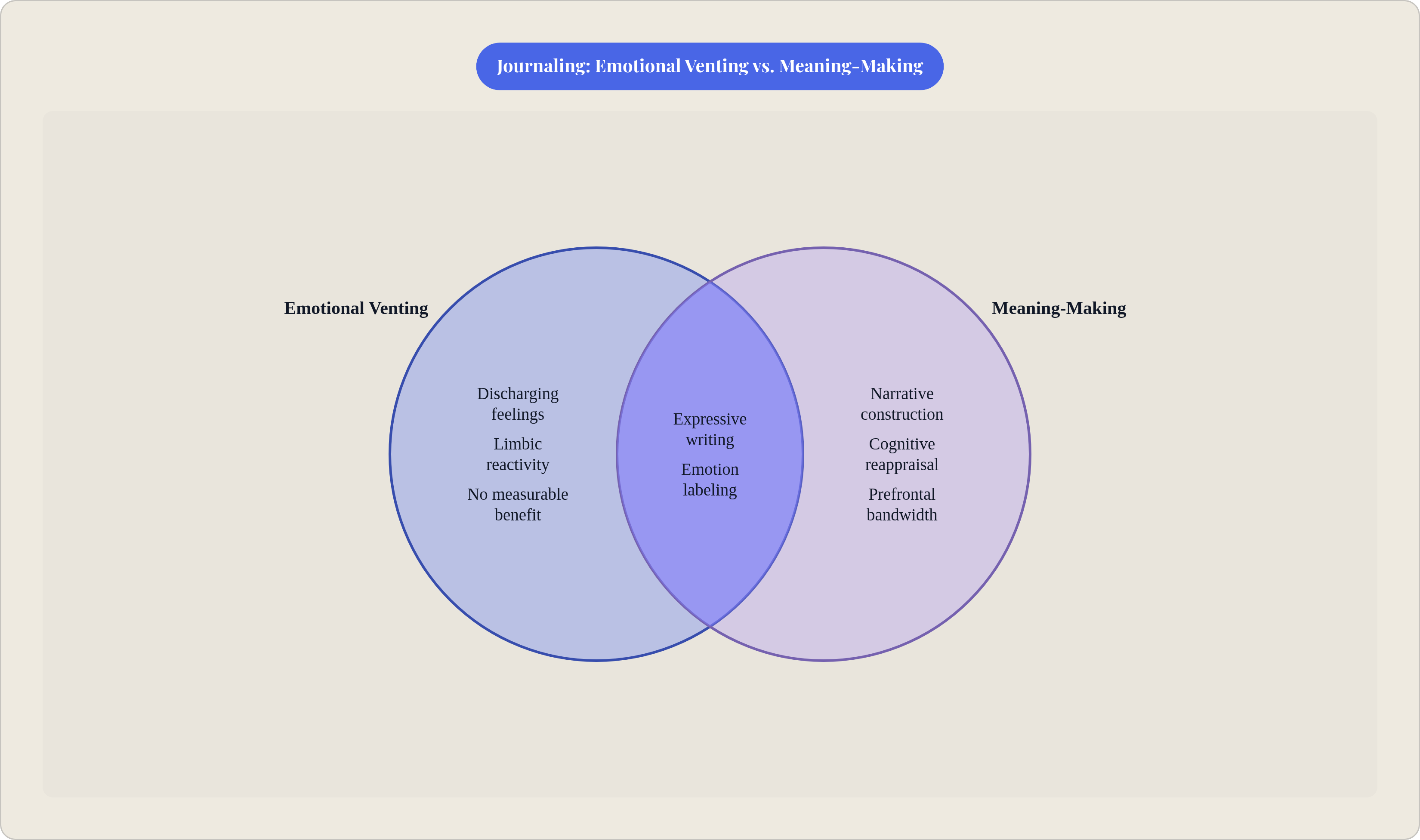
James Pennebaker's expressive writing research gives this the empirical grounding it deserves. His work showed that the therapeutic mechanism in expressive writing is not emotional venting. People who simply discharged feeling on paper showed no measurable benefit. Those who built coherent narrative from chaotic experience did. The operative cognitive move is meaning-making, not expression. When a prompt asks you to "tell the story of what happened as if to a trusted friend," it's scaffolding the exact cognitive structure that produces the benefit. A permission slip to feel things is not the same as an architecture for making sense of them.
There's also the "name it to tame it" principle, documented with reasonable consistency in neuroscience literature. Writing the word afraid or resentful or relieved reduces limbic reactivity. The prefrontal cortex gets more bandwidth. The physical-location question in somatic prompts ("Where do I notice this in my body?") grounds the exercise and interrupts the abstract rumination loop that can make anxious journaling feel worse than no journaling at all. That last part is worth sitting with, because the popular assumption is that more journaling is always better. It isn't. The wrong kind of journaling on the wrong day can tighten the spiral rather than interrupt it — like pressing harder on a knot instead of working around it.
Prompts also create what psychologists call metacognitive distance: the observer stance that makes reflection possible. You're not staring into formlessness; you're answering a specific question from a specific angle. That structural position is the prompt's real gift.
Which raises a question most people don't think to ask: if prompt design shapes the cognitive output, who is designing the prompts you're using, and did they understand what they were building? A session that ends with a clear realization, a decision, a story with a shape, registers as completed. The brain files it, reward circuitry activates, the return becomes more likely. A session that ends with "I have no idea what I just wrote" does the opposite. Prompt design is partly output design, and that is a design problem most people don't realize they're solving when they pull a list off the internet.
How Purpose Shapes Which Prompts Actually Lower Your Activation Cost
A prompt is only frictionless if it matches the job the journal is doing. This is where the general advice to "just start journaling" collapses, because it treats prompts as interchangeable.
Consider the person processing a professional setback who opens their notebook to find a gratitude prompt. The cognitive work required to reorient from grief or frustration to appreciation is real work. It adds friction rather than removing it, and it does so in the most demoralizing way possible: by making the writer feel like they're doing journaling wrong.
So what are the actual jobs a journal can do?
Emotional processing calls for prompts that scaffold narrative construction or cognitive reappraisal. "Tell the story of what happened as if to a trusted friend who wasn't there" borrows Pennebaker's mechanism directly. "What's another way I could look at this situation?" asks the brain to generate a competing interpretation, which is categorically different from simply feeling better about the original one. These are not interchangeable, and conflating them is a quiet mistake.
Habit and goal tracking calls for pattern recognition and forward projection. "What did I consistently avoid this week, and what does that tell me?" isn't asking for feeling; it's asking for data.
Creative ideation needs open-ended curiosity prompts that activate generative thinking rather than analytical evaluation. "What would I explore if I had unlimited time?" engages a different neural register entirely, one that analytical prompts actively suppress.
Daily grounding, the journaling equivalent of a maintenance dose, calls for minimal-friction check-ins: one sentence, present-moment focus, no performance pressure. These exist for writers who need consistency above depth, particularly in high-demand life periods.
It is also worth considering that personality fit layers on top of purpose. An introvert who finds the blank page paralyzing responds differently to an open-ended prompt than someone whose block comes from overthinking a clear idea. The same prompt can scaffold one writer and stall another. And bullet journaling and expressive journaling are structurally different practices: one is task management and pattern capture, the other is emotional processing. Treating them as the same leads to prompts that fit neither.
The practical test is simple. If a prompt makes you want to skip tomorrow's session, it is a friction point, not a scaffold.
Prompt Categories That Research Backs for Building the Early Habit
Emotional Labeling Prompts
"What am I feeling right now, and where do I notice it in my body?"
This is the workhorse prompt for beginners and high-stress periods alike. The mechanism is well-documented: labeling an emotion reduces its intensity. The physical-location component is not decorative; it grounds the exercise and interrupts abstract rumination. Best used for emotional processing goals and for writers who find open prompts overwhelming rather than liberating.
Narrative Construction Prompts
"Tell the story of what happened as if to a trusted friend who wasn't there."
Pennebaker's mechanism, borrowed directly. Organizing chaotic experience into a sequence with a narrator, events, and implied meaning is the operative cognitive move. This prompt is demanding, though. On low-energy days it asks too much. Reserve it for processing significant events rather than slotting it into the daily routine, because using a demanding prompt as filler is how you train yourself to dread opening the notebook.
Cognitive Reappraisal Prompts
"What's another way I could look at this situation?"
Reviews of emotion-regulation literature consistently rank cognitive reappraisal among the most effective self-regulation strategies available. Writing forces the reframe to become explicit rather than half-formed; you can't nod vaguely at an alternative interpretation on paper the way you can in your own head. Best for anxiety, conflict, and decision-making contexts.
Third-Person Self-Distancing Prompts
"What would [your name] say about this challenge?"
The grammatical shift from "I" to your own name creates an observer stance without requiring you to manufacture calm first. It lowers emotional reactivity through a structural trick. For high-conflict or high-stakes situations where first-person writing amplifies distress rather than diffusing it, this is often the prompt that works when others don't. It sounds slightly absurd. It works anyway.
Minimal Check-In Prompts
"One word for today." / "What I'm carrying into tomorrow." / "One thing that worked."
These are not a destination. They are infrastructure. One sentence removes the performance pressure that kills journaling in its first three weeks. The cue-routine-reward loop gets established even when the entry itself is thin. Depth comes later, if it comes at all, and that's fine.
Weekly Pattern-Recognition Prompts
"Reading back through this week: what did I avoid on the same days? What consistently lifted my mood?"
Habit research distinguishes between a willpower orientation and a systems orientation; the latter involves noticing patterns in your own behavior and using them to design better conditions. This prompt makes that concrete. It works best when paired with consistent daily entries that give the weekly review actual material to work with, which is itself a reason to keep the daily entries simple enough to sustain.
A Realistic Note on Gratitude Prompts
Positive psychology literature suggests that writing gratitude daily can become rote, and that the benefits sustain better when spread across a few sessions per week rather than performed as the fixed daily opener. Use gratitude prompts on rotation. A prompt that has become mechanical is a prompt that has become friction, and there is no virtue in friction you've engineered for yourself.
Building the Structural Conditions That Make Prompted Writing Stick
A prompt lowers activation cost in the moment. A fixed context lowers it before the moment arrives. The two work together, and treating prompts as sufficient on their own is a structural mistake that quietly ends a lot of promising practices.
Fix the time and the place. A specific environmental cue, the same chair, the same light, the same time of morning, means the brain begins transitioning into writing mode before the notebook opens. The context does cognitive work the writer doesn't have to do. This is not a productivity cliché; it is how procedural memory actually functions. The cliché just got there first.
Morning versus evening is a function question, not a values question. Morning sessions clear mental static before the day's inputs arrive; they work well for ideation and intention-setting prompts. Evening sessions have access to the day's events as raw material, but they require cognitive bandwidth that is not guaranteed after a difficult day. Picking the wrong one and then blaming yourself for inconsistency is a trap that's easy to avoid and almost universally fallen into.
Habit stacking works. Attaching the journaling session to an existing anchor behavior, "after I pour my coffee, I open the notebook," means the existing habit provides the cue without requiring new decision-making. The cliché is still a cliché because it keeps being true.
Start smaller than feels meaningful. One of the most common early mistakes is opening the practice with a prompt that demands too much. Three sentences on a minimal prompt beats an abandoned half-page on an ambitious one, every time.
The lapse interpretation problem is real and underappreciated. A 2024 meta-analysis published in Healthcare by Singh et al. found that time to automaticity varies considerably across individuals. A missed day is not evidence the habit failed; it is evidence the system needs adjustment. Most people who quit journaling do so because they interpret a lapse as a verdict on their discipline rather than as a signal about their prompt design. If you're skipping sessions regularly, the first question is whether the prompt type matches the goal. The answer is almost always that it doesn't.
How the Writing Tool Affects Whether Prompted Sessions Actually Happen
The tool is part of the habit architecture. This sounds obvious until you watch someone abandon a journaling practice because their app required a login refresh at 6 a.m. and they closed it and never came back. I've done exactly this: stood in the kitchen, coffee going cold, staring at a spinner that was not going to resolve, and decided the universe was telling me something. The universe was not telling me something. The app just had bad offline behavior, and I let that be sufficient reason to stop. You lose the plot — or at least the app — when the technology blinks first.
Offline-first matters more than most app reviews acknowledge. A journaling app that requires a connection to open or sync means a missed session every time the writer is on a plane, in a low-signal area, or in a moment where a login prompt is enough to tip the decision toward skipping. Reliability is a consistency variable, not a convenience feature. The distinction is worth making explicitly, because "convenient" can be dismissed; "consistent" cannot.
Keyboard support is non-negotiable for writers whose sessions are typed. An app that responds slowly to input, buries the entry screen behind modal prompts, or picks fights with formatting makes the session feel like labor before a word is written. That friction is invisible in a demo and decisive in daily use.
The analog-versus-digital question is a genuine tradeoff, not a hierarchy. A 2024 study by Van Der Weel and Van Der Meer published in Frontiers in Psychology found that handwriting generates significantly more complex neural connectivity patterns than typing, particularly in regions associated with memory and learning. For writers who journal primarily for depth and integration, that finding is relevant. But the neurologically superior medium that stays in the drawer is not superior. The practical question is which medium you will actually open consistently, and that question is answered by friction, not neuroscience.
For digital journaling, the features that matter most are prompt delivery built into the interface rather than buried three taps deep, offline access, reliable sync, and a clean entry screen. Joice is designed around exactly this constraint: the app surfaces prompts at the start of each session, operates offline, and keeps keyboard interaction central. Every additional step between opening the app and writing is a step where the session can die.
Matching Prompts to Where You Are in the Habit, Not Where You Want to Be
The mismatch problem is the quiet engine behind most abandoned journaling practices. People don't quit the habit; they quit a prompt set calibrated for someone further along than they are.
In the first three weeks or so, minimal-friction prompts are the right tool. One sentence, present-moment focus, no performance pressure. The goal is not the quality of the entry. The goal is getting the cue-routine-reward loop to fire reliably, in sequence, enough times that it starts to feel like something you do rather than something you're trying to do.
From roughly weeks three through eight, one purpose-matched prompt type becomes appropriate, depending on the writer's stated goal: emotional labeling for someone processing difficulty, cognitive reappraisal for someone navigating conflict or decision fatigue, pattern recognition for someone building toward a behavioral system. Session length stays modest. The habit is still negotiating its own existence.
Past the 66-day threshold, when automaticity begins to stabilize, the habit can carry more demanding prompts. Narrative construction, deep reflection, weekly review. The initiation cost has dropped through repetition, and there is reserve capacity for sessions that ask more.
But what if the timeline doesn't hold? It often doesn't. If skipping a session feels like relief rather than loss, the current prompt set is too demanding for the current phase. Step back, not forward. This is not failure; it is calibration, and the distinction matters if you want a practice that outlasts the first month.
Prompts are adjustable infrastructure. Unlike willpower, they can be redesigned when they stop working. The writer who treats prompts as flexible tools rather than fixed assignments maintains agency over the habit, and that disposition, more than any individual prompt, is what actually produces a practice that lasts.