Journaling for Creativity and Idea Generation
Writing by hand quiets stress and activates the brain networks that generate ideas.

To understand why this works, we have to start with what the brain is actually doing when it generates ideas. Not the romantic version. The neurological one.
The default mode network, a distributed system active during mind-wandering, spontaneous thought, and internally directed cognition, is central to divergent thinking. A 2024 study published in Brain (Oxford Academic), using stereo-EEG in 13 patients, found DMN recruitment during both mind-wandering and alternate uses tasks, the latter being a standard measure of creative ideation. The DMN is where loose associations form. It connects the thing you read last Tuesday to the problem you cannot crack today.
The executive control network does something different: it evaluates, filters, focuses. Both networks are necessary for creative work, but in sequence, not simultaneously. Force evaluation before generation and you suppress the very process producing the raw material. This is the cognitive version of a boss who interrupts the brainstorm to say "but will it scale."
What suppresses the DMN in the first place? Stress. Cortisol and norepinephrine activate the executive control network and quiet the DMN, which is why creative thinking under deadline pressure is so reliably miserable. The brain defaults to narrow, convergent thinking precisely when you most need it to roam. Convenient.
Writing does something pure thinking cannot: it externalizes the problem. Once an idea is on paper, the cognitive load shifts from holding it to interrogating it. You can draw it, challenge it, notice what is missing. The mind alone resists its own scrutiny. The page does not. Practices that reduce ambient stress, which writing consistently does, directly enable the brain state most favorable to creative ideation. Less cortisol, more DMN activity, more generative association. The most creative individuals show stronger connectivity between the DMN and the executive control network during divergent thinking, as though the two networks have learned to stop elbowing each other in a narrow hallway.
Whether journaling actually builds that connectivity over time is unknown. The directional evidence is consistent. Proof remains elusive.
What Handwriting Does That Typing Does Not
The medium is not irrelevant. Anyone who has typed out a grocery list and immediately forgotten half of it on the walk to the store already knows this intuitively. The neuroscience just explains why.
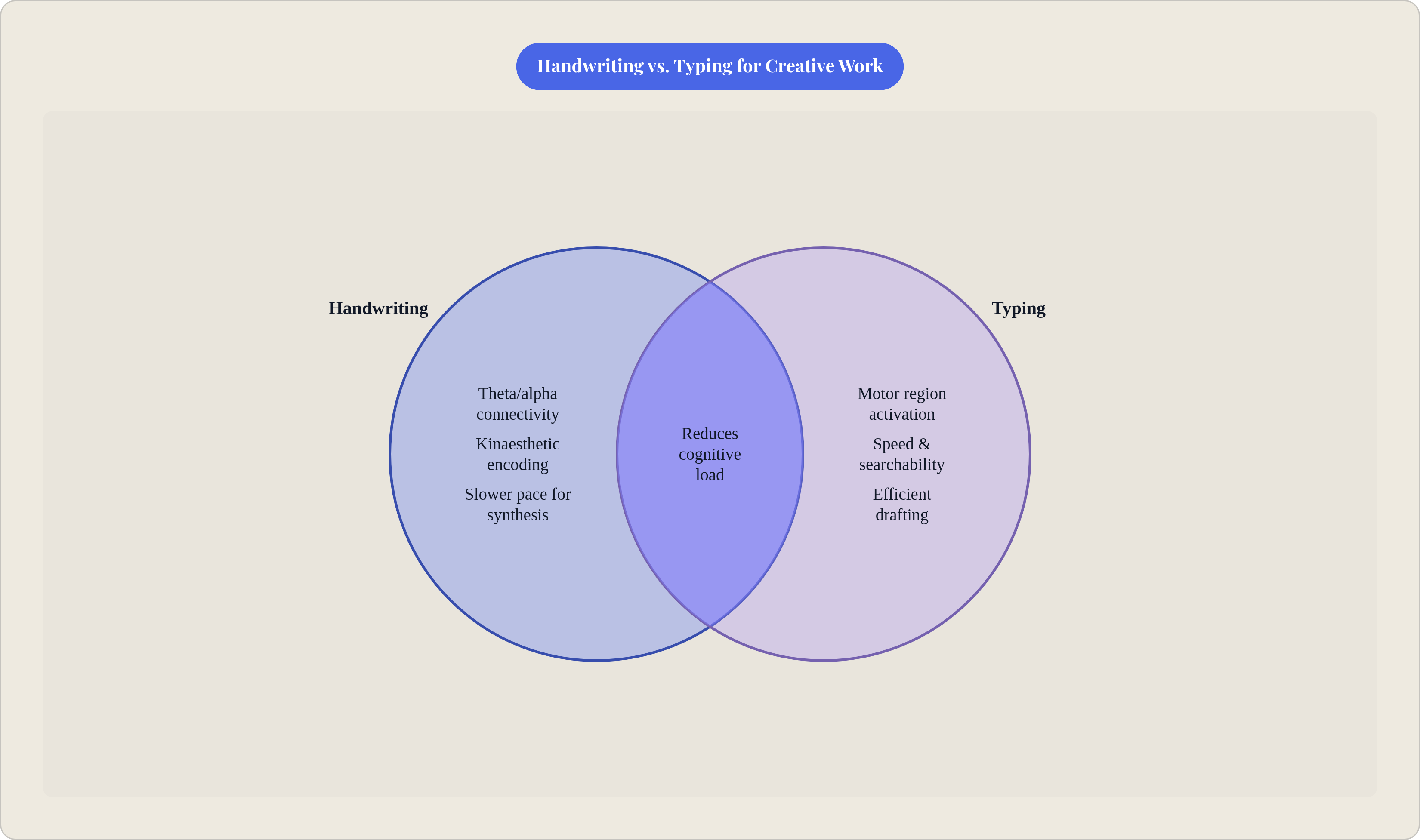
Researchers at the Norwegian University of Science and Technology published findings in 2023 and 2024 from a high-density EEG study of 36 university students. Handwriting produced widespread theta and alpha connectivity across parietal and central brain regions, patterns well-established as critical for memory formation and learning. Typing produced minimal comparable connectivity; activation was largely limited to the motor regions controlling finger movement. At the neural level, typing is closer to pressing a button than to thinking on paper. The keyboard is efficient the way a vending machine is efficient: it delivers, but it does not cook.
Drawing went further still. The same study found drawing produced even stronger connectivity than handwriting, particularly in parietal regions associated with visuospatial processing.
The slower pace of handwriting is a feature, not a limitation. A 2025 meta-analysis found that the deliberate pace of handwriting promotes creative thinking by allowing time for careful consideration and the bridging of disparate thoughts. The pause between words, the moment your pen lifts, is where synthesis happens. Speed-typing bypasses that pause entirely, which is probably why so many typed drafts feel like they outran the thought.
There is also a retention argument. Tactile and kinaesthetic feedback from handwriting strengthens encoding and recall. This matters for creative work because an idea revisited three weeks later is more generative than one you vaguely remember having. The notebook is only useful if you can remember what is in it.
This is not a mandate to abandon the keyboard. For drafting, for speed, for search, typing is superior. But for idea-generation specifically, the physical notebook earns its place.
How Pennebaker's Expressive Writing Research Applies to Creative Work
It is also worth considering what happens when you write about things that are difficult, not just productively ambitious.
Dr. James Pennebaker at the University of Texas at Austin has been studying expressive writing since 1986. By 2009, more than 200 studies had explored its effects across anxiety, cognition, creativity, self-esteem, and physical health. The effect sizes are modest. But the results are consistent, replicated across diverse populations, and produced by a protocol requiring only 15 to 30 minutes per session over three to five days. You have spent longer waiting for coffee.
The cognitive finding most relevant to creative work is this: writers who improved most were not the ones who vented most intensely. They were the ones who used cognitive process words, "realize," "think," "consider," "because," "reason." The benefit came from constructing a coherent narrative around an experience, not from catharsis alone. That distinction matters. Building a story around a problem is itself a generative act, and it has physiological consequences: expressive writing reduces amygdala reactivity and increases prefrontal cortex engagement over time. A mind not perpetually managing unprocessed anxiety has more capacity to notice things, connect things, and generate things.
One honest caveat: the practice can increase distress before it reduces it. Sitting with difficult material requires some tolerance for discomfort, and Pennebaker's research documents this clearly. It is not a reason to avoid the practice. It is a reason not to hand someone a journal and tell them everything will be fine from the first entry.
The Specific Techniques That Make Journaling Generative Rather Than Merely Reflective
Theory without technique is just a longer way of saying "write more." So here is what actually changes the cognitive output.
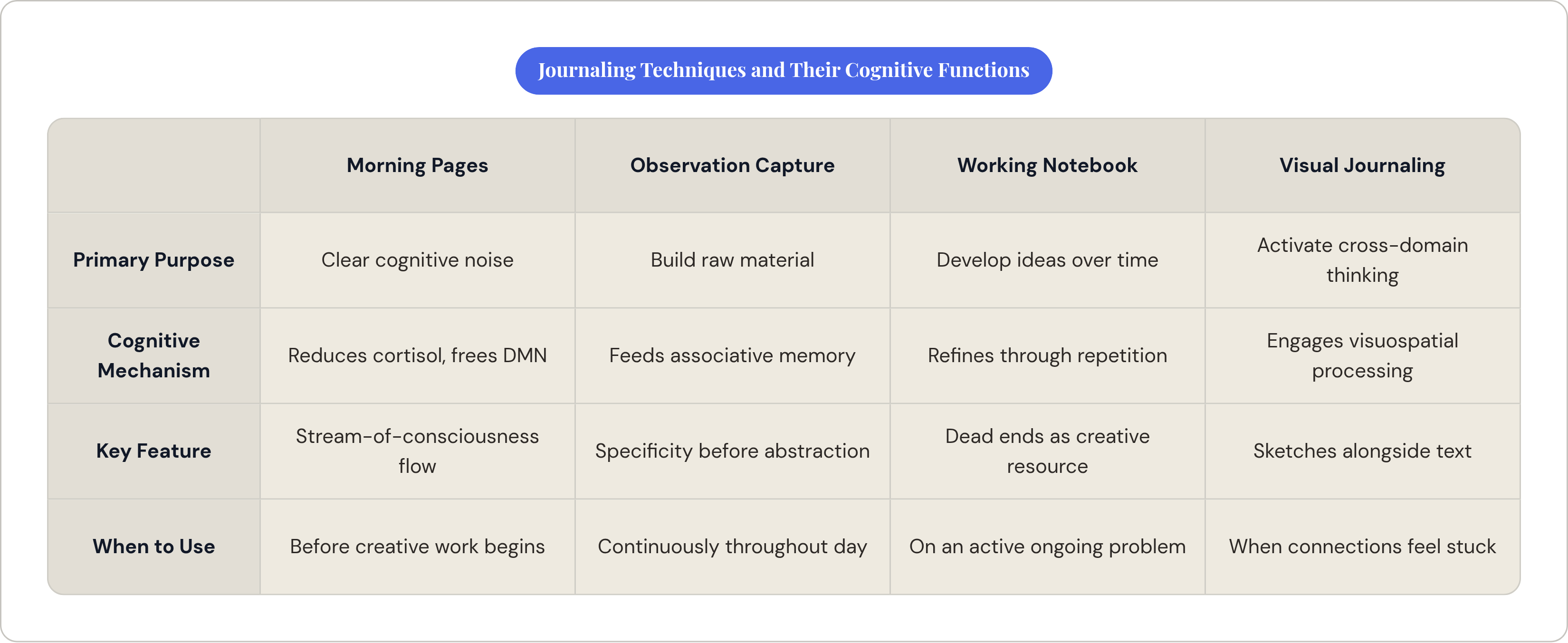
Capture before ideas flee. The commonplace book tradition, stretching back centuries, operated on a simple principle: collect observations, quotes, fragments, and images not because they are finished ideas but because they are raw material that will recombine later. This is not mysticism; it is how associative cognition actually works. The incidental observation you record on a Tuesday is exactly what connects to the problem you are trying to solve in October. The system only works if the observation is written down before it evaporates, which it will, usually before you reach the door.
Morning Pages. Julia Cameron's practice from The Artist's Way is almost aggressively simple: three handwritten pages, stream-of-consciousness, first thing in the morning, without stopping. Cameron calls the pages a "brain drain," releasing worries and ambient noise before the day's creative work begins. Whether or not her spiritual framing compels you, the neurological mechanism aligns with the earlier sections. Reducing unprocessed anxiety lowers the cortisol that suppresses DMN activity. The book has sold more than five million copies, which is not a scientific citation, but it is worth noting.
Divergent thinking on the page. Brainstorming, free-writing, and mind-mapping as deliberate journal practices serve a different function than capturing or clearing. They generate competing ideas, challenge existing assumptions, and break conventional framing. The page permits what the mind alone resists: you can draw something, diagram it, cross it out, circle it, and return to it across days.
Tracking how an idea evolves across entries. This is the technique most people skip. It is also the most powerful. In a working journal, repetition is how an idea matures. The tenth version contains refinement and corrected errors the first version could not anticipate. Preserving the dead ends is itself a creative resource; it shows you why a direction failed, which is often more instructive than knowing why one succeeded.
Visual journaling. Combining written entries with sketches, diagrams, and symbols activates cognitive processing that text alone does not reach. The EEG evidence cited earlier found that drawing produces stronger parietal connectivity than even handwriting. If the goal is cross-domain connection and visuospatial thinking, the sketch does more work than the sentence.
What the Notebooks of Serious Practitioners Reveal About How Ideas Actually Develop
The notebooks that have always interested me most are not the famous ones. They are the ones that look like a mess until you read them in sequence.
Lucia Berlin's working notebooks, which her estate has discussed in interviews, were full of overheard dialogue, fragmented observations from her years as a hospital ward clerk, and half-sentences she returned to sometimes years later. Her stories read like lived experience rendered with impossible precision; the notebooks reveal that the precision was accumulated, not recalled. She was not a natural. She was a compulsive noticer who happened to write things down.
That is a different model than most people carry around. The assumption tends to be that ideas arrive whole, that the notebook is where you put them once they show up. Berlin's notebooks suggest something more uncomfortable: the noticing came first, the ideas came from the accumulated weight of specifics, and none of it was linear.
Edison's notebooks served a related but distinct function. They extended the time horizon of a single idea. A failed experiment recorded in detail prevents the same mistake later. An unimportant result today is exactly what is needed in six months. The notebook made it possible to treat a body of work as a continuous argument rather than a series of isolated attempts, which is also why it is nearly impossible to replicate Edison's output without something like Edison's documentation.
Thoreau's journal grew to roughly two million words, containing natural observations, philosophical questions, weather records, and draft passages. He walked first, observed closely, then wrote. His practice was not abstract brainstorming; it was disciplined noticing, writing down what he actually saw with enough specificity that the observations could generalize into ideas later. Most people begin with the abstraction and try to fill it with examples. Thoreau built from the specific observation outward.
None of these notebooks were diaries of feelings. They were tools for thinking that happened to be written down. Consistency and specificity were the operative variables.
Building the Habit So the Ideas Come Reliably Rather Than Occasionally
Insight without a delivery mechanism is just luck.
The goal of a creative journaling practice is not to produce one remarkable idea. It is to produce a reliable stream of raw material from which good ideas can be selected, developed, and tested. Dedicating specific, recurring time to capturing thoughts creates a habit of noticing. The mind begins generating more because it has somewhere to put what it finds. This is not a claim about willpower or discipline. It is a claim about how habit loops work: behavior that is consistently rewarded, even by the modest satisfaction of filling a page, becomes automatic.
Pennebaker's protocol offers a defensible entry point: 15 to 30 minutes, three to five days. It has experimental backing and does not require a lifelong commitment before it produces results. A 2018 Cambridge study found that 15 minutes of reflective writing per day reduced doctor visits and sick days over the following four months. The physiological effect of reduced stress directly enables the DMN activity that generates creative material.
Matching technique to purpose matters, and this is where most journaling advice fails. Morning pages clear cognitive noise. Observation capture builds raw material. Working notebook entries develop a specific idea across multiple sessions. Visual journaling activates cross-domain and visuospatial thinking. These are distinct cognitive functions, not interchangeable modes. Using them randomly is like grabbing whatever tool is nearest and hoping it fits the work.
The nice notebooks people lose under piles of books are not failures of commitment. They are failures of technique. The difference between journaling that changes nothing and journaling that changes how you think is not how much you write. It is whether you knew what you were trying to do when you picked up the pen.