Journaling Prompts for Self-Reflection
Writing turns invisible thoughts into examinable objects you can actually learn from.

The core mechanism is externalization. When a thought lives only in your head, you experience it. When you write it down, you can look at it, argue with it, catch it being inconsistent. That shift is more consequential than it sounds. Thinking without writing it down is like trying to renovate a house by staring at it — you can see the problems, but you can't move the walls.
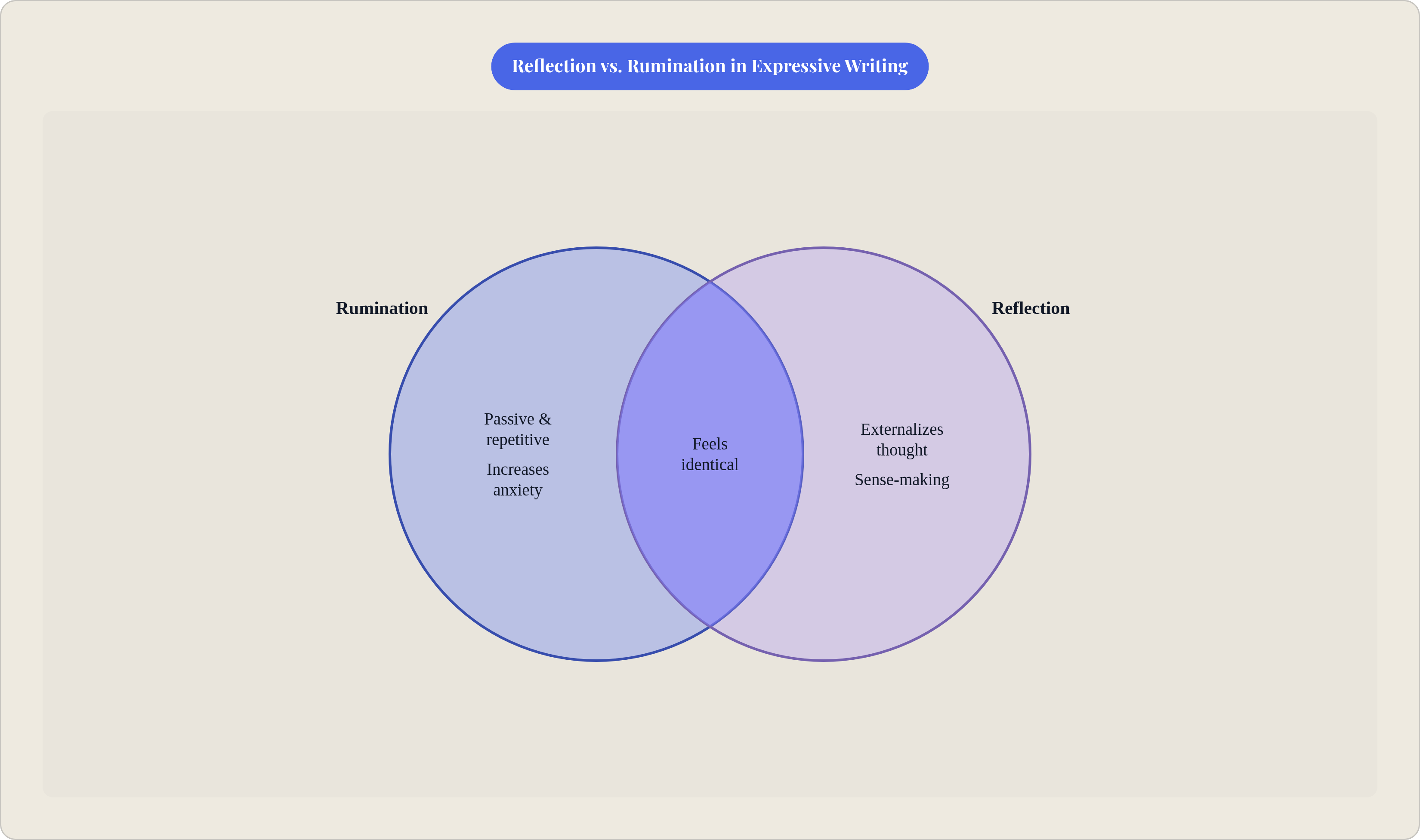
Self-reflection and rumination are not the same process, even though they feel identical from the inside. Rumination is repetitive and passive, circling without arriving anywhere, and is associated with increased depression and anxiety rather than resolution. Writing externalizes a thought, slows it down, and converts a vague spiral into something concrete and examinable, which is the mechanism that separates reflection from rumination. On the science: James Pennebaker's foundational 1986 research showed expressive writers visited health centers significantly less often, but a 2009 meta-analysis of 30 randomized controlled trials found those health benefits minor or inconsistent; the clinical promise was oversold. The cognitive benefits held up separately, Matthew Lieberman's 2007 UCLA research found that putting feelings into words activates the prefrontal cortex while dampening amygdala activity, and Klein and Boals found in 2001 that expressive writing improved working memory by freeing up cognitive resources previously occupied by intrusive thoughts.
James Pennebaker's expressive writing research, beginning in 1986, made the foundational empirical case: participants who wrote about emotionally significant experiences visited health centers significantly less often than those who wrote about trivial topics. The finding became famous, then complicated. A 2009 meta-analysis of 30 randomized controlled trials found the health benefits minor or inconsistent across populations and conditions. The clinical promise was oversold.
The neurological mechanism held up separately. Matthew Lieberman and colleagues at UCLA found in 2007 that putting feelings into words activates the prefrontal cortex while dampening amygdala activity, literally shifting processing from threat-detection to reasoning. Klein and Boals added another layer in 2001: expressive writing about stressful events improved working memory, apparently by freeing up cognitive resources previously occupied by intrusive thoughts running in the background.
That raises an important question: if the clinical outcomes are inconsistent, why bother? Because the cognitive ones aren't. Prefrontal cortex activation, reduced intrusive cognition, the conversion of an experienced feeling into an examined one: these are real and useful regardless of whether they reduce physician visits.
What is the difference between self-reflection and rumination, and does the science actually support expressive writing? Rumination is repetitive and passive; it circles without arriving anywhere. It is associated with increased depression and anxiety, not resolution. Reflection on the page externalizes the thought, slows it down, converts a vague spiral into something you can actually point at. The right prompt keeps reflection from tipping into rumination by giving the thinking a specific destination, which means the prompt itself carries more weight than most people give it credit for.
How to Use a Prompt as a Thinking Tool Rather Than a Writing Exercise
A prompt is a starting direction, not a question to answer correctly. Most people treat them like homework: read the question, produce a tidy response, move on. That explains why so many people try journaling, find it unsatisfying, and conclude they're not the journaling type. They're not the wrong type; they're using the wrong approach.
What actually builds self-awareness is following the thought wherever it goes, not producing a coherent answer to what was asked. The writing arc that works moves loosely through: describing what you notice, naming the feeling, looking for a pattern, identifying one possible implication. Not rigid stages. Just a general direction of travel. When writing stalls, it's usually because it has stopped somewhere in that arc: description without naming, naming without any movement toward pattern.
Write without editing for the first stretch. Uncensored freewriting bypasses the internal critic and surfaces more authentic material than careful prose. Grammar is irrelevant. Coherence is optional. The goal is access.
For charged material specifically, self-distancing language is worth knowing about. Shifting from first person ("I felt...") to third person ("she felt...") creates just enough psychological distance to keep reflection from curdling into self-criticism. The research supports it as a genuine mechanism, not a rhetorical trick.
A 2002 study distinguished two modes of expressive writing: writing that explores and makes sense of what happened versus writing that only expresses distressing emotion. The former is associated with recovery and clarity; the latter alone can reinforce the distress. The prompt functions as a steering mechanism, pulling writing toward sense-making rather than pure emotional discharge. Before choosing any prompt, identify what you actually want to understand. That decision organizes everything that follows.
Prompts for Understanding Your Emotional State in the Moment
These prompts are for anyone who feels reactive, flat, overwhelmed, or vaguely off without being able to name why. The purpose is specific: moving from a diffuse sense of distress to a named, located emotional experience. Specificity is what makes a feeling workable. "I feel bad" is not workable. "I feel afraid that I've already been written off and no one is telling me" is workable.
Most generic prompts fail here because they ask you to label the feeling abstractly. The more useful move is to locate it physically first, because the body often registers something before the conscious mind catches up. Then ask what's underneath it. Irritability, for instance, frequently sits on top of grief or fear. You notice the edge; the real mass is elsewhere.
Some useful directions:
- "What am I carrying right now that I haven't said out loud?"
- "What feeling keeps returning today, and what does it want me to notice?"
- "If this feeling had a specific cause, not a vague one, what would it be?"
Research by Ford, Lam, John, and Mauss (2018) and Baikie and Wilhelm (2005) found that journaling helps people accept rather than judge their emotional experiences, resulting in fewer negative responses to stressors. Acceptance, not suppression or amplification, is what these prompts work toward. They suit a short daily check-in: low stakes, cumulative over time, and quietly clarifying in ways you don't always notice until you look back.
Prompts for Identifying Patterns Across Situations
Why does the same reaction keep appearing in completely different contexts: in a work meeting, in a close friendship, alone on a Sunday afternoon? The answer usually isn't that the situations are related. It's that you are in all of them, carrying the same trigger.
Patterns are nearly invisible from inside a single incident. You need a record. This is one of the few genuinely practical arguments for writing consistently over time, not for the sake of posterity but because future-you needs the data.
It is also worth considering that the behavior itself is often the least interesting thing. What's interesting is the conditions that reliably produce it: who was present, what the stakes were, what preceded it. These prompts ask you to notice repetition and push toward the trigger beneath the behavior.
Some directions worth trying:
- "When do I most reliably shut down or pull away, and what conditions are present?"
- "What pattern do I notice in situations where I feel resentful?"
- "What behavior do I keep repeating even when I can see it isn't working?"
Relationship prompts fit naturally here as a subset. "What pattern do I notice in my closest friendships?" is a pattern question anchored in a specific domain, which makes it easier to approach than a fully abstract question about recurring behavior. Start concrete and work outward. The philosophical ceiling is not the right place to begin.
Prompts for Examining Your Values and What Actually Drives Your Choices
Most people can recite their values if asked. That recitation is cheap. The harder question is whether the values you name are the ones your actual choices reflect, and whether you chose them or absorbed them from people whose approval you've been managing ever since.
Values are not obvious from introspection alone. It's easy to confuse a core value with a behavior you're skilled at, a role you've occupied for a long time, or an expectation so thoroughly internalized that it feels like your own conviction. The purpose of values-focused prompts is to surface the gap between what you say guides you and what your decisions, especially under pressure, actually demonstrate.
Values show up most clearly when two of them compete, or when holding one costs you something real. The stated value that costs you nothing to hold is probably not organizing your behavior in any meaningful way. That's where to look.
Some directions:
- "Where do my choices consistently contradict what I say I value, and what does that gap tell me?"
- "What would I be unwilling to compromise even if it cost me something significant?"
- "What values did the people who raised me hold, and do I actually share them, or have I just never questioned them?"
Values prompts are particularly useful at decision points. When facing a choice where no option is obviously right, knowing what you genuinely hold as non-negotiable functions as a compass. It won't make the choice easy. It will make it legible.
Prompts for Working Through a Specific Decision or Stuck Point
The tempting assumption about being stuck is that the problem is informational: not enough data, not enough options considered. Usually that's wrong. Most people who've been stuck on something for weeks know perfectly well what their options are. The block is emotional, not informational.
There's a point where additional analysis is just avoidance with a productivity alibi. The freeze usually has a more specific cause: fear framed as caution, someone else's standard operating as if it were your own, or an assumption being treated as a fixed constraint when it isn't.
The useful questions here separate fear about a choice from a genuine reason to avoid it. They ask whose voice you hear when you imagine each option. They surface assumptions accepted as constraints without ever being examined.
Some directions:
- "What am I most afraid will happen if I choose the option I actually want?"
- "What would I do if I knew no one whose opinion I care about would find out?"
- "What is the real reason I haven't moved on this, and is that reason actually mine?"
Future-self prompts have a specific evidence base: research shows that writing to or as your future self increases goal persistence and self-compassion, both useful when a decision involves meaningful long-term trade-offs. The question "What will I think of this choice in five years?" is not sentimental. Five-years-from-now you is remarkably free of the social anxiety currently making this feel impossible.
Prompts for Understanding Your History Without Being Trapped by It
Some current reactions are not about the present situation. They are echoes: automatic emotional responses calibrated to an earlier environment, running more or less unchanged ever since. Identifying them doesn't require extended historical excavation. It requires enough clarity to recognize that the response is disproportionate to what's actually happening, and to ask why.
The useful distinction is between relitigating history and using history as information. Past-focused prompts are not about assigning blame or processing every difficult experience in sequence. They're about seeing an origin clearly enough to stop mistaking the echo for the present signal.
The useful questions here approach formative experiences with curiosity rather than judgment. They ask what an earlier experience taught you to believe — about yourself, about other people, about what's safe — and whether that belief is still accurate in the context you actually inhabit now.
Some directions:
- "What did I learn to do to stay safe or accepted when I was young, and where does that still show up?"
- "What story about myself did I absorb from my family that I've never directly questioned?"
- "What is one moment I keep returning to, and what do I think I'm still trying to resolve about it?"
One note: this territory approaches difficult material, and the self-distancing technique described earlier is especially valuable here. For trauma, clinical depression, or serious psychological distress, journaling complements but does not replace professional support. Many therapists assign this kind of writing between sessions precisely because it works best as a supplement, not a substitute.
Choosing the Right Prompt for What You Actually Need Today
The routing question is simpler than it appears. What do you actually want to understand right now?
If you feel reactive or flat and can't articulate why, start with emotion prompts. If you keep noticing the same behavior across unrelated situations, pattern prompts. If your choices and your stated commitments have been drifting apart, values prompts. If you're stuck and you already know your options, decision prompts. If a present reaction feels disproportionate and old, past-focused prompts.
One well-chosen prompt, used for fifteen focused minutes, will do more than twenty questions skimmed in sequence.
If you're not sure which category to start with, notice which one you most want to avoid. That's usually the right answer.
Self-reflection is not a single activity. It is a set of distinct cognitive moves, each suited to a different kind of stuck. The problem with most journaling prompt lists isn't volume; it's that they offer no principle for choosing. Forty questions and no map is not a resource. It's a different kind of overwhelm. The skill isn't willingness to reflect. It's knowing which question you actually need.