Journaling Prompts for Emotional Processing
Cognitive reappraisal—not just emotional venting—is what actually rewires your brain.

James Pennebaker and Sandra Beall's 1986 expressive writing protocol is one of the more replicated findings in clinical psychology. The design was almost insultingly spare: write about your deepest thoughts and feelings for 15 to 20 minutes, three consecutive days, no grammar concerns, no polish required. Over the following four decades, more than 200 randomized controlled trials tested some version of this protocol across dozens of countries. Joanne Frattaroli's 2006 meta-analysis of 146 studies confirmed expressive writing as one of the most evidence-supported brief interventions the field has produced, with documented benefits including reduced anxiety, lower blood pressure, decreased depression, improved immune function, and fewer doctor visits compared to people who wrote about neutral topics.
That's the headline. The caveat is where it gets interesting, and where most journaling advice quietly looks away.
Writers who focused on emotions alone, without moving toward meaning, did not improve. In several analyses, they reported worse symptoms than control groups. The mechanism is what researchers call the emotion-rehearsal trap: pure emotional expression without cognitive reappraisal keeps the distress active rather than resolving it. The writers who improved showed a specific linguistic signature in their entries. They used more cognitive words: "realize," "think," "because," "reason." They weren't just expressing feeling; they were constructing a narrative around it.
Think of it this way: emotions without narrative are like rain without a riverbed — the water goes everywhere and carves nothing.
Some writers arrive at narrative naturally without prompting. Sure. But the evidence shows most don't, and the absence of structure is precisely what keeps them circling the same emotional material for years.
The implication for prompt design is direct: a structure that moves a writer from raw feeling to precise language to meaning is not a stylistic preference. It is what the evidence actually prescribes.
One scope note before going further: expressive writing is not clinical therapy. Anyone experiencing severe depression, active suicidal ideation, or acute PTSD should be working with a licensed mental health professional, not trying to journal their way through it.
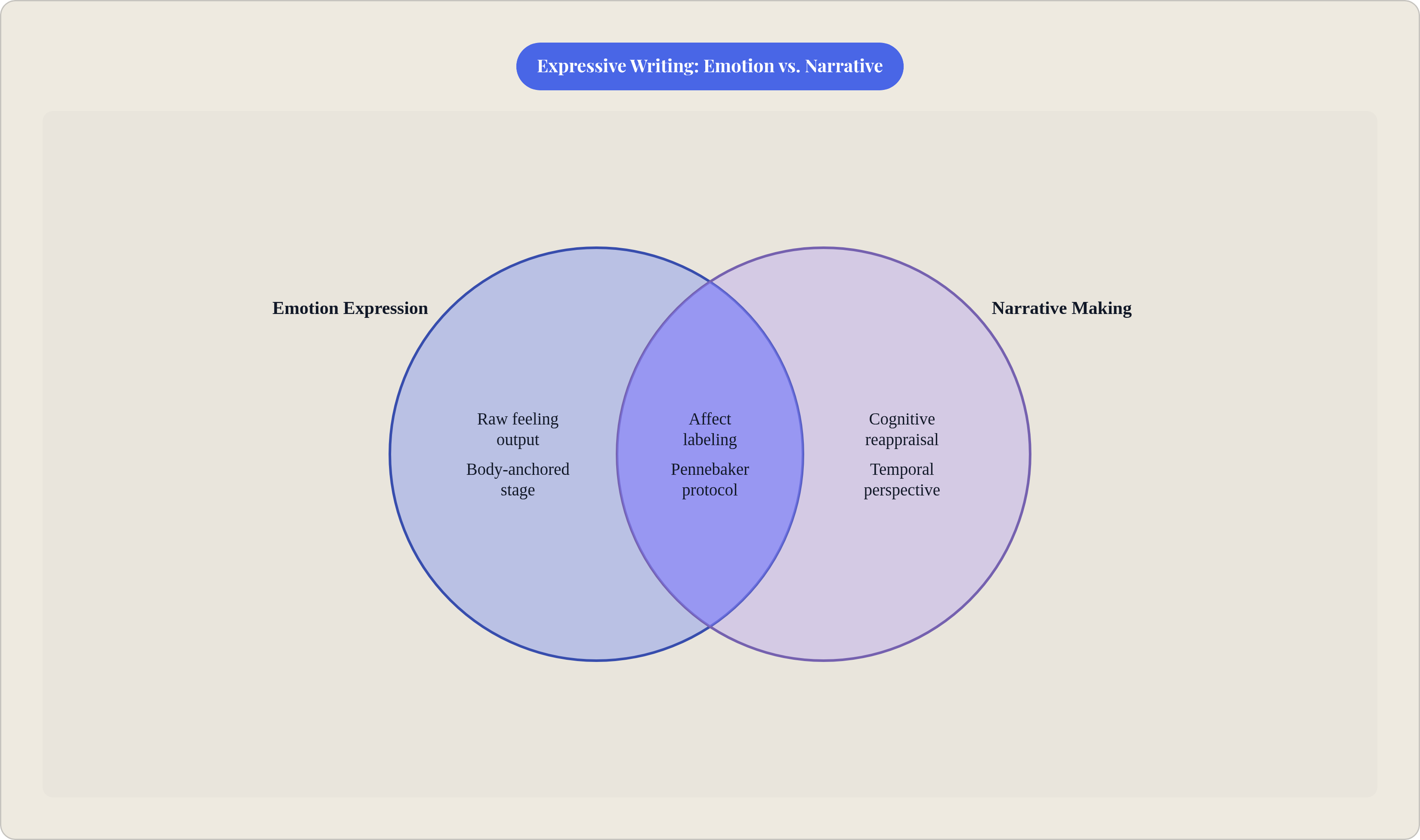
The Three-Stage Sequence That Prompts Should Follow
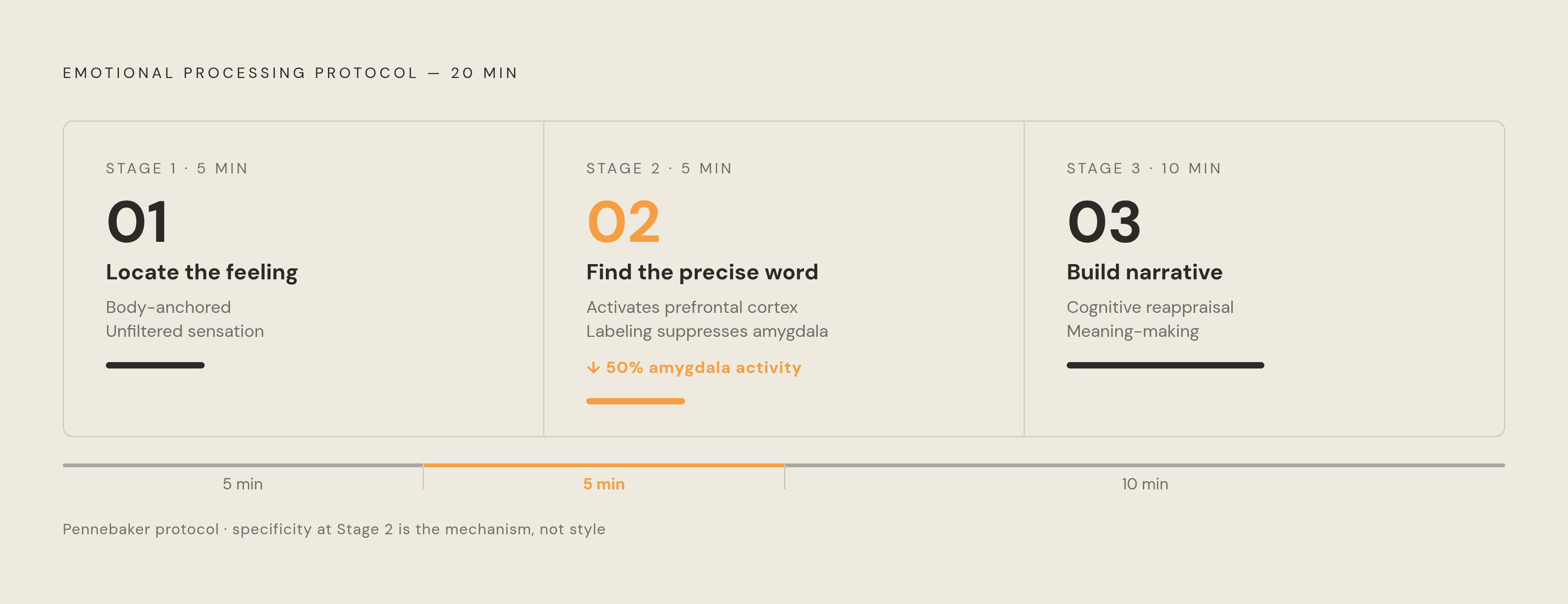
The three-stage arc follows the neurological sequence the research describes, and the sequence is difficult to rearrange in a way that most journaling frameworks don't acknowledge.
Stage 1 locates the emotion before attempting to name it. The body registers feeling before language does, and Stage 1 respects that order. Stage 2 moves from vague acknowledgment to the most accurate word available, because specificity is what activates the affect-labeling mechanism Matthew Lieberman's fMRI research identified: naming an emotion precisely engages the prefrontal cortex and reduces amygdala activity by up to 50 percent. Stage 3 constructs a narrative, practicing what researchers call cognitive reappraisal, which is less about finding a silver lining and more about building a more complete account of what happened.
Why does the order matter so much? Skipping Stage 2 and jumping to meaning-making produces intellectualization masquerading as processing. The writer explains the emotion without ever naming it precisely, and the prefrontal cortex is doing linguistic gymnastics while the amygdala is still running things. Skipping Stage 3 and stopping at labeling produces accurate articulation without resolution. Both truncated versions have real value; neither delivers the full regulatory benefit.
Emotional differentiation, the ability to distinguish between closely related emotional states, is a trainable skill, and writing practice is one of the documented ways people develop it. The sequence below is designed with that training in mind, not just for in-the-moment relief.
Stage 1 Prompts: Getting the Feeling onto the Page Without Editing It
The only job at Stage 1 is to produce raw material. No insight required, no coherence, no grammar. Avoid "why" questions entirely here. Why questions trigger self-justification before the feeling has been located; they push the writer into explanation before description, which short-circuits the whole enterprise.
Design principle: open, permissive, body-anchored.
Sample prompts:
- "Right now, my body feels . If this feeling had a color, texture, or temperature, it would be ."
- "Something happened recently that I haven't fully sat with yet. Here's what I remember about it:"
- "Without editing or explaining, what is actually going on for me today?"
- "If I could say anything to anyone right now without consequence, it would be:"
Stream-of-consciousness is appropriate here. Contradictions are fine. Incomplete sentences are fine. The goal is authentic representation of what is present, not coherent narrative.
Keep a time boundary: five to ten minutes maximum. Longer unstructured venting risks the emotion-rehearsal trap Pennebaker's own caveats flagged. Good Stage 1 output looks like a mess, which is exactly what success looks like at this stage.
Stage 2 Prompts: Finding the Precise Word for What the Feeling Actually Is
This is the stage most people skip, and it is doing the heaviest neurological lifting.
Design principle: force a choice, require a word, push past the first answer. Vague words like "bad," "stressed," and "fine" are nearly wrong at Stage 2. The prompts should make that visible without making the writer feel embarrassed for starting there, because most people start there.
Consider a writer who sits down after a difficult meeting and types "I feel bad." That's the emotional equivalent of saying "something happened." It's technically true and completely uninformative. She stares at the word, adds another sentence, and stares again. What she actually feels — once Stage 2 prompts her toward it — is "undermined": a specific flavor of bad with a specific source and a specific set of implications. That word opens a door the word "bad" keeps shut.
Sample prompts:
- "The closest single word for what I'm feeling is . But if I'm more honest, it's closer to ."
- "Is this feeling about something that happened, something I'm afraid will happen, or something I believe about myself? Which one fits best?"
- "What am I actually feeling underneath the frustration, anger, or numbness?"
- "On a spectrum from 'mildly unsettled' to 'overwhelmed,' where am I, and what puts me there?"
The question "why do I feel this way?" fails at Stage 2 because it skips labeling and jumps directly to explanation, which is a cognitive defense dressed up as introspection. Fix the label first; the investigation comes later.
For anxiety specifically: anxiety is future-oriented by nature, and Stage 2 prompts for it should name the specific threat the brain is simulating, not just the general feeling of unease. "Anxious," "dread," "apprehension," and "foreboding" are not synonyms. Each implies a different cognitive frame and opens a different path forward. That's not semantic pedantry; it is the precision the affect-labeling mechanism requires to do anything useful.
Consulting an emotion wheel or vocabulary list at this stage is not a crutch. It is a precision tool, the same way a thesaurus is a precision tool for a writer trying to find the word that is actually right rather than merely close.
Stage 3 Prompts: Building a Narrative That Makes the Emotion Legible
Stage 3 is not about forced resolution. It is not silver-lining extraction. It is not explaining the emotion away. It is the construction of a more complete story, one that includes the feeling rather than dismisses it. The goal is not to blast the emotion out of existence but to give it a channel, which is a meaningfully different project.
The cognitive word shift that signals Stage 3 is working is easy to spot in re-reading: "realize," "think," "consider," "because," "reason." When those words appear in an entry, meaning-making is happening. The prefrontal cortex is online.
Sample prompts:
- "What story am I telling myself about this situation? Is there another version that is equally true?"
- "What would I tell a close friend who came to me feeling exactly this way?"
- "What does this feeling tell me about what I value or need right now?"
- "Looking at this from a year out, what do I understand about this moment that I can't see yet?"
- "What is one thing I can do, not to fix this, but to take care of myself while it's unresolved?"
The temporal perspective prompt draws on research into how time horizon affects emotional reactivity. Situating a feeling as a moment in a longer arc rather than a permanent condition is not denial; it is accurate. Most acute emotional events are not permanent states, and the prompt helps the writer's cognition catch up to that fact.
One underused Stage 3 variant: the unsent letter. Writing to a person or situation as if they will never read it shifts perspective without requiring any real-world confrontation. It reduces the emotional charge around conflict in a way direct processing sometimes fails to, because the writer isn't simultaneously managing anticipated reactions. The letter is purely for the writer, which is exactly the condition Stage 3 requires.
How to Sequence These Prompts Across a Single Session
The recommended session structure:
- 5 minutes: Stage 1, unfiltered, body-anchored, no editing
- 5 minutes: Stage 2, labeling, refining, finding the precise word
- 10 minutes: Stage 3, narrative, reappraisal, meaning-making
Total: 20 minutes. Consistent with Pennebaker's original protocol. Research also shows that even two-minute sessions spread across days produce measurable health benefits, so the floor for "enough" is lower than most people assume.
The session should not feel like therapy homework. It has a clear beginning, middle, and end; a job that takes 20 minutes and is finished.
When to use the full sequence versus a single stage: for acute emotional events, recurring patterns, conflict, or loss, use all three. For daily check-ins, Stage 2 alone trains granularity over time. When the feeling is already named and the need is to move forward, Stage 3 alone is sufficient. These aren't rigid rules; they're calibrations based on what the moment actually requires.
One structural note on motivation: purpose-driven sessions, those with a clear sequential job to do, engage the brain's reward circuitry differently than open-ended ones. Giving the session a defined arc is not just a processing preference; it matters for sustainability. Anyone who has started a journaling habit and abandoned it by week three knows this already, though they probably blamed their own discipline rather than the design of the practice.
Whether You Handwrite or Type Changes What Stage 2 Actually Produces
A 2024 high-density EEG study by Van Der Weel and Van Der Meer found that handwriting generates stronger neural connectivity patterns than typing, engaging more than 25 distinct brain regions simultaneously. The implications for Stage 2 are specific: handwriting's slower pace tends to force lexical selection in a way typing does not. You cannot write every word as fast as you think it, so you must choose. That choosing is the practice.
But what if the argument cuts the other way? Digital journaling enables faster capture of raw feeling at Stage 1, before it dissipates. It also enables searchable archives, which is genuinely useful for Stage 3 pattern recognition across months or years of entries. Neither advantage is trivial.
The practical synthesis: handwriting is the stronger medium for Stages 2 and 3, where deliberation is doing the work. Digital tools reduce friction at Stage 1 and extend Stage 3 through searchability. Using both strategically is not indecision; it is matching the medium to the cognitive demand of each stage.
One clarification worth making explicit: per Ihara and colleagues' 2021 research, the neurological benefits of handwriting hold whether writing on paper or digitally with a stylus. The key variable is the pen, not the substrate. Useful news for anyone already invested in a tablet workflow.
The medium is not the practice. A writer who types consistently is running the affect-labeling mechanism. A writer who handwrites only occasionally is trading consistency for a marginally better instrument. Consistency enables the training effect; the tool matters only at the edges.
Building the Habit So the Sequence Becomes Automatic
The core obstacle to consistent emotional journaling is not motivation. It is structure. Without structure, emotional journaling collapses into one of two things: avoidance (the blank page that feels impossibly large) or rumination (the venting loop that feels like progress but isn't). The three-stage sequence addresses both by converting an ambiguous task into a defined one.
Prompts eliminate decision fatigue. The mental energy goes to the writing, not to figuring out how to start. That reduction in activation cost is why prompted journaling tends to outperform blank-page journaling for most people over time, not because the prompts are magic but because they remove the friction that defeats the habit before it begins.
Minimum viable practice: Stage 2 alone, one precise emotion label per day, is enough to begin training emotional granularity. The bar for entry does not have to be the full 20-minute protocol. Starting with a single sentence that identifies a precise feeling is a legitimate starting point, and probably a more honest one than planning a 20-minute session you'll skip on a Tuesday.
Habit anchoring works better than scheduling. Attaching the session to an existing routine, morning coffee, evening wind-down, the commute home, reduces activation cost further. The trigger already exists; the practice attaches to it.
After two to three weeks, re-reading early entries reveals something that functions as its own motivation: the shift from vague to precise language becomes visible on the page. "I was upset" becomes "I was ashamed, specifically because I felt I'd failed someone who trusted me." That shift is evidence the affect-labeling mechanism is taking hold. Seeing it in your own handwriting, or your own typed words, is more persuasive than any research citation.
When the sequence feels forced, Stage 1 is often the right re-entry point. Return to raw description before attempting to name or reframe. The sequence is designed to move forward, but it also works as a reset, and knowing that makes it considerably less precious.
The journal has a specific job here: emotional processing through structured labeling. That specificity is what makes it sustainable. Vague habits built on vague intentions are the ones people quietly drop. A practice with a defined mechanism, a clear arc, and observable output is a different kind of commitment. It also happens to be what the neuroscience supports, which is a rare and somewhat satisfying alignment.