Journaling Prompts for Anxiety and Overthinking
Writing interrupts anxiety loops by forcing the brain to externalize and organize chaotic thoughts.

To understand why writing works, you have to look at what it actually changes about the brain's task.
Pure rumination is internally recursive. The same content cycles through the same pathways, generating affect without resolution, burning cognitive resources without producing output. Writing forces a structural interruption: it requires the brain to serialize thoughts into language and project that language outward onto a surface. You stop being a participant in the loop and become, however briefly, an observer of it. That shift is not metaphorical. It is mechanical.
The neural correlates matter here. Writing activates language centers and prefrontal regulatory circuitry, pulling activation away from the threat-detection circuits that keep the loop running. This is the neuroscientific basis for Dan Siegel's "name it to tame it": labeling an emotion in explicit language reduces its felt intensity, giving the prefrontal cortex something concrete to work with rather than a diffuse threat state to react to. The brain, given an object, behaves differently than the brain given a fog.
James Pennebaker's research established that writing about emotional experiences for as little as 15 minutes per day across four consecutive days produces measurable reductions in anxiety that persist months later. That is a modest investment for a non-trivial effect.
But there is a caveat worth registering early. A 2022 systematic review in Family Medicine and Community Health found that journaling reduced anxiety symptoms by an average of 9% across studies, with structured techniques producing the largest effects. Structured, specifically, outperformed unguided. Everything that follows is essentially an attempt to understand why.
Anxiety itself deserves a precise definition before going further, because most people underestimate what they are actually dealing with. Rumination, as Susan Nolen-Hoeksema and later Ed Watkins established, is a closed loop that mimics reflection while achieving none of it. Michel Dugas and colleagues identified in 1998 that the loop is driven by intolerance of uncertainty: the mind keeps cycling because it believes more thinking will eventually produce certainty. It won't. The cycling intensifies the very intolerance fueling it. Structurally, this looks like fronto-cortical hyper-activation, the executive brain working overtime on a threat it cannot localize, while regulatory connections between the amygdala and anterior cingulate cortex are simultaneously weakened. The brain in a rumination loop is not malfunctioning. It is doing exactly what executive circuitry is designed to do, just on the wrong problem, with no external input to redirect it. That last phrase is where writing enters.
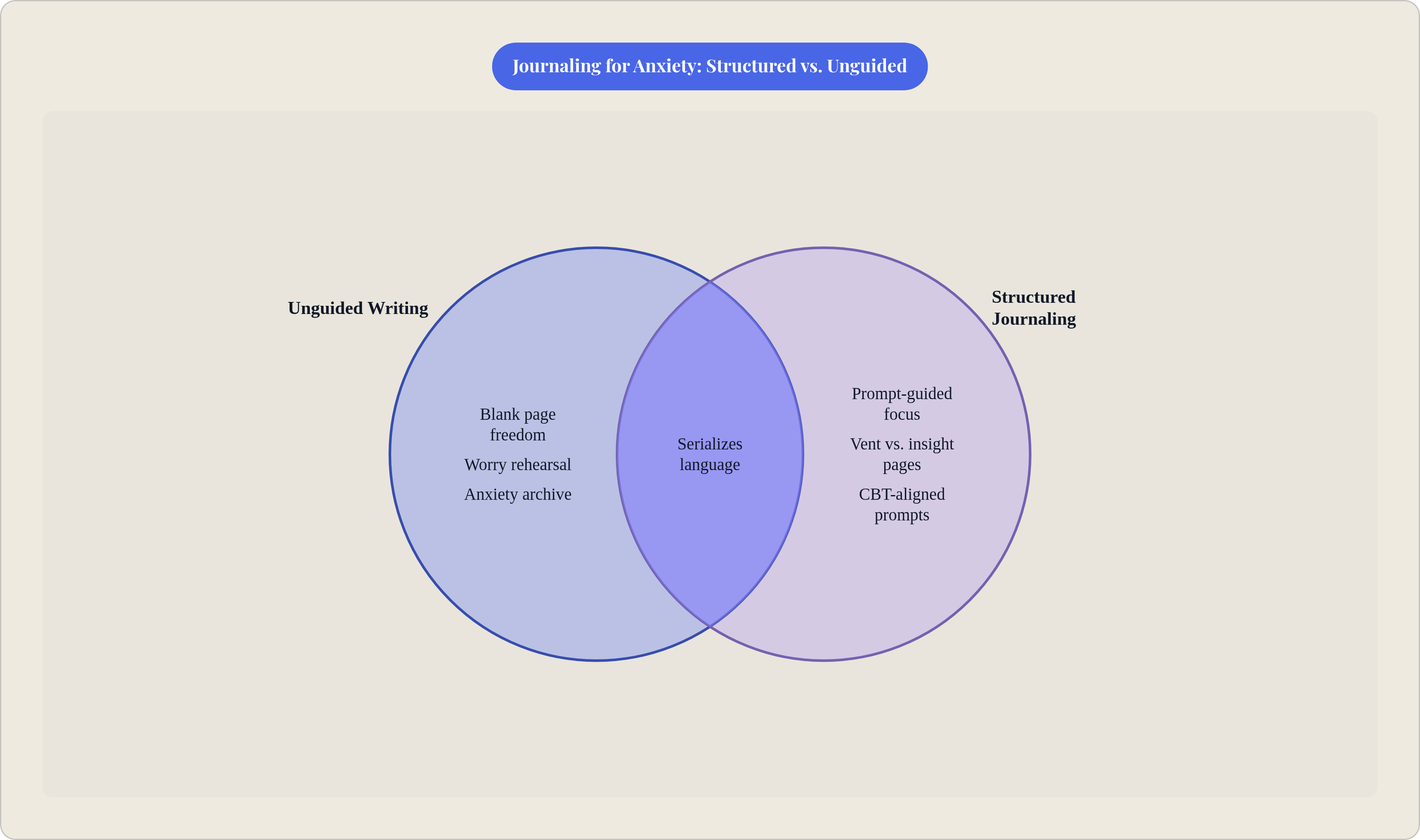
Why unguided free-writing often makes anxiety worse, not better
The blank page is neutral. What fills it is not.
Expressive writing, in Pennebaker's sense, moves toward meaning. It processes, contextualizes, eventually arrives somewhere. Rumination on paper, which looks identical from the outside, just spins. The same blank page can produce either outcome, and the difference is almost entirely structural. Intent doesn't determine the result; the presence or absence of a guiding constraint does.
Most people who open a journal while anxious fully intend to feel better. But without a prompt, the anxious mind does what anxious minds do: it fills available space with more anxiety. Pages of unstructured worry rehearsal don't release the spiral; they deepen it, while generating the false comfort that something productive is happening because words are appearing. I've done this. It is worse than not writing at all.
Timing compounds the problem. Engaging the anxiety system heavily in the hours before sleep is a reliable path to insomnia. Naming and examining belong earlier in the day, when regulatory capacity is intact. Evening sessions, if they happen, should default to grounding and redirecting.
One useful practical distinction: vent pages versus insight pages. A vent page is raw output, the unedited brain-dump that functions as release. Write it and, if useful, physically destroy it. The destruction is not theater; it signals closure. An insight page looks for patterns, tracks what was true across sessions, and is worth keeping. Treating these as separate documents is a small but meaningful intervention in whether the journal becomes a regulation tool or an anxiety archive.
Structured prompts work because they act like a track. The anxious mind, given a specific question to answer, has somewhere to go. Without a question, it has unlimited runway. And an anxious mind with unlimited runway is just a worry with a word count.
Prompts that name the anxiety: getting vague dread onto the page as something specific
Vague fears are neurologically scarier than named ones. Specificity is the first act of regulation, not a warm-up to it.
Thomas Borkovec's cognitive model of worry identified something counterintuitive here: the mind stays abstract on purpose. Abstraction lets it avoid the felt emotional experience underneath the loop. If the worry never gets specific, the brain never has to confront the actual fear; it can keep processing at the level of "everything will go wrong" indefinitely. Naming collapses that evasion.
The prompts in this cluster are not trying to fix anything. They are only trying to get something concrete on the page.
"What specifically am I anxious about right now?" Not "everything." Not "work, generally." Break it into a discrete object: a specific email, a particular conversation, one decision. Singular and concrete.
"What emotion am I feeling, and where do I feel it in my body?" Body-location prompts move attention from abstract cognition to physical sensation, grounding the brain in the present moment rather than the feared future. The somatic signal is a present-tense anchor, not a metaphor.
"What is this worry actually about beneath the surface reaction?" The presenting anxiety is frequently not the real one. The worry about being late to a meeting is sometimes a worry about being seen as unreliable. The worry about a medical appointment is sometimes a worry about loss of control. This prompt asks the brain to take one step down.
"If I had to give this feeling a name, what would it be?" Not a clinical category. An adjective, a proper noun, a character. Whatever externalizes it.
One is tempted to dismiss these prompts as too simple. But that's exactly the point. The anxious brain doesn't need more complexity; it needs a more tractable problem. "What, specifically?" is solvable. "Why does everything feel wrong?" is not.
What this cluster is not: it is not asking you to evaluate, reframe, or resolve. Skipping naming and jumping to solutions is the most common reason journaling attempts fail. The problem has to be fully on the page before you can do anything useful with it.
Prompts that externalize the anxiety: getting it outside the skull and onto a surface you can look at
What is on paper cannot simultaneously loop in the head with the same intensity. Writing offloads content into the world, reducing the cognitive burden of holding it internally. The brain is no longer the only container.
"Write out every thought currently cycling in your head, without editing." All of it. The repetitive ones especially. This is the brain-dump, and its value is not in what it produces but in what it empties.
"What's the decision I'm avoiding by continuing to think about this?" This one lands harder than it sounds. Rumination frequently functions as avoidance of a decision that feels costly or uncertain. Naming the avoided decision exposes the function the loop is actually serving.
"If this worry were a character speaking to me, what would it say, and what does it want?" Personification creates distance. The anxiety is no longer you; it is something you are observing. This is metacognition in practice: thinking about the thinking rather than thinking inside it.
"What would I tell a friend who came to me with exactly this worry?" This one works differently for different people, and it's worth being direct about that. Self-compassion research consistently shows people regulate more effectively when they address their own situation from a third-person perspective. A 2025 paper in the International Journal of Social Impact, mapping Big Five personality dimensions to overthinking patterns, found that people-pleasers, whose anxiety is relational and other-directed, respond particularly well to this reframe. For them, giving counsel to an imagined friend is not hypothetical; it is practicing the exact form of thinking they are already good at.
It is also worth considering the CBT technique of scheduled worry time here. The protocol designates a specific 20 to 30 minute window for worry and instructs the person to postpone all other worry thoughts to that window. The journaling session becomes that container. The prompts become the boundary. Anxiety gets its appointment, and the rest of the day gets its air back.
Prompts that examine the anxiety: testing the loop's claims against evidence
The loop makes claims. It says this will probably go wrong. It says that person is angry with you. It says the situation is as bad as it feels. These claims arrive with great confidence and are rarely interrogated.
CBT's thought record structure formalizes the examination: situation, emotion, automatic thought, evidence for, evidence against, balanced thought. Journaling prompts can operationalize this sequence without requiring a therapist in the room.
"What evidence supports this worry, and what evidence contradicts it?" Not "is this rational?" That question invites defensiveness. Evidence is concrete, and concrete is workable.
"What's the most realistic outcome, as opposed to the worst-case one?" The brain in a threat state defaults to worst-case as preparation. Asking explicitly for the realistic case forces a different calculation.
"Has this type of worry been accurate before? What actually happened?" This is the historical audit, and it is frequently humbling. Most anxiety loops have a track record. The track record is usually more reassuring than the current loop admits.
"What am I assuming about what other people are thinking or feeling, and do I actually know that?" This prompt addresses a specific and under-examined domain: relationship overthinking, where most of the anxiety is projection. The mind constructs another person's inner state and then responds to that construction as though it were confirmed. Writing the assumption out explicitly and then asking whether it is actually evidenced interrupts the projection before it compounds.
But these prompts require something from the writer: the anxiety must already be externalized before they are useful. Jumping straight to "is this rational?" while still inside the loop produces defensiveness, rationalization, and often more looping. Sequence matters. Examination comes after externalization, not instead of it.
For readers who want a packaged framework, the CATCH method, standing for Capture, Appoint, Think, Challenge, Harvest, sequences this as a daily practice that takes roughly three to five minutes. It is a useful scaffold for anyone who finds open prompts too unstructured to start with.
Prompts that redirect the anxiety: moving from what's looping to what's actually actionable
The goal here is not to eliminate anxiety. It is to restore the sense that movement is possible.
"What part of this is within my control, and what part isn't?" The explicit control/no-control split is particularly important for anxiety driven by intolerance of uncertainty, the core mechanism identified earlier. Writing it out breaks the illusion that more thinking will produce more control over the uncontrollable part. It doesn't argue with the anxiety; it just redraws the map.
"What's one concrete thing I could do today that would make this situation even slightly better?" Not solve it. Slightly better. The prompt is calibrated deliberately. "Solve it" is often impossible, which is why the loop exists. "Slightly better" almost always has an answer.
"What would it look like to accept the uncertain part rather than solve it?" This is harder. Acceptance-based prompts work best when the examining work has already been done; they land as resignation when the anxiety is still unnamed. But for a loop that is about irreducible uncertainty, this question is often the most important one in the session.
"What do I need right now: information, action, rest, or to let this go?" The answer is sometimes just to let it go. Writing that down is more useful than it sounds.
Gratitude and "what went well" prompts belong at this stage, not as a separate wellness practice but as the natural closing gesture of a redirecting session. Research has found that two weeks of gratitude journaling can increase happiness for up to six months. The timing matters, though: this kind of closing is well-suited for evening, when heavier examination work is contraindicated anyway.
How to build a session that moves through all four stages without spiraling
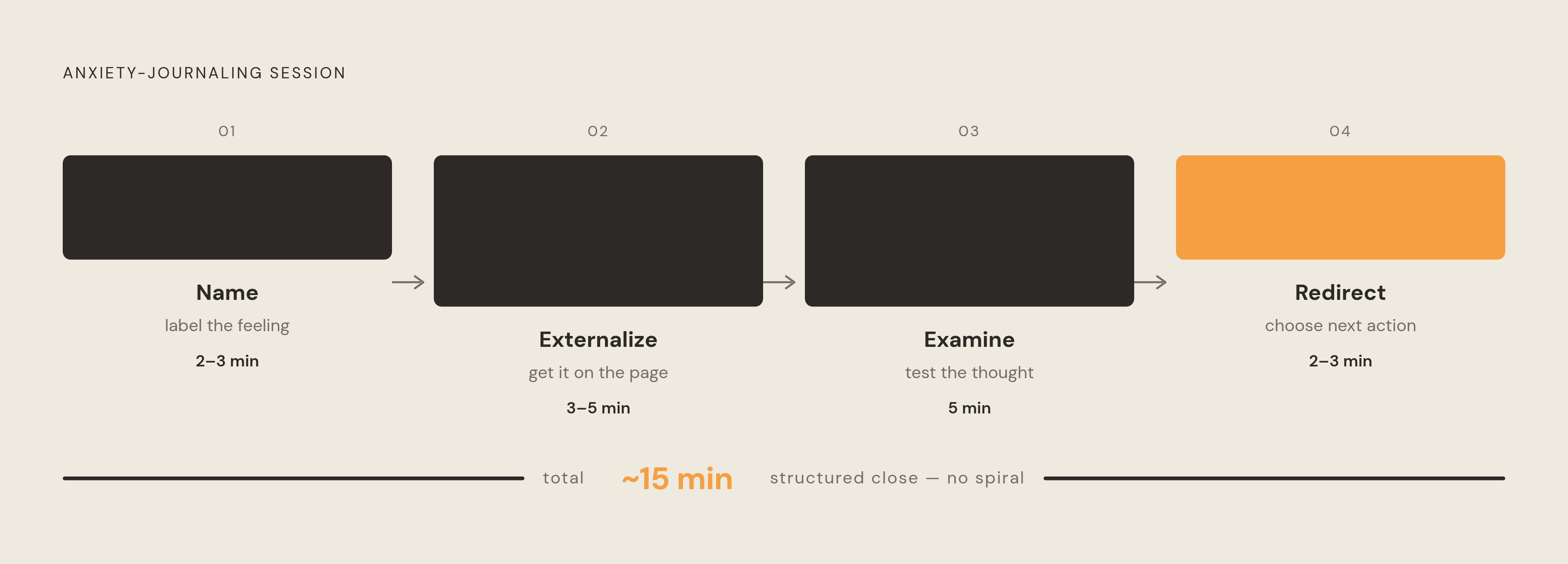
A complete session does not require the time commitment most people imagine. Pennebaker's effects emerged from 15 to 20 minutes. Each stage can be brief if the prompts are specific.
The arc: two to three minutes on naming, one prompt only, just get the concrete object onto the page. Three to five minutes on externalizing, either a brain-dump or a structured worry write; use a vent page if needed, and write and destroy if the content is raw. Five minutes on examining, one or two CBT-aligned prompts that test the worry's claims. Two to three minutes on redirecting, one action or acceptance prompt, close with something grounding.
Fifteen minutes, with a natural stopping point built in. That stopping point matters more than any individual prompt. Open-ended sessions are precisely where spiraling happens; the session needs an off-ramp, not an invitation to keep going.
Timing: heavier anxiety work belongs earlier in the day when regulatory capacity is intact. Evening sessions should skip directly to redirecting and gratitude, treating the examining prompts as off-limits after a certain hour.
Prompt selection within each stage is not one-size-fits-all. A 2025 paper by Rathore in the International Journal of Social Impact found that perfectionist overthinking styles respond best to examining prompts, specifically the reality-testing and historical-accuracy questions. Anxious brooders benefit most from externalizing work. People-pleasers respond most readily to the friend prompt. None of this requires a personality assessment; a few sessions of noticing which prompts move the needle and which produce more loops is sufficient calibration.
Whether to write by hand or screen for anxiety work
The neuroscience case for handwriting is interesting, and not just as received wisdom. A 2024 study at the Norwegian University of Science and Technology using high-density EEG found that handwriting produced substantially more elaborate neural connectivity than typing, particularly in regions involved in memory formation and deeper cognitive processing. The slower pace of handwriting is not a limitation; it is the mechanism. Deliberate engagement with each word is exactly what examining and redirecting prompts require, and speed works against depth here.
But the case for digital is not trivial. A phone is always available. Digital is searchable across sessions. Keeping insight pages separate from vent pages is easier to manage in an app than in a physical notebook. For people who type faster than they write by hand, the friction of longhand can become an obstacle to starting at all, and not starting is worse than any medium question.
The practical answer, at least the one I've landed on, is a hybrid: handwriting for naming and externalizing, where slower and more embodied processing is an asset and where vent pages can be physically destroyed, and digital for insight pages and pattern-tracking across time.
One thing that matters more than the device: the environment. An anxiety journaling session interrupted by notifications and app badges is a compromised session. A distraction-free writing environment is a structural requirement, not a preference. Whether a lined notebook and a timer does the job, the point stands: the environment shapes the session before a single word is written.
The medium is a secondary question. The primary one is whether the session has a structure, a sequence, and a stopping point. What the research supports is that the anxious brain does not need a blank page. It needs a track.