Journal Prompts for Mental Health Check-Ins
Research shows writing about your feelings quiets anxiety while organizing your thoughts.

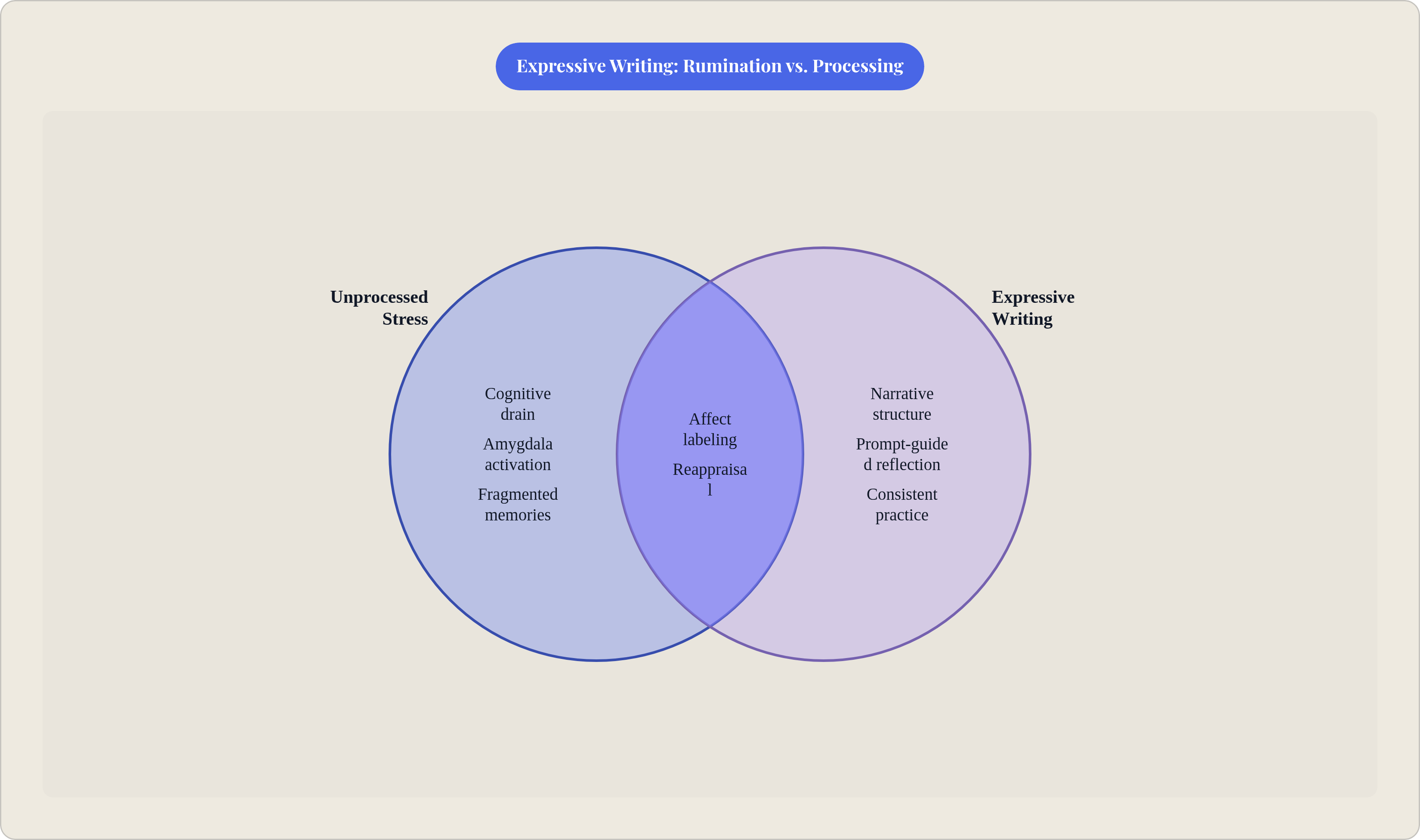
James Pennebaker spent decades running people through expressive writing studies, and the pooled effect size across more than a hundred of them lands at.16 (Cohen's d) on health outcomes. Sit with that number for a second instead of dressing it up:.16 is a nudge, but the nudge shows up again and again across wildly different populations, conditions, and countries. Consistency is the finding here, more than magnitude.
So what's happening physiologically? Writing about something distressing seems to quiet the amygdala while activating the prefrontal cortex, the part of your brain that plans and regulates rather than just clangs the alarm bell. You're rerouting activity from the reactive circuit to the organizing one. There's a related idea out of Michigan State, where researchers found that worrying consumes cognitive resources even when you're not actively dwelling on it. You don't have to be actively spiraling about something for it to cost you; it just sits there, taking up cognitive space you'd rather use for your actual job or an actual conversation. Write it down, and you get some of that memory back.
There's a narrative piece too. Bad experiences that don't get processed tend to sit around as fragments: a smell, a sentence someone said in passing, a knot in your stomach that shows up every Tuesday for reasons you can't name. Writing forces sequence onto those fragments, a beginning, a middle, something resembling an end. That's a fundamentally different object for your brain to hold than a loose bag of triggers.
Here's the part nobody puts on the brochure: expressive writing can make you feel worse before it makes you feel better. It happens often enough in the research that it deserves saying plainly, because otherwise people write one entry, feel a little wrecked, and conclude the exercise broke something. Discomfort that spikes and then recedes is the documented pattern, and the people who benefit most, per the research, are the ones who actually engage rather than perform engagement, filling in blanks because a page told them to. That's the design test for every prompt below: does it ask you to show up, or just to comply?
Prompts for naming what you're feeling when you can't find the words
Affect labeling, just naming an emotion out loud or on paper, is one of the sturdier techniques in the field for making a feeling workable. Feels almost too simple to count as an intervention, but it's one of the sturdier findings in this whole field, and you can't work through a feeling you haven't identified yet, which is why this category goes first. Everything else in this piece depends on it working.
This is for the day you sit down feeling "off" and that's genuinely the most specific word you've got. The prompts below stay physical and loose on purpose; analysis comes later, if it comes at all today.
- "If this feeling had a color, a texture, and a weight, what would they be?"
- "Where in my body am I holding tension right now, and what's that tension trying to say?"
- "What emotion am I most reluctant to admit is actually here today?"
- "If today got a weather forecast, what would it say?"
- "What's the feeling under the feeling? What's the first one a cover story for?"
Treat these like invitations, not depositions. If a prompt starts to feel like cross-examination, the tone is off even when the words are technically right.
Prompts for mapping anxiety: separating the fear from the facts
Anxiety runs on vagueness. It loops because the thought never gets pinned down long enough to actually look at; it just keeps circling, picking up intensity each pass. Writing the specific fear down drags it out of rumination, which is diffuse and automatic, and into examination, which is deliberate and actually uses the parts of your brain that can do something with information.
This category borrows its shape from cognitive behavioral therapy: name the triggering thought, then test it. What's the evidence for it, and what's the evidence against it? What's a reading of the situation that's proportionate instead of catastrophic? Most anxious thoughts run on a small rotation of distortions, catastrophizing, all-or-nothing framing, assuming you know exactly what other people are thinking about you, and just naming the distortion out loud tends to loosen its grip a little.
- "What exactly am I afraid will happen? One specific sentence, no vague dread allowed."
- "What's the most realistic outcome here, not the best case, not the worst case?"
- "What would I tell a friend who brought me this exact worry?"
- "What part of this is actually within my control? Can I write two separate lists, one for what is, one for what isn't?"
- "Has a version of this fear come true before? What actually happened when it did?"
Worth saying again since it applies doubly here: writing about anxiety can spike it briefly before it eases. If your chest tightens partway through, that's usually a sign you're in the middle of the exercise doing its work.
Prompts for processing stress you haven't been able to put down
Stress that never gets voiced doesn't just evaporate on its own. It gets stored somewhere and keeps cycling through the body regardless of whether you've technically "solved" the problem underneath it. This category is a container for whatever you've been hauling around without ever setting it down.
Pennebaker's work points specifically at secrecy and suppression as physiologically expensive; writing about something you've kept unspoken lowers that cost even when nothing about the actual situation changes one bit. The prompts here don't need to be clever. Their whole job is giving you permission to stop holding the door shut.
- "What have I been carrying this week that I haven't said out loud to anyone?"
- "What's draining me most right now that I keep waving off as 'not a big deal'?"
- "If I were allowed to complain completely freely for five minutes, what would I say?"
- "What part of my current situation am I pretending is fine when it really isn't?"
- "What do I need right now that I haven't asked for, or given myself?"
Notice how different this feels from the anxiety set above. Those asked you to test a thought against evidence; these ask you to say the true thing.
Prompts for reframing: shifting a stuck story without dismissing it
Reappraisal gets a bad reputation because people confuse it with denial. Reframing asks whether the story you're currently telling about a hard thing is the only version available, or just the loudest one, all while leaving room for the hard thing to have genuinely been hard. A 2025 scoping review of digital mental health tools found cognitive reappraisal among the strongest predictors of long-term improvement from reflective practice, which is a surprisingly strong endorsement for something that sounds like a soft skill you'd find in a corporate training deck.
Here's the risk worth naming directly: reframing slides into toxic positivity fast when it's used to skip past pain instead of widening the view around it. "Everything happens for a reason" dismisses whatever you were actually feeling. The prompts below try to open the door wider.
Time perspective matters more than people expect. A couple of the prompts below deliberately yank your vantage point five years down the road just to see what today looks like from up there.
- "What is this situation teaching me that I wouldn't have learned any other way?"
- "How might I think about this moment five years from now?"
- "What's a version of this story that's harder on me than the facts actually require?"
- "Where am I really the protagonist, and where might I have more agency than I'm giving myself credit for?"
- "What would a wiser version of me, one who already got through this, say right now?"
These land a lot better after you've already run the naming and release prompts above them. Reframing at someone who hasn't been heard yet just feels like being talked over.
Prompts for a low-energy day when the goal is just to check in, not excavate
Some days, the honest goal is showing up. Pennebaker's own protocol guidance leans on consistency over intensity: a short, honest entry on a bad day beats a skipped day, every time, and the broader research on habit formation agrees that frequency does more of the work than duration ever does.
This category lowers the bar on purpose, short, concrete, finishable in under two minutes if that's genuinely all today has in it.
- "Three words for how I feel right now, no explanation required."
- "One thing that was hard today. One thing that wasn't."
- "What do I need most in the next 24 hours?"
- "Rate today 1 to 10, one sentence on why."
- "What's the one thing I want to remember about today, even if today was rough?"
If you're depleted enough to have scrolled straight to this section, that's accurate information about where you are right now, and this is the right tool for it.
Prompts for reconnecting with what you actually value when you feel lost or flat
Chronic stress and low mood have a narrowing effect on attention; the whole world shrinks down to the next task, the next deadline, the next fire that needs putting out. This category tries to widen the aperture back out, to reconnect you with the longer arc of who you're actually trying to be.
Acceptance and Commitment Therapy offers a useful pivot here: alongside asking how to reduce the pain, it asks what you're building toward despite it. That shift tends to matter most during grief, big transitions, or the strange flat stretch where nothing feels wrong exactly, but nothing feels like you either.
- "What did I do recently that felt genuinely like me, in line with who I want to be?"
- "What would I regret not trying or saying in the next year?"
- "When do I feel most alive and present? What's usually true in those moments?"
- "What am I tolerating right now that conflicts with something I claim to value?"
- "If I stripped away what I'm supposed to want, what do I actually want?"
These prompts use where you are right now to find a direction, a different exercise from fantasizing about being somewhere else.
How often to use these prompts and what to notice over time
Clinical protocols generally land on three to four sessions a week, 15 to 20 minutes each, as the frequency that produces reliable results. Daily use works too, and it doesn't demand anywhere near that much time; a two-minute check-in on a genuinely rough day still counts. Research on journaling suggests measurable neuroplasticity changes from consistent practice tend to show up somewhere in the four to six week range, which is a useful number to keep in your back pocket on the days it feels like nothing is happening. Nothing visible at week two isn't the same thing as nothing occurring.
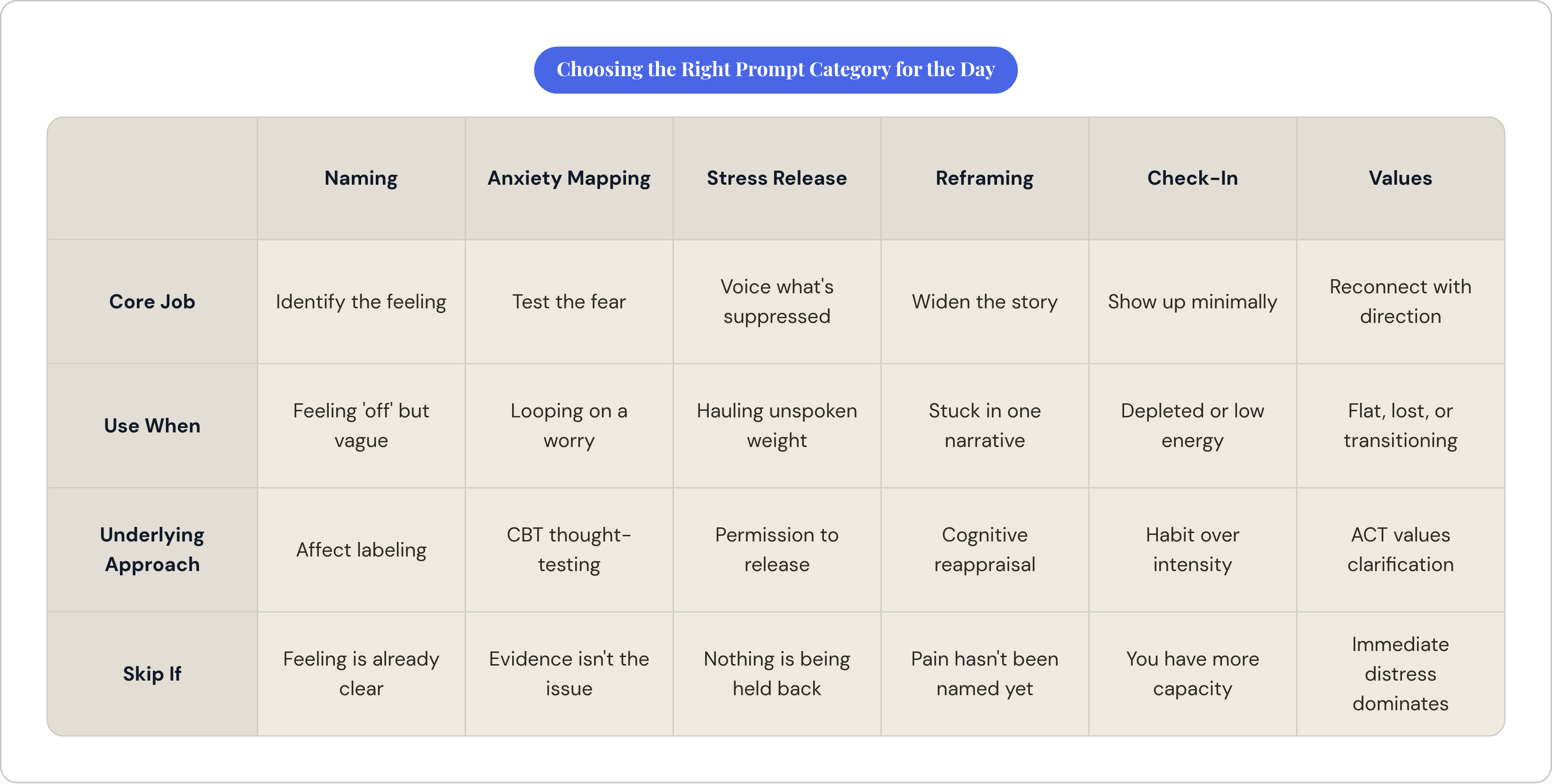
The harder skill, if I'm honest, isn't picking a prompt. It's picking the right category for the day, not by mood label (sad, anxious, tired) but by function: does this moment need a name, a release, an examination, a wider lens, or just an honest checkmark that you showed up at all? That question gets easier with repetition, not easy exactly, just easier.
Across entries over weeks, watch for the same drains showing up again and again, the same relationships or situations getting described in slightly different words each time. And pay attention to which category you keep skipping entirely. Avoidance of a specific prompt type is data in itself; if you never once touch the anxiety-mapping section, that's worth a second look.
One practical note before we close this out. Some people hit a wall with the blank page itself, no matter how good the prompt sitting above it is; the friction is in the typing, not the thinking. Voice journaling apps keep the same prompt-then-response structure but let you talk instead of type, which matters more than it sounds like on exactly the low-energy days this piece keeps circling back to.
A prompt is a tool, and no version of this practice expects you to arrive with the correct answer already loaded. The right prompt for any given day is just whichever one matches the actual job that day has for you, and figuring out which job that is gets a little easier every time you sit down and ask.