Journal Prompts for Processing Grief and Loss
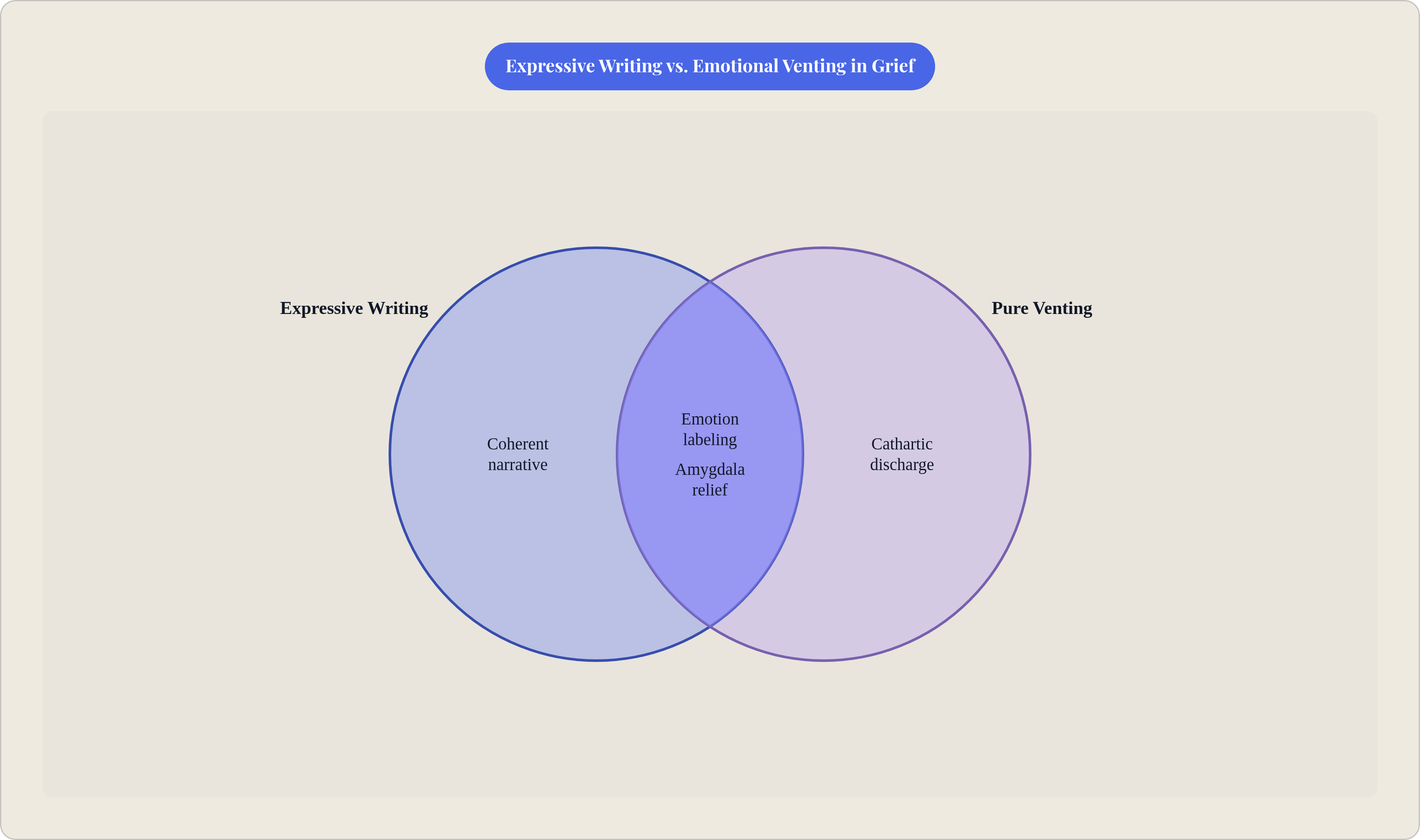
Writing about loss activates the brain's meaning-making capacity more than cathartic venting alone.

James Pennebaker and Sandra Beal's 1986 protocol remains the foundational text, and it is disarmingly simple: write for 15 to 20 minutes across consecutive days about your "deepest thoughts and feelings," without worrying about grammar or completeness. Do not perform. Editing can wait. Just write.
What the subsequent literature supports is real but modest. Reflective writing has been linked to reductions in anxiety, depressive symptoms, and intrusive thoughts. Some studies document lower physiological stress markers and fewer health clinic visits among participants who wrote about emotional experiences. There is MRI evidence showing that labeling an emotion, literally writing "I feel loss" or "I feel anger," reduces amygdala reactivity and increases prefrontal regulation. The brain quiets, measurably, when we name what is happening to it.
But the caveat earns its place. A meta-analysis of 30 randomized controlled trials found no significant effect sizes for somatic or psychological health variables. Smyth's 1998 meta-analysis of 13 studies found an overall effect size of d=0.47: meaningful, solidly medium, not transformative. The research supports a practice, not a cure.
What distinguishes effective expressive writing from ineffective venting is movement. Research by Lumley and Provenzano found that writing about benefits found in adversity produces particularly robust outcomes, while pure cathartic discharge is less effective than writing that moves toward coherent meaning. The goal is not to feel better faster. It is to build, sentence by sentence, a story that can hold the loss without collapsing under it.
The psychological arc grief tends to follow
Kübler-Ross gave us the most widely distributed map of grief. That map was drawn from interviews with the dying, not the bereaved. Its five stages were never designed to function as a checklist for loss, and applying them that way has produced a specific, underappreciated harm: people who are not moving through stages in sequence conclude they are grieving incorrectly.
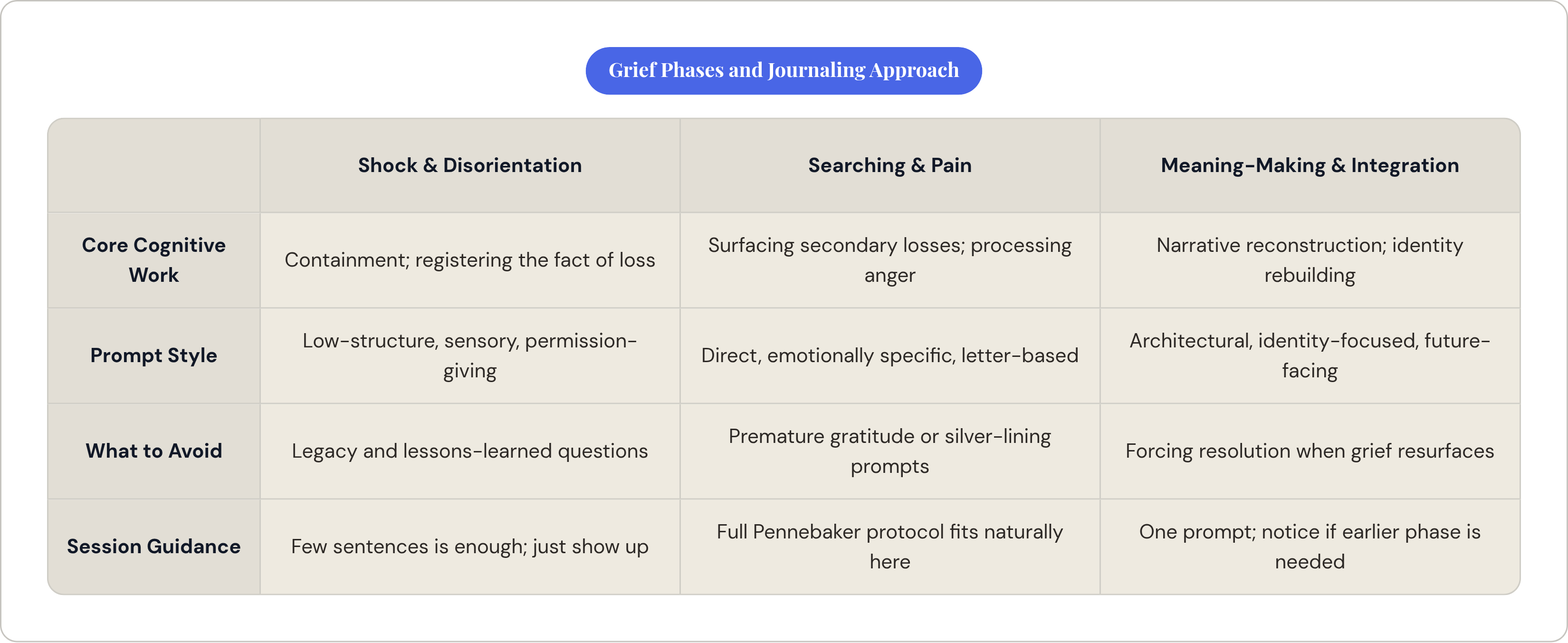
A more useful framework for journaling purposes organizes grief into three broad phases defined by what cognitive and emotional work they actually demand.
The first is shock and disorientation. The loss is cognitively registered but not yet emotionally integrated. Thought is fragmented. Numbness coexists with intrusive images. The nervous system has absorbed information the rest of the self has not yet caught up to.
The second is active searching and pain. The brain, operating according to its own relentless logic, attempts to locate what is no longer there. This is the phase of waves and yearning and unexpected anger, of secondary losses surfacing: who you were in relation to the person, the routine that assumed their presence, the future that now requires wholesale reconstruction.
The third is meaning-making and integration. A 2021 paper in Current Opinion in Psychology frames grief explicitly as a form of learning, the brain updating its predictive model of the world. Psychologist Robert Neimeyer's research demonstrates that individuals who construct a coherent narrative about their loss show significantly better grief outcomes than those who cannot. Story, it turns out, is not just comfort. It is mechanism.
These phases are a compass, not a timetable. People move between them on the same afternoon. The sections that follow are a reference to return to, not a ladder to climb.
Prompts for early grief: when the mind is still catching up
A 2025 review in Brain Science Advances identifies altered activity in the amygdala, hippocampus, and prefrontal cortex during acute grief, the regions governing emotion regulation, memory, and attachment. The brain is, in a literal sense, remapping where the lost person existed in space and time. That process has its own pace, and it does not particularly care about yours.
What early grief needs is not insight. Perspective can wait. Containment comes first: a place to put the overwhelming before anyone asks you to make sense of it.
This is why a prompt like "what did they teach you?" can feel, in acute grief, almost cruel. It is a meaning-making question posed to a brain that has not finished registering the fact of loss. The cognitive infrastructure required to answer it has not been built yet.
Prompts that work in this phase are low-structure, permission-giving, anchored in the immediate and sensory.
Write whatever comes. Don't finish a thought if you can't. This mirrors Pennebaker's core instruction directly. It names the chaos as the content rather than treating it as an obstacle to content.
Describe where you are right now: the room, the light, what you can hear. Sensory grounding before emotional language. The nervous system needs an on-ramp, and the body usually offers one.
What do you keep reaching for that isn't there anymore? This uses the brain's own searching behavior as raw material. It does not demand explanation. It asks only for the noticing.
List what today has felt like. Not what happened. What it felt like. List-making is particularly useful in early grief because it requires naming without requiring narrative. Lowest viable unit of emotional language, and sometimes that is exactly what is available.
Write one thing you don't want to forget right now. Preservation over analysis. Capture, not process.
Keep sessions to 15 to 20 minutes per the research-supported protocol, but in early grief, a few sentences is enough. The point is showing up, not producing.
One thing to avoid at this stage: prompts about legacy, lessons learned, or what the person "would have wanted for you." Asked too early, they produce guilt or shutdown rather than anything useful. Those belong later.
Prompts for the searching phase: sitting with the full weight of loss
The searching phase is where grief reveals its actual dimensions. Most people expect one loss. This phase delivers several.
Alan Wolfelt's framework of secondary losses is useful here, not because it taxonomizes grief neatly, but because it explains why the feeling is so disproportionately large. Beyond the person, grief takes the role identity built around them, the security they provided, the future plans that silently assumed their presence. Multiple losses, stacked, presenting as one.
That raises an important question: if a grieving person does not recognize secondary losses, how do they write about them? They write around them, which produces the frustrating experience of feeling like journaling is not working. The prompts in this phase are designed to surface what is actually there.
What have I lost beyond the person themselves? What else disappeared with them? Many writers find that answering this changes the shape of their grief from overwhelming to, at least, intelligible.
Write about something you are angry about. Don't edit it. Anger in grief is among the most suppressed emotions, and its expression has clear evidential support. The MRI evidence on emotional labeling applies directly: writing "I am furious that" and completing the sentence does measurable neurological work.
What do you wish you had said? What do you wish they had said to you? This opens toward letter-writing, among the best-supported specific approaches in the grief literature. Neimeyer's narrative reconstruction work incorporates letters to the deceased as a primary vehicle for relational continuity.
Describe a memory with as much sensory detail as you can: sight, sound, smell, touch. The intensity of recall in this phase is not pathological. It is the searching behavior itself. Writing through it gives it somewhere to land.
What guilt are you carrying? Is any of it actually yours to carry? The second question is not rhetorical. It is an invitation to examine rather than absorb. The prompt names a cognitive distortion without resolving it prematurely, which is the honest approach.
Write a letter to them. Say whatever you need to say. The continuing bonds framework, which supplanted the older "closure" model, holds that the relationship does not end with death; its nature changes. Letter-writing reflects this truthfully, and it gives the writer a relational form that does not require goodbye.
The full Pennebaker protocol, three to five sessions at 15 to 20 minutes each, fits naturally in this phase. Enough time to go somewhere meaningful without manufacturing false resolution.
Prompts for meaning-making: building a story that holds the loss
Worth stating plainly: meaning-making is not getting over it. It is not the silver lining.
Neimeyer's constructivist framework describes loss as a disruption to the "assumptive world," the inner architecture of meaning through which we organize our lives. Meaning-making is reconstruction. It does not erase the loss; it builds around it. The distinction matters because too many people arrive at this phase expecting to feel resolved and instead feel confused when they don't.
A 2025 study by Rolbiecki and colleagues examined how grieving individuals construct new life narratives through storytelling that redefines identity after loss, identifying writing as one of the primary vehicles for this reconstruction. The prompts in this phase are not softer or easier. They ask for harder, more architectural work.
What did knowing them change in you? Is that something you want to carry forward? This positions the relationship as ongoing influence rather than closed chapter.
Where does this loss fit in the larger story of your life? Not what it means in the abstract. Where does it actually sit? Philosophical abstraction is often avoidance dressed in nicer language. The ask here is narrative placement, specific and personal.
What do you understand about yourself now that you didn't before? This prompt earns its right to be asked only after the earlier phases have done their work. Posed too soon, it is presumptuous. Posed here, it can be genuinely revelatory.
Write about who you are becoming in the space they used to occupy. Identity reconstruction is the most difficult work of this phase. This prompt addresses it without flinching.
What would you want to remember about how you got through this? Future-facing, continuity-affirming. It inverts the perspective from loss to survival, which is a different kind of truth and one that deserves its own record.
Write about one thing you are grateful for that is still here. Gratitude in grief is not toxic positivity. Per Lumley and Provenzano's research on benefit-finding in adversity, it is one of the more robust mechanisms for durable psychological improvement. This prompt belongs specifically here, not distributed casually across earlier phases where it has no business being.
If a prompt in this section feels unreachable on a given day, that is information, not failure. Return to an earlier phase without ceremony.
How personality shapes which prompts actually work
The phase framework addresses when. Personality addresses whether a given prompt format will work at all, which is a separate and underappreciated variable.
Big Five research applied to grief coping offers a practical map. High Introversion correlates with comfort in asynchronous, text-based processing. Unstructured free-write prompts work well for this profile precisely because they offer space without social pressure. High Conscientiousness responds well to defined structure and clear timeframes. The Pennebaker protocol's architecture, set duration, set number of sessions, consistent conditions, provides the scaffolding that makes emotional writing feel manageable rather than formless. Without it, this profile often stalls.
High Openness is the profile most likely to engage early with narrative processing. Meaning-making prompts can land before others are ready for them; identity-reconstruction questions are not evasions for this type, they are the format. High Extraversion presents a more interesting challenge. Solo journaling is often insufficient. Prompts that produce material for later sharing, letters, reflections intended to be read aloud, can bridge the private writing practice with the communal processing this profile needs.
But what if your writing approach does not match your prompt format, regardless of personality? Some writers need a prompt only as a launchpad, abandoning it within sentences. Others need it to remain visible throughout as a structuring constraint. Neither approach is more emotionally sophisticated. Knowing your own style determines how strictly to follow any given prompt, which means the most useful instruction is to try one and notice what you reach for next.
No personality type is a better griever. This is format fit, not emotional competence.
Practical setup for a grief journaling practice
The research-supported session shape has not changed much since Pennebaker: 15 to 20 minutes, focused on a single prompt or theme, without editing or self-censoring. The no-editing instruction is not stylistic modesty. Editing activates the prefrontal evaluative systems that grief writing is trying to bypass. Let it be imperfect.
On frequency: the original protocol uses consecutive days for an initial writing period. For sustained grief journaling, regularity matters more than frequency. A consistent weekly practice is more sustainable, and less likely to retraumatize, than daily sessions that leave no recovery space between them.
On digital versus analog: the choice matters less than reliability and low friction. A tool that is easy to open and will not lose entries is more important than any particular feature set. For grief writing specifically, privacy and offline access are worth prioritizing over novelty. Cloud-dependent applications that require a connection introduce an unnecessary barrier at vulnerable moments. Some apps allow you to speak your entries rather than type them, which removes the blank-page friction that can make sitting down to write feel like one more demand during an already heavy time.
One more thing worth stating clearly. If journaling consistently ends in escalated distress rather than any degree of release, that is a signal. Journaling is a processing tool, not a substitute for professional support in complicated or prolonged grief.
A simple starting instruction: open to a blank page, set a timer for 15 minutes, pick one prompt from the phase that matches today. Not where you think you should be. Where you actually are. Write without finishing every thought. The incomplete sentence is sometimes exactly the point.