Journalling Ideas for Everyday Life
There is something almost comedically humble about journaling. You sit down with a notebook or an app, you write some words no …
There is something almost comedically humble about journaling. You sit down with a notebook or an app, you write some words no one will ever read, and somehow this is supposed to help. No sophisticated equipment, no credentialed intermediary, no billable hours. Just you, a blank page, and the vague suspicion that you are either doing something useful or performing self-improvement theater for an audience of one.
After years of writing, and years of watching other people try and abandon the practice, I have landed somewhere more generous: journaling works, but mostly when it has a clear job to do. The problem is not motivation. Most people sit down without any idea what they are sitting down for.
James Pennebaker's Emotional Disclosure Theory offers the most compelling explanation for why the practice works at all. Writing about emotionally significant experiences helps organize chaotic, ruminative thought into coherent narrative, which in turn improves both mental clarity and psychological resilience. The mechanism is not mystical; it is cognitive. Language imposes structure on experience, and structured experience is easier to metabolize. That said, journaling is a complement to professional mental health care, not a substitute for it. It belongs in the same category as exercise: beneficial, and not a replacement for medicine.
What follows is an attempt to map the practice to specific daily needs: processing stress, building toward goals, sparking creative thought, and cultivating gratitude. The thesis is simple. Matching the right approach to the right need is the move that makes journaling both easier to begin and worth continuing.
The everyday problems journaling can realistically solve
The blank page is not the obstacle. The absence of a reason to fill it is.
That distinction matters because most journaling advice skips directly to prompts and formats without addressing the more fundamental question: what are you actually trying to accomplish right now? Stress and creativity require very different approaches. Conflating them is how people end up writing three aimless paragraphs and concluding that journaling is not for them.
Four practical needs emerge consistently as the ones journaling can realistically address: processing stress and difficult emotions, tracking goals and building accountability, sparking and organizing creative thought, and cultivating gratitude and directed positive attention. Each has a corresponding set of techniques. Each collapses into a different kind of session.
The evidence that these benefits are real rather than aspirational is not negligible. A 2022 systematic review published in Family Medicine and Community Health found that journaling improved mental health outcomes for individuals struggling with anxiety and PTSD, at minimal cost or risk. That is a meaningful finding: not that journaling is a panacea, but that it produces measurable benefit in exactly the populations who need low-barrier interventions. The implication is that the benefits are accessible, not reserved for people with abundant time and a talent for introspection.
The rest of this piece maps each need to its corresponding approach. The goal is to give any given session a job before it starts.
Journaling to process stress and difficult emotions
Why does writing about a hard day actually help, and not just feel like complaining into a void?
The answer lives somewhere between cognition and physiology. Clinical research attributed to Petrie and colleagues found that regular journaling can reduce cortisol levels by up to 23 percent. Cortisol is the primary stress hormone; its reduction is not a metaphor for feeling better but a measurable biological shift. The act of writing imposes narrative structure on diffuse emotional arousal, which signals the nervous system that the threat has been processed.
The right tool for this purpose is expressive or freewriting: stream of consciousness, no grammar enforcement, no editing mid-sentence, no curated insight. The goal is volume and velocity, not quality. This differs meaningfully from morning pages, the Julia Cameron practice discussed later, because stress journaling carries no timing requirement. It can happen at 2 p.m. in a parking lot or at midnight on a phone. The lower the barrier, the more likely it happens when it is actually needed.
For those who find freewriting too unstructured when emotions are acute, mindfulness journaling offers a calmer alternative. Describe your immediate surroundings: what you can see, touch, smell. The exercise sounds deceptively simple, but it pulls attention from rumination into sensory present-tense experience, which is precisely where catastrophizing loses its grip.
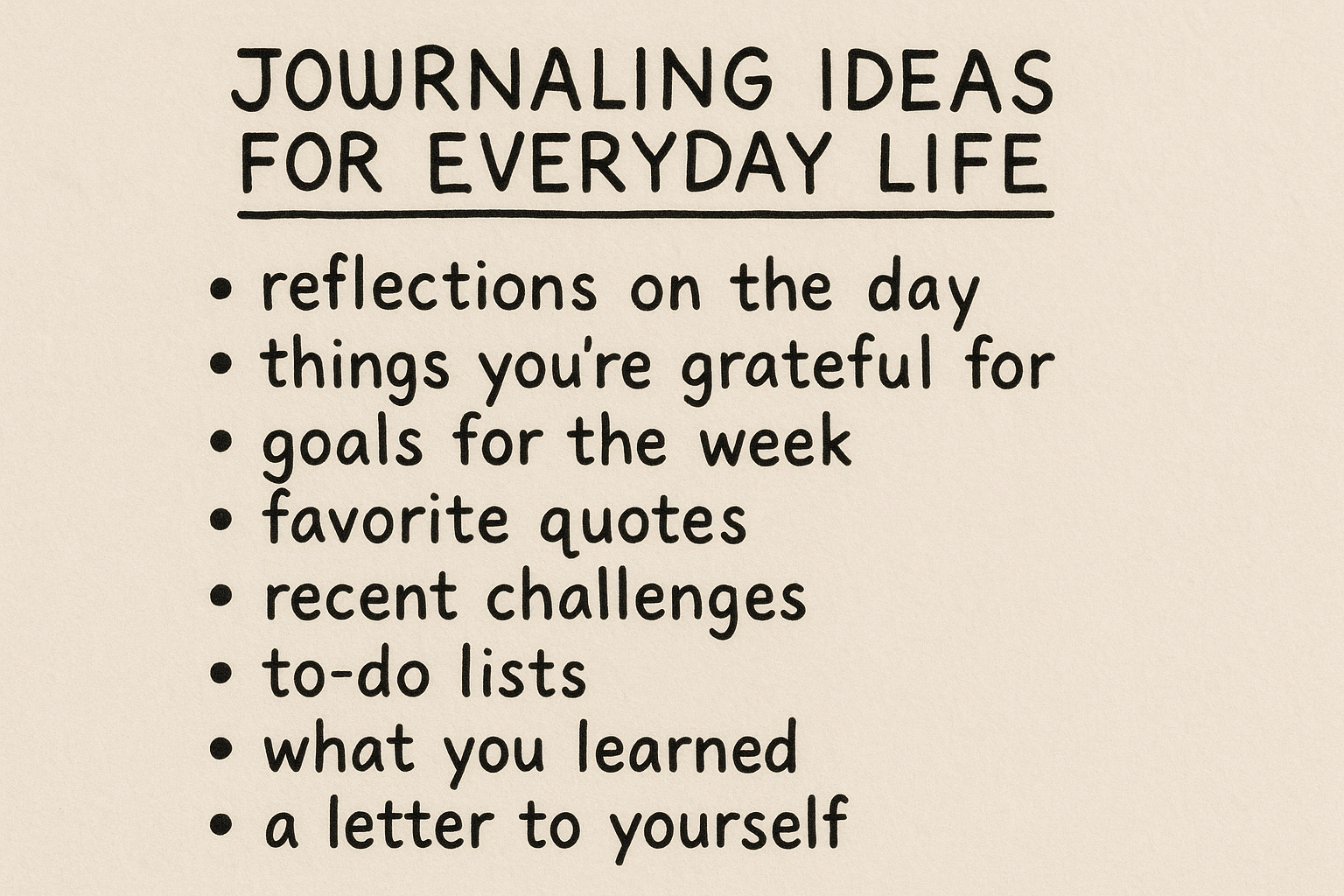
Useful prompts for stress processing include: "How did I feel today, and what contributed to those feelings?" and "Describe a recent challenge. What did it teach you?" Both are observational rather than evaluative, which is the critical distinction.
One concern is that writing about a stressful event simply extends the time spent thinking about it. That concern is legitimate, and the research on rumination supports taking it seriously. CBT-based journaling addresses this directly: identify the distressing thought, question its accuracy, reframe it toward a more proportionate interpretation. Clinical evidence on cognitive journaling shows this approach tends to reduce both anxiety and depressive symptoms. The key is that prompts should direct attention toward what happened and what you noticed, not toward open-ended emotional rehearsal. "What can I learn from this?" works. "Why does this keep happening to me?" does not.
Journaling to build and track goals
Goals written down behave differently than goals held mentally. That is not motivational poster sentiment; it is the observable consequence of making something concrete enough to return to.
Bullet journaling is the natural architecture for this purpose. Developed by Ryder Carroll, the system combines task management, goal-setting, and periodic reflection in a single notebook using a deliberate syntax of bullets, symbols, and indexing. Daily tasks coexist with long-term aspirations; habit trackers make progress visible as a grid of filled boxes rather than a vague sense of effort. The design is intentionally analog, which creates a friction-free record that does not require navigating interfaces or software updates.
The underlying mechanism is accountability without external pressure. Revisiting written goals regularly creates a low-grade obligation to oneself, which turns out to be more durable than social accountability for many people. Emmons and McCullough's 2003 research on gratitude and wellbeing found a notable crossover effect: participants who kept structured weekly reflection lists were more likely to make measurable progress toward personal goals over a two-month period. Reflection and goal achievement, it appears, are more tightly coupled than they look.
Prompts that work well here include: "Where will I be in five years, and what steps do I need to start now?" and "How do I define success right now, and how has that changed?" Both require the writer to be specific, which is where goal journaling earns its value. Vague aspirations remain vague; the act of writing them into granular specificity begins the process of operationalizing them.
It is also worth noting a cultural shift currently underway in the bullet journaling community. The practice drifted for several years toward elaborately decorated spreads, the kind that photograph beautifully and accomplish little. The trend as of 2025 appears to be correcting back toward Carroll's original intent: simplicity, function, and productivity over aesthetics. That correction is, candidly, overdue.
Journaling to spark and sustain creative thinking
Creative journaling rests on a single operating principle: non-judgment is the condition, not the reward. No idea goes unwritten because it seems stupid. Editing is a separate session, on a different day, in a different cognitive mode. Conflating the two is how creative output stalls.
Julia Cameron's morning pages practice, detailed in The Artist's Way, remains the most widely cited structure for this purpose. Three handwritten pages of stream-of-consciousness thought, completed first thing in the morning before engaging with any external input, phone, email, or news. The timing is not incidental. Writing before the day's cognitive demands accumulate tends to capture unfiltered thought in a way that an evening session can struggle to replicate; the morning mind has not yet been shaped by the day's priorities and concerns.
But what if mornings are unavailable? Prompted brainstorming offers a workable alternative for constrained schedules. A focused question provides enough direction that freewriting does not simply drift; the discipline of a specific prompt keeps creative output actionable rather than impressionistic. Sample prompts include: "What problem am I trying to solve, and what is the most unexpected solution I can imagine?" and "What did you see today that was beautiful?" The second prompt trains the observational habit that feeds creative work over time, which is more valuable than any single brainstorming session.
Art journaling deserves mention as a non-verbal alternative for visual thinkers. Mixed-media layouts can access emotional and imaginative territory that language alone does not always reach. The format is different in kind, not merely aesthetics; for some people, image-making unlocks associations that sentence-writing forecloses.
That raises an important question: is there a risk that highly structured creative prompts simply replace one form of constraint with another? Yes, and it is worth sitting with. The value of a prompt is that it provides ignition, not that it determines the destination. The moment a prompt starts dictating the output, it has exceeded its purpose.
Journaling to cultivate gratitude and positive attention
Emmons and McCullough's 2003 study remains the foundational evidence for gratitude journaling, and it is worth being precise about what it actually showed. Participants who kept weekly gratitude lists reported higher wellbeing, more optimism, fewer physical complaints, and more exercise compared to control groups. These are not trivial outcomes. They are also not explained by the act of writing alone; they reflect a directed reorientation of attention, training the mind to notice what is going well rather than scanning exclusively for threat.
The frequency finding from Lyubomirsky and colleagues is the counterintuitive detail most gratitude advice ignores: writing once per week outperformed writing three times per week. Daily practice leads to what Emmons has termed "gratitude fatigue," the point at which the exercise becomes mechanical and loses emotional salience. The implication is that less, done more deliberately, tends to produce better results. This runs counter to most habit advice, which valorizes daily repetition as inherently superior.
Useful prompts include: "What are three good things that happened yesterday?" and "What made me smile or laugh today?" and "What are you looking forward to right now?" The third prompt is underused; anticipatory gratitude activates appreciation before an event rather than in retrospect, which extends the emotional benefit.
One-line-a-day journaling is the minimal viable format for this purpose, a brief evening entry that creates space for reflection without time pressure. Digdon and Koble's 2011 research found that writing a gratitude list before bed can reduce worry and improve sleep onset and continuity. Evening, then, is the natural anchor point for this practice: it pairs with an existing transition, closing the day rather than opening it.
How to choose the right format — paper, digital, or app
The honest answer is that the best format is whichever one you will actually use with regularity. Medium is secondary to showing up. That said, the choice is not entirely neutral.
The case for handwriting rests on a 2024 study in cognitive psychology and neuroscience finding that handwriting stimulates brain connectivity patterns associated with learning, memory, and recall. If depth of reflection is the goal, the slower pace of pen on paper supports it. There is also the screen-free ritual argument: paper creates a deliberate boundary that digital interfaces, which are adjacent to every other distraction, cannot replicate as cleanly.
The case for digital is equally defensible. Searchability, backup, and constant accessibility remove friction, and friction is the primary enemy of new habits. Pennebaker's expressive writing research showed that participants derived comparable emotional processing benefits regardless of whether they typed or wrote by hand, which is a useful corrective to anyone who believes analog is inherently superior for this purpose.
AI-powered journaling apps represent the newest development in the space. The better ones offer personalized prompts that adapt to prior entries, which is a meaningful solution to blank-page paralysis for people who struggle to self-generate starting points. The digital journal apps market reached USD 5.1 billion in 2024 and is projected to reach USD 13.58 billion by 2033, according to Straits Research's 2025 figures. That growth reflects something real: a large number of people are already looking for structured, accessible support for the practice.
The diagnostic question is simply: what is your biggest obstacle? If it is consistency, use your phone; the absence of friction matters more than the medium. If it is distraction, use paper; the ritual of a physical notebook is itself part of the value.
Building a journaling habit that survives a busy week
The most reliable way to kill a journaling habit is to set the bar too high.
One or two lines is enough. A single word that captures the emotional temperature of the day counts, on the days when that is all there is. The point is not to produce; the point is to maintain continuity with the practice. A brief, imperfect entry keeps the habit alive. A skipped session because the conditions were not ideal does not.
Habit stacking is the behavioral mechanism most supported by the research. Attaching journaling to an existing automatic behavior, morning coffee, post-shower, before sleep, creates a reliable temporal and environmental cue without demanding willpower. Asaf Mazar at the Wharton School has emphasized that new habits survive best when anchored to established ones; the existing behavior does the work of triggering the new one.
The frequency question is worth revisiting here. Positive effects do not require daily writing. Research on online expressive writing found that 15 minutes three days a week over 12 weeks produced increased wellbeing and measurably fewer depressive symptoms, with improvements appearing within the first month. The implication is that a sustainable, sub-daily practice tends to outperform an ambitious daily practice that erodes under pressure.
Keep two or three go-to prompts available, one for stress, one for goals, one for gratitude. Their function is purely mechanical: they eliminate the moment of hesitation that derails a session before it starts. The prompts do not need to be clever. They need to be present.
On habit formation timelines: the old "30-day rule" has not survived more recent scrutiny. Habit consolidation varies considerably by person and behavior; what matters is reaching enough consistency that the behavior becomes self-reinforcing, rather than hitting a specific calendar milestone. Missing a day is not a relapse. It is a Tuesday.
Commit to a duration you will actually clear. A 10-minute session that happens is worth more than a 60-minute session that keeps getting deferred. The point, in the end, is not the journal itself. It is the small, repeated act of paying deliberate attention to your own life, noticing what is happening, what it costs, what it teaches. That attention is where every benefit documented above actually originates. The notebook is just where you park it.