The App That Hears the Worry You Repeated Four Times This Week and Names It for You
AI finds the worry you've mentioned four times without realizing it.
AI journaling can turn four apparently separate worries into one recognizable pattern by reading across entries over time. For someone seeking a voice journaling app with entry pattern recognition and weekly reflections, the key distinction is whether it connects entries or merely summarizes each recording. The value is not advice from a machine, but a recurring concern made visible enough for a person to examine.
Why your brain experiences the same worry four times without recognizing it as one thing
You keep a journal, but still feel caught in circles. Monday’s entry concerns a meeting, while Thursday’s concerns another uncomfortable moment at work. Each feels like a response to a particular event, so each receives its own explanation. What does not necessarily appear is the thread joining them, such as a recurring fear of being judged. The journal contains that connection without making it obvious.
Working memory helps explain the gap. It can hold only so much information at once, so earlier worries do not stay in mind to be compared. When Thursday’s anxiety arrives, Monday’s may no longer be in mind to compare it with. What is happening now offers the easiest way to explain the feeling. The same worry can thus keep feeling like something new.
James Pennebaker’s research at the University of Texas established benefits of expressive writing for physical health, psychological well-being, and immune function, with processing central to those benefits. UCLA neuroscience research found that writing about emotions reduces amygdala activation, which helps explain why writing one entry can calm an emotional response. Neither finding means a longitudinal picture assembles itself. Processing today’s feelings and recognizing a thread through months of entries are different tasks, and the second requires comparison across an archive.
What AI actually does when it reads across your entries over time
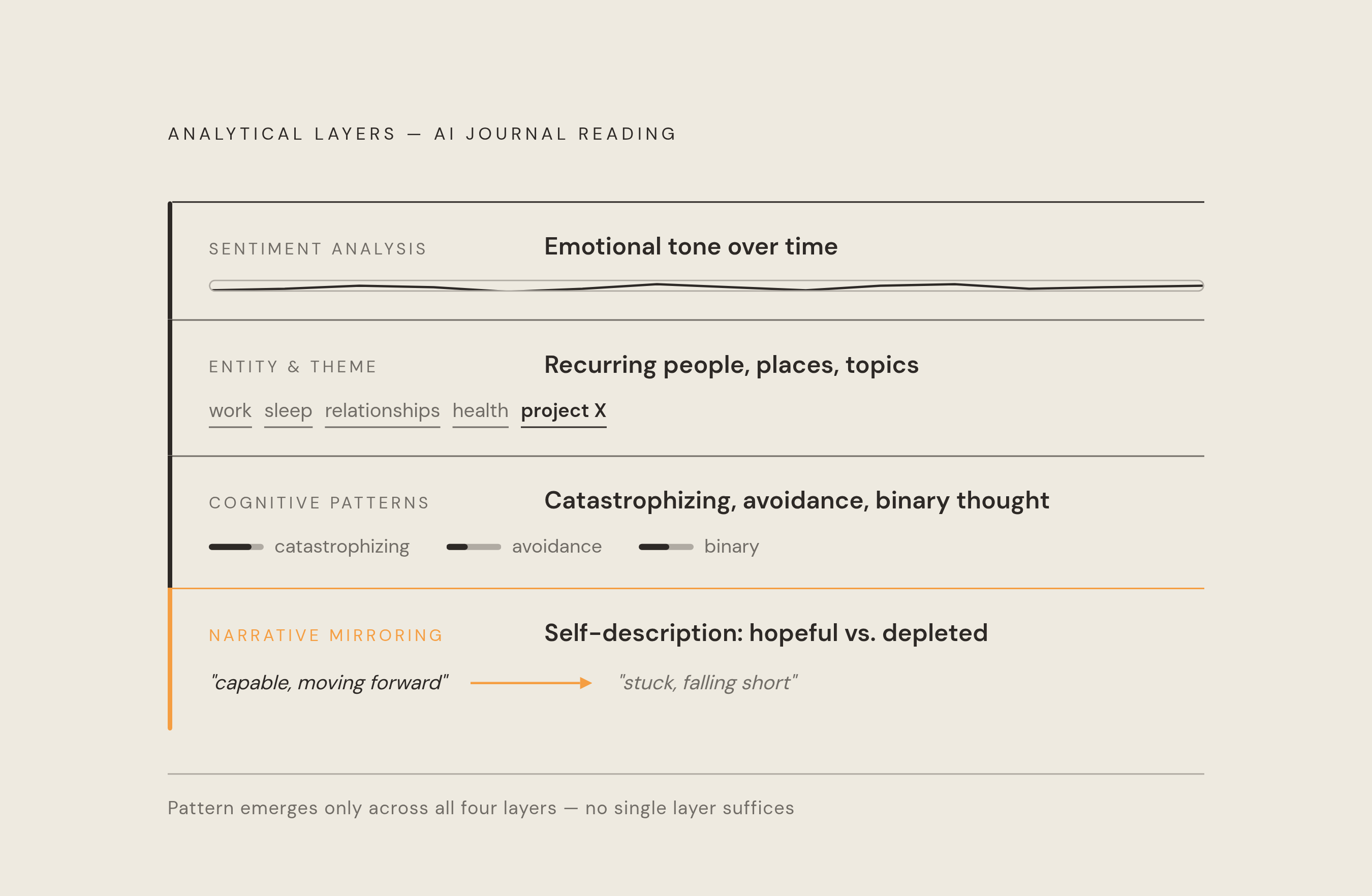
AI can make that comparison without asking the writer to keep the whole archive in working memory. Its useful contribution is relating the latest entry to earlier ones, using recurring subjects, emotional tone, and thought structures as points of comparison. The timespan changes what can become visible. A meeting that looks unremarkable alone may belong to a series when read beside other entries.
Sentiment analysis tracks emotional tone, while entity and theme extraction identifies recurring people, projects, places, and topics. Cognitive pattern detection looks for ways of thinking such as catastrophizing, black-and-white thinking, or avoidance. Narrative mirroring compares how someone describes themselves when hopeful with how they do so when depleted.
Context also distinguishes this work from counting words. Natural language processing can distinguish a phrase about doing well from one that uses similar words to describe distress. In practice, the result might be a weekly mood summary, a recurring-theme report, or a plain-language alert such as “You seem stressed every Monday”. The useful report connects its conclusion to specific entries. Those references give the user something to examine.
One documented user account illustrates the difference in scale. After a writer submitted two years of entries for analysis, the system surfaced themes including external validation and a possible fear of intimacy beneath romantic pursuit. It also identified a contrast between idealized descriptions of happiness and choices that did not honor those ideals, linking its conclusions to entries. The writer reported feeling shocked at first, then relieved.
Why being shown a pattern you couldn't name yourself feels different from being told something you already knew
Advice often starts with a problem already on the table. This experience starts a step earlier, when someone sees that problems they thought were unrelated might belong together. Nothing had necessarily been suppressed or deliberately avoided. The pieces of the worry were available, but they had not been arranged in a way that made their relationship visible.
That distinction explains why naming can feel both “unsettling and liberating”. The discomfort comes from seeing repetition where there had seemed to be separate circumstances. The relief comes from finally having something definite to think about or discuss. A vague sense of going in circles acquires a subject. This changes both the organization of the problem and the pressure attached to it.
Life Note’s “Talk to Your Past Self” feature offers one design approach to this experience. It resurfaces entries from weeks or months earlier and facilitates a dialogue between past and present selves. Temporal juxtaposition places different moments close enough for continuity or change to become visible. The emotional force comes from encountering an earlier version of the same concern without having remembered it as such.
How much history does that require? There is no universal minimum, because the pattern being sought determines the span needed to reveal it. A week can support a description of that week, but cannot reveal a recurrence that only becomes visible over months. The distinction is between summarizing recent material and recognizing a longer arc. A tool needs access to that arc before it can usefully describe it.
How voice changes what gets captured and therefore what patterns become visible
People tend to edit as they type, so they may drop an unfinished sentence or smooth out an awkward phrase that adds a caveat. That can produce a clear account of the day. It can also remove repetitions or half-formed worries that would have helped reveal what kept returning to mind. The finished paragraph is not always a complete record of the thinking behind it.
Speaking permits a different kind of record. People circle back, contradict themselves, stumble, and return to a subject they thought they had finished. A worry mentioned four times in a spoken entry leaves a different trace from one carefully stated once in writing. The repetition is part of the material. This changes what is available for comparison later.
That is why voice-first design is different from voice-to-text alone. Transcription changes how words get into a journal, while conversational design changes how someone goes about recording their thoughts. Talking through a day can admit tangents and unfinished concerns that dictating a composed diary entry would exclude. More of what a person would otherwise leave unrecorded becomes available to examine, which may help show how the worries connect.
What apps let you talk through your thoughts and see patterns over time?
Zendiary / Zeni is a web app whose AI assistant generates weekly and monthly mood summaries and pattern alerts, including “You seem stressed every Monday”. It says it protects privacy through AES-256 end-to-end encryption, zero-knowledge architecture, and local-first storage with optional cloud backup to a personal Google Drive or iCloud. Those details describe reporting and storage arrangements. They do not, on their own, establish a conversational voice-journaling experience.
Know Your Ethos combines AI-powered voice journaling with Stoic principles on iOS and Android. Its personal “daimon” is an AI mirror inspired by the Stoic concept of an inner voice of reason. Its pricing options are free, a monthly subscription, or an annual subscription. That establishes a voice-led approach and a philosophical frame. The documented description here does not establish weekly pattern reports, so those should not be inferred from the presence of AI.
Nuju describes a different part of the proposition. Its own account says that, after a few weeks, the AI surfaces weekly mood cycles, relationship correlations, and recurring emotional themes. These are concrete examples of connections across entries. They are not, by themselves, documentation of voice input or a scheduled weekly report. A weekly cycle is a finding, while a weekly report is a delivery format.
For a buyer, these distinctions prevent a feature label from doing too much work. The relevant criteria are voice capture, context across entries, weekly or monthly reporting, and references back to the material behind a conclusion. None substitutes for another. A voice recording can receive only a single-entry summary, while a longitudinal report can be built from typed entries. The strongest basis for trust is a tool that makes both its scope and its evidence clear.
The real limits of AI pattern recognition — and the one objection that deserves to land
The archive is evidence, but it is incomplete evidence. An AI reading voice entries has access only to what was said. It cannot distinguish an honest entry from a performed one simply because both are written in a personal voice. More entries add to the record, but the same limits still apply. A recurring theme in the journal is therefore not automatically a complete account of the person.
The safety questions extend beyond inaccurate interpretation. Many AI journaling apps have no regulatory oversight or long-term safety data, so questions about their safety remain even when they help in the short term. Heavy use and vulnerability deserve particular attention. The American Psychological Association’s November 2025 health advisory on generative AI chatbots and wellness apps addresses concerns in this area. Journaling support should not be confused with established mental health care.
Privacy is especially consequential because of the material involved. Worries put into words, relationship patterns, and emotional cycles can show more about a person than an ordinary account record. Encryption and storage choices are therefore relevant, but privacy by design belongs within a broader safety approach that also includes reality anchoring, use moderation, vulnerability detection, and clinician integration. These safeguards address different risks. A reassuring statement about one does not answer questions about all the others.
The strongest objection, however, concerns understanding. A system might notice that references to a mother recur in entries about failure, yet that association cannot establish what the relationship means or what should follow. Fluent wording does not close the gap. The AI can suggest a pattern and point to evidence, while people still have to work out what it means.
How to use a pattern once it's been named
The practical next step is to sit with the proposed pattern across a few more entries. That gives the writer a chance to compare the label with experience as it unfolds. Does it fit, or does it flatten important differences? The entries behind the original claim provide a starting point. New entries can then make the pattern clearer or give reasons to question it.
The pattern can be looked at through three lenses: time, people, and projects or situations. Time draws attention to whether the pattern intensifies on particular weekdays, in the morning, or in specific contexts. People directs attention to shifts in tone or mood when certain names appear. Projects and situations focus on recurring scenarios associated with the worry.
From there, the same approach suggests a micro-experiment with one constraint, one behavior, one simple measure, and one review cadence. The scale stays deliberately small. Rather than treating the pattern as a demand for a life overhaul, the writer tests a change small enough to evaluate in a week. The purpose is to connect an interpretation the person finds useful with something observable.
A weekly report then takes on a different role. Instead of always being asked to discover something new, it becomes a feedback loop for examining whether the named pattern is shifting. Brief voice check-ins made on a regular basis can help track whether the pattern showed up that day, without the need to write a full entry. The journal now has a specific job. What began as an archive of scattered moments becomes a tool for following one question over time.
Sources
- "I Talked an AI Chatbot, So What's Next?" How U.S. Young Adults Imagine Responsible AI for Emotion Coping
- Worry and rumination elicit similar neural representations: neuroimaging evidence for repetitive negative thinking
- Reflection Before Action: Designing a Framework for Quantifying Thought Patterns for Increased Self-awareness in Personal Decision Making
- Breaking Negative Cycles: A Reflection-To-Action System For Adaptive Change
- Scales, Reflections, and Conversations: A Multi-Modal Approach to Emotion Annotation
- Writing as cognitive rehabilitation in MCI and dementia: a systematic review of therapeutic benefits and applications
- F1000Research Article: The Limits of AI in Understanding Emotions: Challenges in Bridging Human Experience and Machine Perception.
- Who Determines the Meaning of an Emotion? Affective Sovereignty as an Epistemic Consequence of Measurement Limits