Vision Board Journaling as a Goal-Setting Practice
Pairing vision boards with structured journaling turns motivation into actionable plans.

Visualization is not pseudoscience, but the version most people practice is. Research consistently shows it boosts motivation, clarifies intention, and primes attention toward relevant environmental cues. Self-determination theory treats it as settled: goals aligned with intrinsic values show meaningfully higher achievement rates than externally motivated ones. That finding alone is the strongest argument for doing values-clarification work before building a board, not after the fact, as an afterthought, once the Pinterest aesthetic has already been committed to poster board.
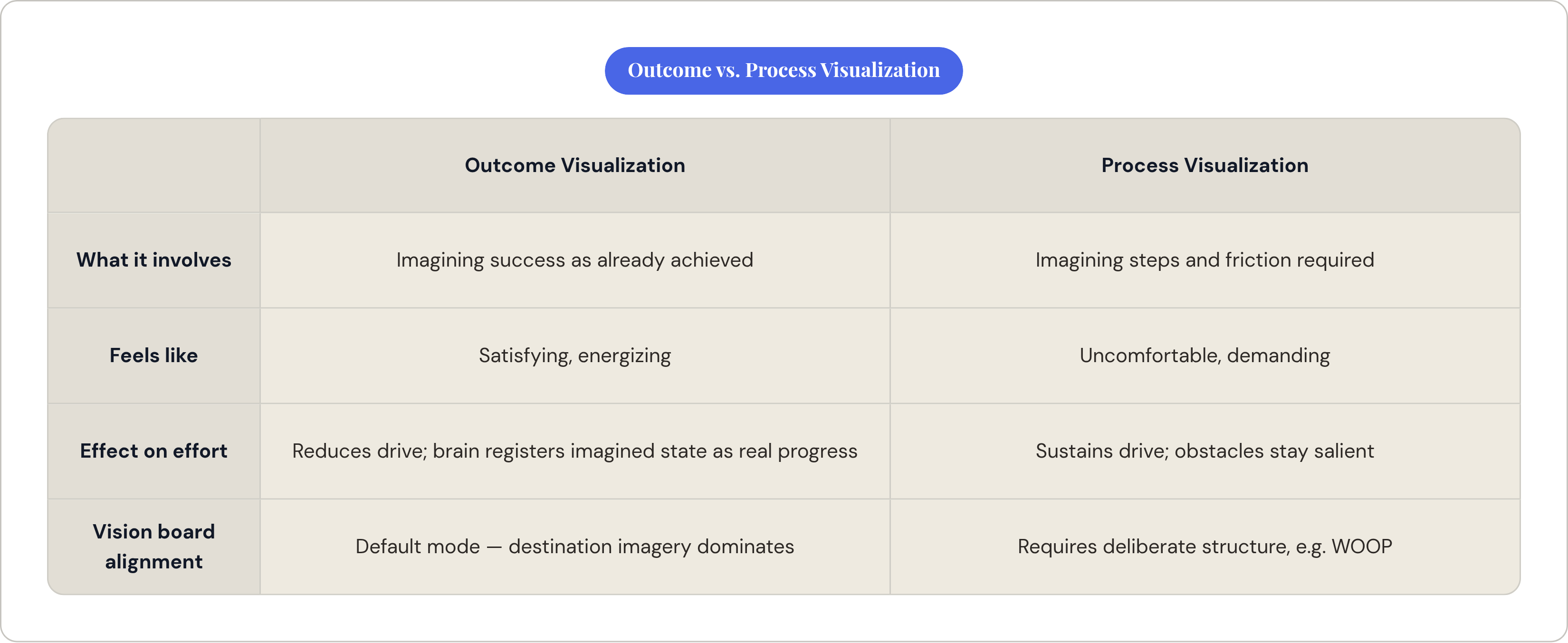
But here is the part the vision board industrial complex quietly buries: vividly imagining a finished goal, without engaging the obstacles between here and there, can actually reduce the drive to pursue it. Research draws a sharp line between outcome visualization (imagining success as already achieved) and process visualization (imagining the steps and friction required to get there). The former feels good. It also saps effort, because the brain partially registers the imagined state as real progress. A board full of destination imagery is, almost by design, pure outcome visualization. Nobody in this space wants to say that plainly, so I will.
The RAS claim deserves a brief, honest detour. The Reticular Activating System is real neuroscience. The idea that staring at a collage "reprograms" it is folk neuroscience dressed up in anatomical terminology. Stating that distinction plainly saves considerable time downstream.
What imagery does well: it holds the emotional charge of a goal, makes it feel concrete, keeps attention loosely oriented toward what matters. What imagery cannot do alone: prompt reflection when motivation dips, surface obstacles before they become blockers, or translate desire into planned action. That is not a design flaw to be patched; it is a functional gap requiring a fundamentally different tool. The board is a compass, and the journal is the map — one tells you which direction feels right; the other shows you the terrain between here and there. You need both, and in that order.
Why journaling is the mechanism that activates a vision board
The division of labor is less intuitive than it first appears, which is why most people miss it. The board holds the image of what matters. The journal does the cognitive work of getting there. These are not redundant functions; they operate on entirely different registers. Conflating them is the mistake.
Structured writing adds something imagery cannot reach. It forces explicit articulation of obstacles, generates if-then thinking that converts vague intention into concrete behavior, and externalizes thought in a way that activates analytical processing. Imagery does none of that, which is why the board alone stays motivationally inert past the initial enthusiasm. The typical arc: make the board on a Sunday, feel energized, stop looking at it by Wednesday.
But the type of journaling matters more than most practitioners realize. James Pennebaker's foundational research established that the protocol is the active ingredient, not the act of writing itself. Free-writing into a blank page is quite different from moving through structured reflection. The version of journaling that tends to work looks quite different from the version most people default to when they sit down with good intentions and no framework and end up writing about their weekend.
The board functions best as a recurring visual prompt inside a structured session, one the writer returns to deliberately rather than glances at decoratively. Together, visual anchor and structured written reflection cover what neither accomplishes alone. Separately, they collect dust, which is probably where most of them are right now.
The WOOP framework as the missing structure inside vision board practice
WOOP, developed by NYU psychologist Gabriele Oettingen, is the most rigorously validated framework for the exact problem vision boards create. Wish, Outcome, Obstacle, Plan. Its design deliberately combines positive future thinking with obstacle confrontation, which is precisely the step pure vision-boarding skips entirely. Not coincidentally, confronting obstacles is also the least enjoyable part of goal-setting, and the self-help market has been monetizing that aversion for decades.
In practice: name the goal clearly; describe the best result of achieving it; identify the main internal barrier (not external circumstance but personal pattern); write an if-then implementation intention tied specifically to that barrier. The whole protocol takes five to ten minutes, which is either its most underrated feature or the reason people reflexively distrust it.
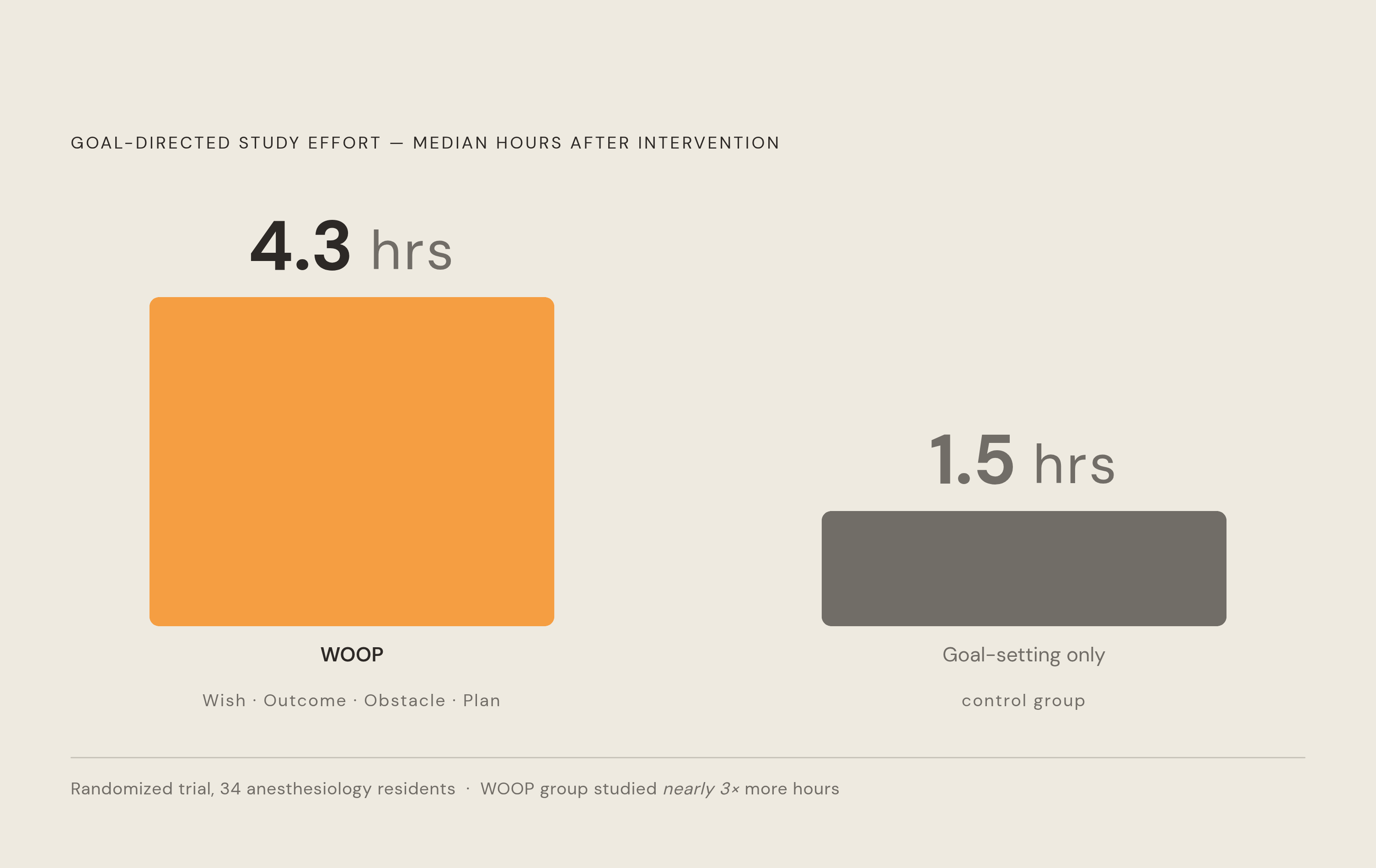
The evidence is not soft. In a randomized trial of 34 anesthesiology residents, the WOOP group spent a median of 4.3 hours studying toward their goals in the weeks following the intervention; the goal-setting-only group spent a median of 1.5 hours. Across 24 trials, mental contrasting combined with if-then plans produced meaningful gains in goal attainment over control conditions. The effect size is modest. It also replicates across health, academic, and professional domains, which is more than can be said for most interventions in this category.
That raises a question worth sitting with: if the research is this consistent, why isn't WOOP a household word? Probably because confronting the obstacle is unpleasant. Positive visualization is pleasant. Writing down the specific personal pattern most likely to derail you is uncomfortable. The asymmetry explains a great deal about what sells in this space.
One caveat worth naming: long-term durability of WOOP is not yet well established in controlled research; most studies follow participants for only a few months. Treat it as a recurring tool rather than a one-time installation, and that limitation largely resolves itself.
Connected to the board, each significant image becomes the anchor for its own WOOP session. A vision of financial stability gets a WOOP entry. So does the image representing a career shift or a health goal. The collage stops being a mood board and becomes a structured goal inventory. The board tells you what you want; the WOOP entry tells you what is actually in the way. That second question is the one that matters.
Before the board: the values-clarification work that makes the imagery honest
Most people select images for what looks aspirational rather than what aligns with who they actually are. This is why so many boards feel hollow within a few weeks. The images were chosen by aesthetic resonance, not self-knowledge. The result is a curated fantasy, which is a generous description of what amounts to an expensive Pinterest board that eventually gets rolled up and stored in a closet.
A short journaling session before the board is built changes that. Not a formal values inventory in the HR-workshop sense, but a handful of prompts designed to surface intrinsic motivations rather than aspirational aesthetics. What did I do last year that felt meaningful, not just accomplished? Which goals am I pursuing because I want them versus because someone else expects them? What would stay on this board if no one else would ever see it? That last question is doing serious work.
The future-self technique belongs here specifically. Writing in vivid present tense as if a goal is already achieved ("I am sitting on the beach, knowing I saved enough for this trip") surfaces emotional alignment or misalignment before the board is constructed. It works well for visually oriented, big-picture thinkers. The technique does not work equally well for everyone, and there is no point pretending otherwise.
The output of this session is a written values inventory that functions as a filter during image selection. Keep what survives honest interrogation; discard what looks good but fails to resonate under scrutiny. A board built after this work is actually worth returning to, because the images carry meaning the writer identified themselves rather than borrowed from the internet.
How to structure a recurring vision board journaling session
The Evidence-Action Loop offers a workable skeleton: written intention, honest assessment, strategic adjustment, returned to two or three times per week. Less a rigid protocol than a framework that keeps sessions from drifting into undirected free-writing, which is the default failure mode and also the most comfortable one.
Phase one is intention. Look at the board before writing. Pick one image or goal area. Write what you intend to do toward it before the next session, when you will do it, and what will get in the way. Specific enough to be falsifiable. Vague intentions are just wishes with better handwriting.
Phase two is assessment. What happened, what blocked it, what surprised you. This is a record, not a performance review. The only variable that makes it useful is honesty, which sounds obvious and is somehow the hardest part of the whole practice.
Phase three is adjustment. After several sessions, look across entries for patterns. Adjust the approach, not necessarily the goal. This is where the longitudinal value of the journal begins to compound, and also where most people quit, because it requires reading old entries rather than writing new ones. Reading old entries is humbling. That is probably why it works.
WOOP entries belong inside this structure. For complex goals, Edwin Locke and Gary Latham's research on goal-setting distinguishes performance goals from learning goals; in a journal, complex goals are better served by "what do I need to figure out?" than "did I hit the target?" That single reframe changes the entire character of what the session is for.
The board opens the session visually. The journal holds the structured thinking. Duration is largely irrelevant; the structure is doing the work.
Handwriting versus typing for vision board journaling
A 2025 meta-analysis from the University of California, Irvine, reviewing 23 studies found that handwritten notes led to substantially better long-term retention than typed notes, even when participants reviewed their notes before testing. A February 2025 paper in Life found that handwriting engages wider brain networks tied to movement, memory, and cognition than typing does.
For this specific practice, both findings matter. Future-self writing and WOOP sessions involve forming and rehearsing ideas, not merely recording them after the fact. The slower pace of handwriting keeps thinking embodied; the hand participates in forming the idea rather than transcribing it once the mind has already moved on. For the neural rehearsal that underlies effective visualization, that sensory involvement tends to strengthen the effect. The friction is a feature. There is no elegant way to say that without sounding like a productivity influencer, but the evidence points in that direction.
Digital tools offer something handwriting structurally cannot: searchability. Pattern recognition across weeks or months of entries is the most cognitively demanding part of the adjustment phase, and a searchable archive makes it tractable rather than aspirational. Digital tools also lower the activation cost of starting a session, which matters more than it sounds. A practice that does not get started is not a practice; it is a good intention.
The most significant finding from comparative research on medium: consistency of practice outweighs medium. The best format is whichever one gets used. That is not a hedge designed to avoid commitment; it is the conclusion the data actually supports.
A hybrid worth considering: handwrite WOOP and future-self entries, where depth and embodied processing matter most; use a digital tool for assessment entries and pattern tracking, where searchability and speed are the priorities.
Choosing a journaling tool that supports an ongoing practice
The selection principle is simple: reduce friction, not add it. That sounds obvious, and it is still the thing most people get wrong, reaching for the most feature-rich option rather than the one with the lowest activation cost. More features tend to mean more reasons not to open the app.
For vision board journaling specifically, a few capabilities matter more than others. Prompt support reduces the cognitive overhead of rebuilding session structure from scratch each time. Reliable, fast entry keeps the barrier to starting low. Search or review capability is essential for the adjustment phase, where the longitudinal value of the practice either compounds or evaporates.
For those who find writing a barrier, voice journaling addresses the blank-page problem directly. Speaking through a WOOP session or a future-self reflection is lower friction for many people than typing or handwriting, and it makes reflective practice available in moments when sitting down to write is genuinely impractical. Joice is built for this use case: a voice-first journaling app that lets users talk through goals and obstacles, with automatic transcripts and pattern-surfacing that make the assessment and adjustment phases functional without requiring manual review. For a reflective practice that needs to happen between meetings, in transit, or anywhere a notebook is impractical, it is a credible option. Voice journaling generally is an underused format; most people have never tried it seriously enough to know whether it fits how their thinking actually works.
For those who prefer writing, a dedicated app with offline capability and distraction-free focus remains the stronger choice for depth.
The right tool is determined by what someone will actually return to. Full stop.
What a sustained vision board journaling practice looks like over time
The board itself needs revisiting. Goals shift; images that once resonated eventually stop. A quarterly review session in the journal should assess whether the board still reflects intrinsic values, not just whether the goals have been achieved. That is a different question, and it is the more important one. A board full of goals you have outgrown is worse than no board at all — like wearing a coat that fit you three winters ago and calling it preparation.
The journal entries build longitudinal value. Patterns visible at three months are not visible at three weeks. That is not a motivational claim; it is a data-density claim. There is simply more signal to read after enough entries accumulate, and the patterns that emerge are rarely the ones you predicted when you started.
The dropout risk is the same for journaling as for the board: both become artifacts if no structure calls the practitioner back to them regularly. The integration is what makes both durable. The board gives the journal a visual object to return to; the journal gives the board a reason to be consulted rather than glanced at while walking past. Remove either, and you have a decorative collage or a neglected notebook. Both outcomes are a surprisingly expensive way to accomplish nothing.
Start with one image on the board, one WOOP session in writing, one return session the following week. The method scales from there. What it does not do is work passively, which is, in the end, precisely the point.