Hands-Free Anxiety Journaling When Even Picking Up Your Phone Feels Like Too Much
Speaking bypasses the writing barriers that freeze anxious minds.
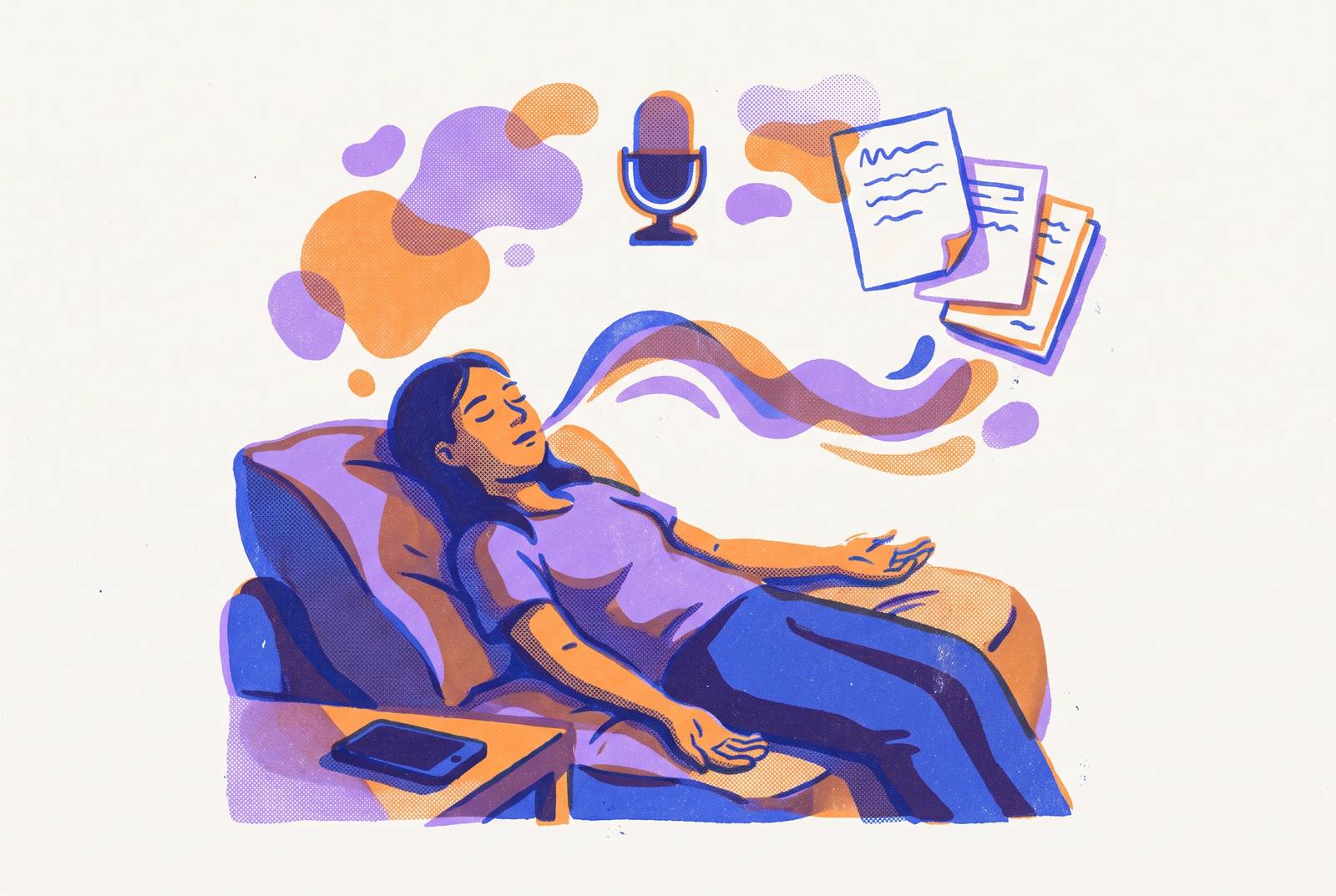
Voice journaling for anxiety and overthinking offers a way to put feelings into words without the added work of typing. VoiceScriber works for offline recording and transcription on iPhone, while Empath lets people make entries by phone call without opening an app. But the central advantage is simpler than any product feature. Speaking, with or without a recording, lowers the effort of reflecting when anxiety makes writing feel impossible.
Why journaling fails anxiety at the moment it's needed most
The worry keeps circling, the notebook is within reach, and still the page stays empty. There is plenty to say, but turning it into an opening sentence feels like another task on an already impossible list. Even choosing where to begin takes effort. The moment that seems to call most urgently for journaling can be the moment when doing it feels least possible.
You have to feel the emotion, find words for it, arrange those words into sentences, and sustain the physical act of writing or typing. That translation from felt experience to readable language is a bottleneck. When anxiety has already taken up attention, even something familiar can feel harder than expected.
The blank page adds a decision before expression has even begun. Which thought belongs first, how much context is necessary, and does the sentence make sense? A private notebook can somehow acquire an imaginary examiner. The obstacle is not necessarily reluctance to face a feeling, but the work required to give it an acceptable written shape. That distinction shifts the problem from motivation to structure.
What actually happens in the brain when you name a feeling out loud
Putting an emotion into words changes how it is processed, whether those words are spoken or written. UCLA fMRI studies demonstrated that naming an emotion can reduce activity in the amygdala, the brain’s threat-detection center. This process is called affect labeling.
External expression also supports cognitive offloading. This relieves working memory of the job of holding a worry. A thought no longer has to be kept entirely in mind while it is being examined. Narrative construction adds another kind of organization. Giving an experience a sequence can help distinguish what happened from what is feared next, creating an exit ramp from circular thinking.
James Pennebaker’s foundational research concerned written emotional disclosure. Subsequent comparative work found that spoken disclosure can produce similar, and in some studies stronger, effects on emotional regulation and stress reduction. A systematic review and meta-analysis in BMJ Family Medicine and Community Health concluded that journaling interventions can improve mental illness symptoms and overall wellbeing. These findings support articulation while leaving relief from any individual entry uncertain.
Venting alone is not the whole mechanism. Writing only about emotions has shown little benefit, while naming feelings and putting a story in order do more than just release pressure. The implication for voice journaling is specific. Speaking can preserve the useful work of journaling without preserving all the demands of writing.
Why speaking bypasses the barriers that writing puts up
Writing often activates an internal editor before a thought is finished. Words get replaced, contradictions get tidied away, and coherence becomes a quiet requirement. Speaking permits a different sequence. An unfinished thought can lead into another, and a contradiction can occur in speech before there is time to censor it.
Voice also retains qualities that text cannot directly preserve, including pacing, hesitation, pauses, and changes in tone. A quiet voice or a long silence is part of what is said, where a writer would have to describe it.
The physical requirements are lighter as well. Speaking can happen while walking, pacing, lying in bed, or commuting, where writing may be awkward or unavailable. There is no need to produce a visually orderly page. For an anxious person who freezes at the writing stage, this is a structural advantage.
But what if hearing the worry makes it worse? Some people find spoken anxious thoughts amplifying rather than calming, especially on replay. University of Michigan research on self-distancing associates more reflective, third-person language with better emotional regulation. Describing the anxious self from the outside can offer a little distance when first-person narration feels too activating.
What hands-free journaling actually looks like in practice
To put that lower-effort approach into practice, begin somewhere speaking feels comfortable and stay with one situation. A daily check-in can describe what happened and how it landed. Emotional processing can follow a difficult experience as it unfolds, while a morning intention can give words to the day ahead. Stream-of-consciousness recording can go wherever the thoughts lead, without a plan or a tidy ending.
A first attempt needs very little structure. Three questions can supply it, asking what happened, what meaning you are giving it, and what you need next. As an example of the shape, rather than a script, a spoken entry might describe one event, separate the interpretation from the event, and consider whether the next step is an action, a conversation, or no decision yet. Your own situation supplies the content.
Stopping is part of the practice, too. A short attempt is enough once you have said what you wanted to say. The recording can be kept, reduced to one useful point, or deleted. If speaking becomes another circuit around the same worry without new information, pausing is more useful than extending the session.
Speaking without recording works when no saved file is wanted, while a voice memo can be played back later. A written note remains useful when speaking is inconvenient. A conversation adds another person’s response or question.
Twenty-five prompts structured for anxious minds specifically
Prompts replace the demand to invent an opening with something to respond to. These twenty-five starting points are grouped by function, so there is no need to work through them all. One is enough to begin. The aim is to turn a feeling that keeps going round into a string of words.
For naming what is happening now, consider these five openings. Which feeling is strongest right now? Where does that feeling show up in your body? Which word comes closest to describing it? What feels hardest to say aloud? Which feelings seem to contradict each other?
For separating an event from its interpretation, try these five questions. What actually happened? What meaning are you giving that event? Which part is a fact and which part is a forecast? What are you afraid will happen next? Where does the description end and the prediction begin?
For identifying what is needed, these five prompts leave room for something other than immediate action. What do you need next? Does this moment call for action, rest, or conversation? What could remain undecided for now? What would you want to say to someone about this? What is one action you want to take?
For processing something that has passed, these five questions give the replay a direction. Which event keeps returning to mind? What happened first, and what happened next? Which part of the event are you interpreting now? How would you describe the experience in the third person? What useful point, if any, would you keep from this account?
For anchoring to the present, try these five brief questions. What can you see around you? What sounds can you hear? What physical sensation is most noticeable? What do you notice about your voice as you speak? What is happening around you now, separate from what you fear?
How to choose a voice journaling tool based on your privacy threshold
The first comparison is where your words go. Anxiety entries can contain material that feels difficult to say even in private, and knowing it will reach a server can encourage self-censorship. More features do not automatically make expression easier. The right choice depends on what gets in the way most, whether that is data exposure, opening an app, or not knowing how to begin.
VoiceScriber is the strongest fit among these options for on-device privacy. It works entirely offline on iPhone, including in airplane mode, and its recordings and transcriptions never leave the device. A one-time purchase option is available. Its limitation is platform access, since it is iOS-only.
Empath is the best fit for those who want to skip opening an app. Entries can arrive through phone calls, WhatsApp, Telegram, in-app typing, or in-app voice recording and flow into one unified record. It uses HIPAA-compliant infrastructure and encryption at rest, with an explicit policy that entries are never used to train AI or sold to third parties. Those protections are distinct from keeping everything offline.
Puffy suits readers who want to name their feelings as well as record them. The free, iOS-only app uses cloud AI transcription, then offers a feelings wheel with six primary emotions and 34 sub-emotions and shows how feelings change over time. Rocket Journal offers a different kind of guidance. Its free iOS app combines unstructured Rant Mode with therapy-inspired prompts in Reflect Mode, and AI analyzes entries for emotional themes and patterns. It offers transparent data handling and account and data deletion options, though it is newer and lacks some polish of more established platforms.
A local voice memo can stay out of cloud storage if backup and sync settings allow it. Cloud transcription adds features but exposes more data. Before assuming deletion has removed everything, check recently deleted folders, backups, and the app’s current documentation.
When the phone itself is the problem: physical alternatives for high-anxiety moments
Speaking without recording comes first when even unlocking a phone feels like too much. You can describe the anxious thought aloud as if speaking to a trusted friend, without creating a file or choosing a tool.
For some readers, the smartphone environment is itself part of the difficulty. Notifications, social apps, and a browser one tap away make it more than a neutral recording surface. A different app cannot remove that whole environment. In that situation, removing the phone is a structural change rather than a failure to use the available technology well.
Readers who want a persistent written record have other options. Dedicated, single-function writing hardware removes access to apps, notifications, and browsing, though it still requires writing. Paper offers a simpler version of separation. It needs no account or cloud service, and its readability does not depend on a company remaining in business.
Neither option is necessary for everyone. If translating a feeling into writing is the obstacle, dedicated writing hardware does not eliminate it. If the device is what distracts, though, a separate writing device or paper may work better. Usability on the difficult day determines which form to choose.
Building a voice journaling habit that survives the worst days
A routine that depends on calm, focus, and an uninterrupted desk may be poorly matched to the moment anxiety returns. The useful standard is smaller. On bad days, continuity can be the goal.
For that reason, the minimum practice can be two minutes of spoken words. A fixed moment, such as a morning walk, commute, or the time before sleep, removes the recurring decision about when to begin. A nightly ritual can lower scheduling pressure.
Streaks and archives remain optional. Missing a day does not invalidate the practice, and a recording does not have to become part of a permanent collection. Success need not mean producing more material. It can mean finding a usable form of expression without turning the process into another obligation.
The most durable journaling habit asks for the least effort when anxiety is highest. Speaking, with or without a device, can bring that effort down to simply giving the feeling words. Voice journaling offers support alongside professional care. If anxiety persists or interferes with daily life, seek help from a qualified mental health professional.