Journaling vs Diary Writing Differences
Diary records what happened; journaling reflects on what it means.

The structural differences are less diagnostic than people assume. Both can be handwritten or digital, bound or loose, daily or sporadic. The actual difference is in what each one is trying to accomplish.
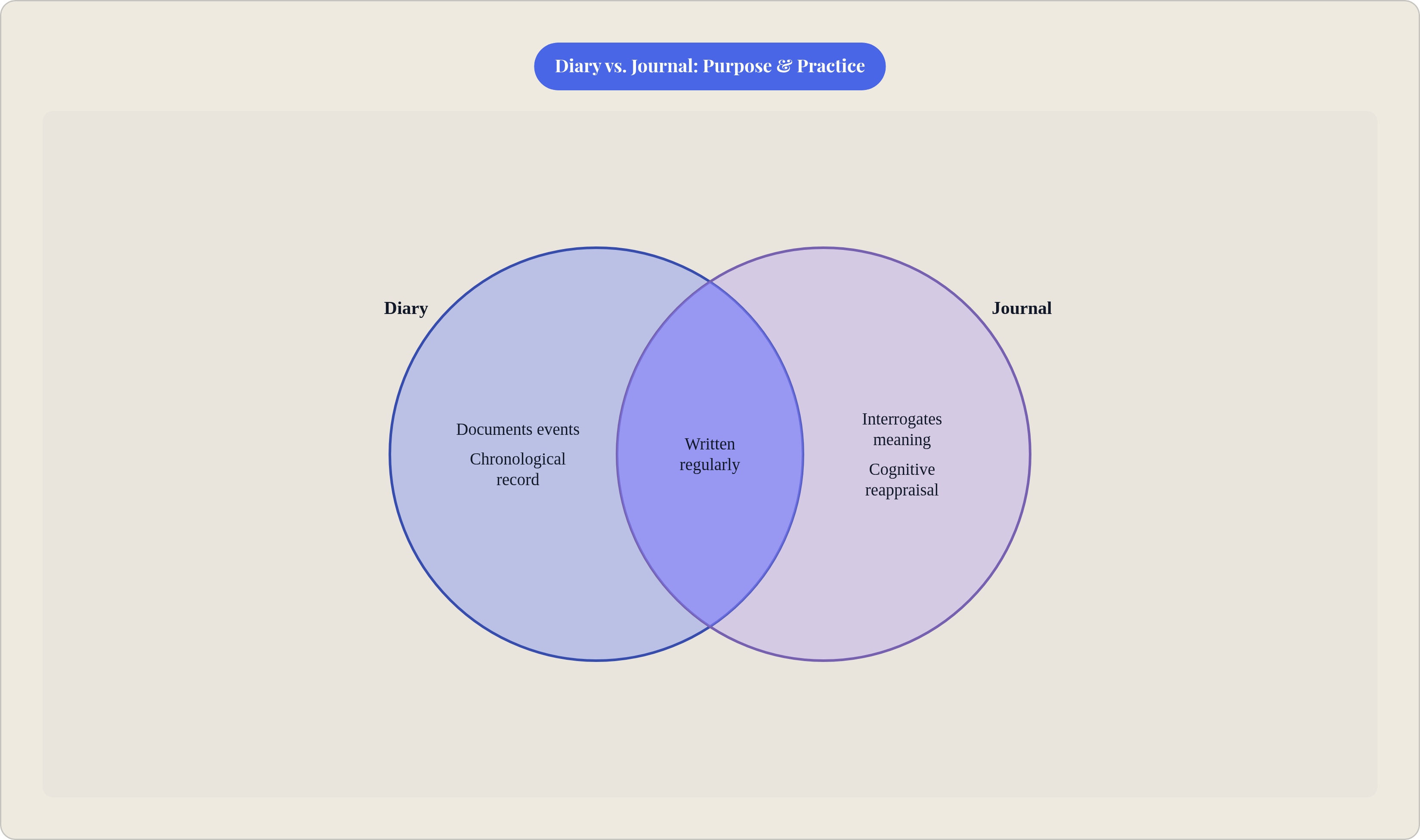
A diary documents. It captures what happened: factual, largely chronological, often brief. "I went to work today. Had an argument with my boss. Pretty annoyed." That is a complete diary entry. The emotional content is present-tense and largely unexamined, which is fine. That's the job.
A journal interrogates. It reflects on what happened and asks why it matters. A journal entry about the same argument examines what the irritation revealed about an unspoken expectation, or what pattern it represents across similar situations, or what the writer actually wants to model next time.
The clearest test, and one worth applying to your own writing: after finishing a page, do you know more about the event, or more about yourself in relation to it? A diary is the photograph. A journal is the argument you get into later about what the photograph means, who looks tired, and whether that family vacation was actually as good as everyone agreed it was at the time.
Why Intention Is the Real Dividing Line, Not Format or Frequency
Format is confusing here because it is identical. Same notebook, same pen, same Friday evening. One writer documents; the other reflects. From the outside, indistinguishable. From the inside, entirely different cognitive operations.
Frequency is similarly unreliable as a classifier. Some diarists write every day. Some journalers write once a month, only when something won't leave them alone. Cadence tells you almost nothing.
What actually matters is the writer's intention before the pen touches the page. Diary intention is preservational: I want to remember this. Journal intention is interrogative: I want to make sense of this. The same event can be written about in either mode. The mode is chosen, not inherited from the event itself.
That raises a question for anyone who writes regularly and still feels stuck: is the problem that you're not writing enough, or that your intention has been documentary when it needed to be reflective? One of those problems is solved by sitting down more often. The other isn't.
What the Brain Does Differently When Writing to Reflect Versus Writing to Record
This is where the argument becomes harder to dismiss as semantic.
James Pennebaker's expressive writing research, which began in 1986, produced an outcome that surprised even him: participants who wrote for fifteen to twenty minutes about difficult events over four days showed improvements in mood, immune function, and, in student populations, academic performance. The detail worth dwelling on is that the active variable was not how much people wrote, or how often. It was whether they were constructing interpretive meaning from the events they described. Pure venting, it turned out, produced no lasting benefit. The structured attempt to understand an experience was doing the work.
Reflective writing engages the prefrontal cortex, the region responsible for organizing thought and reducing the kind of diffuse emotional reactivity that makes hard experiences feel unmanageable. Emotional labeling, naming in writing what you feel and why, measurably reduces limbic reactivity. That is not a metaphor for something. That is a documented neurological effect.
Event-logging does not trigger that same engagement. Describing what happened without interrogating it leaves the emotional response largely unprocessed. The writing feels cathartic in the moment; the relief does not last, which is probably why so many consistent diarists still report feeling unresolved about things they have written about repeatedly.
One technique worth noting: writing about yourself in the third person, what researchers call self-distancing, lowers emotional reactivity further by creating cognitive separation from the experience. It is an odd thing to do, and it feels awkward the first several times. But it works, and it is a tool available to reflective journalers that a diarist would rarely reach for, because the diary's orientation is toward faithful first-person capture, not analytical remove.
The underlying mechanism is what emotion researchers call cognitive reappraisal: rewriting an experience into a more adaptive, better-integrated interpretation. It is not what happens when you write "pretty annoyed" and close the notebook.
What Diary-Keeping Does Well That Journaling Doesn't
Treating this as a simple hierarchy, journaling virtuous, diary primitive, is a mistake the research does not actually support.
Diaries produce retrievable chronological records of events, relationships, and lived experience that reflective journals rarely do. If you want to know what you actually did last April, a diary is useful. A journal entry from that same month will tell you how you were processing something emotionally, with little reference to what was concretely happening around you. Those are different kinds of knowledge, and both matter depending on what you need.
Accountability is another diary advantage. The factual, timestamped structure makes diary-keeping well-suited for tracking concrete patterns: what you ate, how a project evolved, who you saw and when. The diary is a record. The journal is a reckoning. They are not competing; they are adjacent.
The cognitive load of diary-writing is also lower, and that is not a weakness. A diary requires no framework, no prompt, no particular intention beyond showing up. That lower barrier matters for people who need consistency more than sophistication right now.
And diaries have functioned as primary historical sources for centuries precisely because they document lived experience without editorial processing. Samuel Pepys was not journaling. He was diaring, obsessively and in code, and the historical record is considerably richer for it.
How Different Journaling Methods Reflect the Reflective Intention in Different Ways
Reflective intention is not a single format. It is a posture toward the page, and different methods operationalize it differently, some more honestly than their marketing suggests.
Morning Pages
Julia Cameron introduced morning pages in The Artist's Way in 1992: three longhand pages of stream-of-consciousness writing, done first thing in the morning before the day's cognitive static accumulates. The goal is explicitly not to produce meaningful prose. It is to clear mental noise, which is a different thing entirely. Cameron's instruction not to re-read entries for at least eight weeks is telling: the value is in the act of clearing, not in the record. Think of it as wringing out a wet cloth before you sit down to do the actual work. This is not a diary, and it is only a journal in the loosest sense. It is closer to a pressure valve.
Gratitude Journaling
Gratitude journaling is explicitly reflective by design: the focus is not on events but on what those events meant and why they were worth appreciating. Sonja Lyubomirsky's research found that weekly gratitude writing lifts well-being more reliably than daily writing, which becomes rote. That finding is instructive. When reflective writing becomes automated enough, it drifts back toward documentation, and the benefit quietly disappears. The intention is the active ingredient. Lose the intention to examine something, and you are just filling a box.
Bullet Journaling
Ryder Carroll's bullet journal system, developed in 2013, combines planner, diary, and to-do list through rapid logging and symbolic notation. In its core function it is closer to a diary than a reflective journal. Bullet journaling works best when understood as a planning and tracking tool, ideally paired with a separate reflective practice rather than substituted for one. That distinction matters because a lot of people have decorated and indexed their way into believing they are journaling when they are, in fact, making very organized lists.
Prompt-Based Journaling
Structured prompts, values-clarification questions, growth-mindset reframes, self-distancing exercises, are the most explicit method of enforcing reflective intention through form. They work well for writers who, given an open page, default to narrating events rather than interrogating them. The prompt removes the ambiguity about which mode you're supposed to be in. A 2019 study in Behavior Modification found that participants matched with journaling styles aligned to their personality and goals showed significantly greater psychological benefit than those assigned a random method. The right method is not the most popular one. It is the one that fits how your brain actually processes information, which is a variable worth investigating before you buy another notebook.
How to Identify Which Practice You're Actually Doing, and Which One You Need
The self-diagnostic question is simple, even if the answer sometimes isn't: after finishing a page, do you feel like you've documented something, or understood something?
Signs you have been diary-writing when you needed to be journaling: your entries describe events and emotions but rarely interrogate them; you feel like you are reporting to the page rather than thinking on it; you write consistently but feel no clearer about recurring decisions, patterns, or emotional loops. The writing is happening. The processing isn't.
Signs you have been journaling when a diary would actually serve you better: you want a record of what happened, not just how you felt about it; you are tracking something concrete where facts matter more than meaning; the open-ended pressure of reflective writing produces friction rather than insight.
The two practices are not mutually exclusive. A layered structure works well for many people: a diary layer for facts and events, and a periodic reflective session to process what those events meant. The diary gives you the raw material. The journal gives you the interpretation.
For anyone uncertain where to start: five to ten minutes with a single structured prompt is more useful than an open page. The prompt enforces reflective intention without requiring you to already know what you want to examine. If you knew exactly what you needed to examine, you probably wouldn't need the journal in the first place.