Journaling Ideas for Everyday Life
Prompts solve the blank page problem by matching journaling to moments already in your day.

Most people who quit journaling do not lack anything to say. They quit because the blank page charges an entry fee before a single word gets written: decide what matters, decide how to start, decide whether any of it is worth the ink. That is not a motivation problem, it is a design problem, and it explains why a habit that sounds simple on paper (sit, write, reflect) fails constantly in practice. A prompt fixes this by replacing composition with response: instead of inventing an essay from nothing, the writer answers a specific question, the way a conversation moves forward without anyone needing to outline it first. The rest of this piece works from that one structural fix, matching prompts and formats to the moments already built into an ordinary day rather than asking anyone to manufacture a new one.
What writing does to the brain
The case for journaling is not vibes. James Pennebaker's research at the University of Texas at Austin found that expressive writing measurably improves physical and mental health outcomes and emotional processing, and Matthew Lieberman's fMRI work at UCLA found something more specific: labeling emotions in writing reduces amygdala activation while increasing prefrontal cortex activity. Translate that out of lab language and the mechanism is almost mechanical. The amygdala runs the brain's alarm system, fast and indiscriminate. The prefrontal cortex handles reasoning and regulation, slower but more precise. Writing a feeling down in words appears to shift processing load from the first system to the second, which is a fairly elegant trick for something that requires no equipment beyond a pen.
Handwriting specifically seems to recruit more of the brain at once. Neuroscientist Farah Qureshi, quoted in Marie Claire in a piece published May 18, 2026, explains that handwriting activates fine motor control, sensory feedback, visual processing, and higher cognitive functions simultaneously, systems working in concert in a way typing does not replicate. Part of the reason is pure pace. Handwriting is slower than typing, and that slowness forces the writer to compress and interpret rather than transcribe verbatim, which gives memory more to encode and attention more to hold onto.
What does this mean for someone deciding between a handwritten and a digital approach? Pennebaker's formal protocol uses 15–20-minute sessions, but the minimum effective dose for building a sustainable habit sits closer to five. Depth of engagement, not duration, carries the effect. A three-phase goal-setting prompt moves through who you are now, who you want to become, and what one small action today bridges the gap, following the DMT principle of keeping each goal detailed, measurable, and time-specific. Start where it is possible to finish. That is not a compromise on the research, it is the research, read correctly.
Morning prompts that turn the first quiet window of the day into a thinking tool
Morning has a property no other part of the day shares: whatever gets decided there has the whole day left to act on it.
A few formats make good use of that window.
For people whose minds run analytical, a sharper prompt works better: identify one system or one behavior to watch today, nothing broader. That gives the journal an actual job instead of a general mood to narrate.
The 3-Question Method, adapted for morning, asks three things in sequence: what to get right today, what to carry over from yesterday that needs to go, and what would make today feel worthwhile. And for the associative thinkers, structure itself is the obstacle. Five minutes of stream-of-consciousness writing, no editing, no outline, clears the backlog before the day asks for focus. Which of these fits depends less on discipline than on what kind of thinker is holding the pen, a question the article returns to directly in a few sections.
Midday check-ins for people who process stress better by naming it than by pushing through
Most journaling advice assumes two moments exist: morning and night. The middle of the day gets ignored, which is strange, because midday is often when stress is loudest and least examined, buried under the next meeting instead of addressed.
One of the sturdier tools here has an actual evidence base behind it. CBT Thought Record journaling, which documents a negative thought, names the cognitive distortion behind it, and writes a rational reframe, is one of the few journaling formats with independent clinical research supporting it, and it does not require a long sitting to work. None of this is therapy. It is a short exercise in checking a thought's math, the same way a person might reread an email before sending it to catch a tone they did not intend.
A tighter, three-line version works for people who want nothing more elaborate than a hallway pause: what is the loudest thought in the head right now, is that thought a fact or an interpretation, and what would one tell a friend who said this to them. Why does naming the thought help instead of just sitting with it? Because once the worry is on the page instead of circling in working memory, the prefrontal cortex has something concrete to reason about rather than a vague, recurring static.
Writing after morning coffee, before bed, or during a lunch break are the three most durable anchor points because they are already structurally present in most people's days.
Evening review formats that close the day without requiring a writing session
Evening is the slot most people associate with journaling, and also the slot most likely to get skipped, because by the end of the day the day has usually spent whatever discipline it had left. The fix is not motivation, it is format: a bounded set of questions with a clear finish line beats an open page every time energy is low.
The Stoic Evening Review runs three questions: what bad habit was curbed today, and in what way the day was better than yesterday, a format short enough to finish in under three minutes that functions as a kind of moral accountability check.
The 3-Question Method applied to evening asks what went well, what would be done differently, and what was learned, which has a specific second-order benefit: it hands tomorrow morning's entry a concrete starting point instead of a blank page. Gratitude prompts belong at night for a different reason than they belong in the morning. A morning gratitude line sets tone; an evening one trains the brain to locate what actually worked inside a day that, taken as a whole, might have felt like a mess. And future-self journaling, writing from the vantage point of the person the writer is trying to become rather than the one currently exhausted on the couch, suits planners who think in long arcs and need the gap between where they are and where they are headed made visible before bed closes the day out.
Picking the wrong one for the wrong night just produces another skipped entry, and the next section tackles the deeper problem: matching a format to a brain depends on how that brain processes information, not merely on time of day.
Matching the journaling format to how your brain processes information
A journaling method survives only if it fits how its writer's mind already works. That single distinction explains more failed journaling habits than motivation ever will.
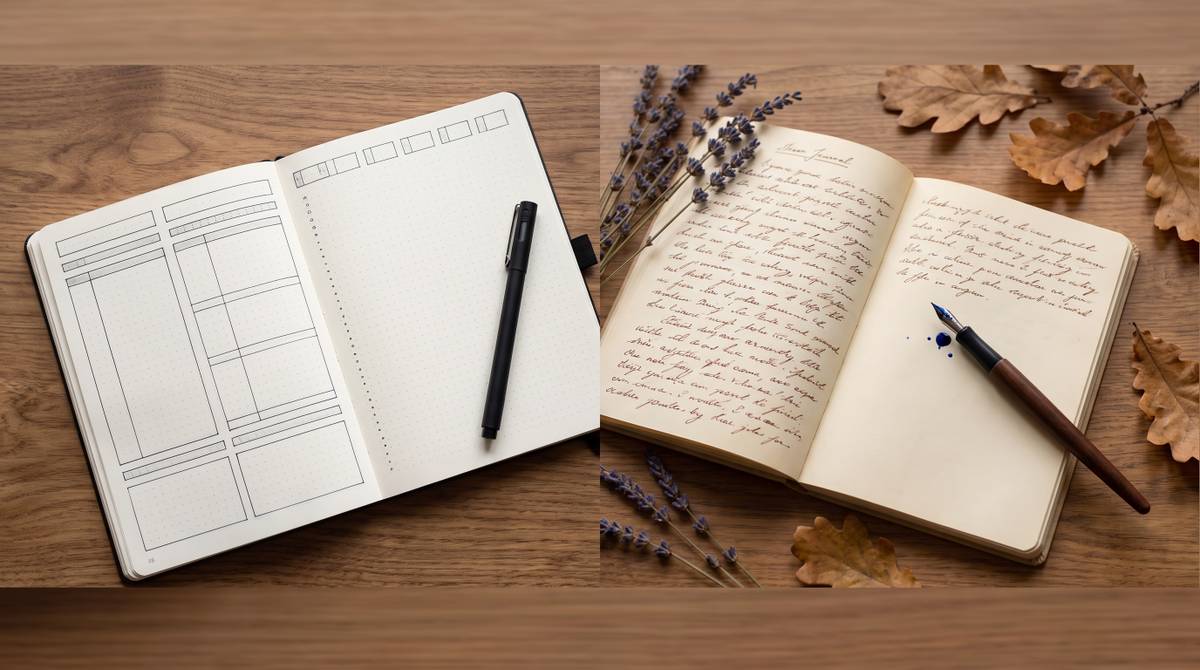
Bullet journaling is a structured method combining daily logs, habit tracking, and quick notation, and it gives the page a clear administrative function rather than an emotional one. Creative, associative thinkers, the ones who generate ideas faster than they can file them, do better with unstructured stream-of-consciousness writing, which lets thoughts land on the page without an editor standing at the door. Analytical problem-solvers get more out of the journal by treating it like a whiteboard: not "how do I feel about this" but "what is actually happening here and what are the variables." And visionary, long-range planners benefit from future-self journaling, the same format mentioned in the evening section, because writing from the imagined vantage point of a future self clarifies goals that otherwise stay comfortably abstract.
How does a person figure out which of these fits without taking a personality quiz? A three-question framework does the sorting: how much time is available right now, is the task processing a feeling or solving a problem, and does this moment call for structure or for freedom. Running any of the formats above through those three questions makes the fit obvious fairly quickly.
Bullet journaling and reflective journaling are not two flavors of the same activity. One manages tasks, the other processes emotion, and treating them as interchangeable is likely the single biggest reason people conclude that "journaling doesn't work for me," when what actually happened is that they used a filing system to try to process grief, or a feelings prompt to try to organize a to-do list. Match the tool to the job before concluding the tool is broken.
Building a journaling habit that survives the days when you do not feel like it
Everything so far assumes the writer shows up. Most days, eventually, they will not want to.
Consistency comes from reducing the number of decisions required at the moment of practice, not from manufacturing more motivation to override the resistance. Five focused minutes done daily outlasts the ambitious session that happens a couple of times and then quietly stops. This is the same logic behind laying out workout clothes the night before: remove the decision, and the behavior becomes close to automatic.
Habit stacking is the mechanical version of that principle. Attach the journaling moment to something that already happens every day (morning coffee, a lunch break, the few minutes before the lights go off) and the existing trigger fires the new behavior without requiring a separate act of will. These three anchors work specifically because they are already structurally present in most people's routines; nothing has to be invented to make room for them.
Prompts do the same friction-reduction work at a smaller scale. Answering a specific question costs less than composing an entry from a blank page, which is the entire argument this piece opened with, now applied at the level of daily behavior rather than the format of a single sitting. Rotating among categories, self-discovery, gratitude, anxiety-naming, goal-setting, keeps the practice from calcifying into a script the writer could recite in their sleep, which is its own quiet failure mode.
What about the days the entries come out shallow or repetitive? That is a risk with any daily habit, and the fix is to raise the honesty floor on the entries that do happen rather than journal less often: a short, specific, uncomfortable sentence will outperform a long, polished, safe paragraph nearly every time. Quantity sustains the habit. Honesty is what makes the habit worth sustaining.
Choosing between paper, app, and voice for everyday journaling
People treat the medium choice like a referendum on seriousness, as though choosing an app over a notebook says something about commitment. It is a tradeoff between two real, well-documented advantages, and the right call depends on which friction a given person is actually fighting.
Handwriting's cognitive edge holds up. Research cited in Marie Claire found that handwriting activates a broader brain network than typing, engages multiple systems at once, and supports stronger memory encoding, with the slower physical pace forcing deeper processing rather than passive transcription.
Digital journaling's advantage is different but no less concrete: a phone is already in every pocket, and portability removes the friction that derails most habits before they start. An app that is always present gets used more often than a notebook left elsewhere. The tradeoff is structural rather than incidental. Even a well-built app lives on a device engineered for interruption; a notification arriving mid-entry can undo the reflective state the writing was trying to produce.
Most people do not choose only one. Most committed practitioners don't. Hybrid workflows have become something close to a working consensus: handwritten brainstorming for creative flow and distraction-free thinking, paired with digital or voice capture for portability and day-to-day consistency. Used that way, paper and screen stop competing and start dividing labor, each handling the part it is actually good at.
For anyone who wants handwriting's depth without carrying the distraction risk of a general-purpose device, dedicated single-purpose writing hardware exists specifically to solve that problem. The Freewrite Smart Typewriter (Gen3) runs $699, the Freewrite Traveler offers a portable variant with an E Ink display and a scissor-switch keyboard and no browser or apps to speak of, and the Freewrite Alpha sits at the more affordable end of the line; the reMarkable Paper Pro is separately noted by Forbes Vetted as the best writing tablet overall⟗. These are legitimate tools for a writer who has already diagnosed digital distraction as the specific problem, though they solve it by trading one friction for another: the friction of carrying, charging, and justifying a second dedicated device.
None of that changes the underlying calculation. The format that wins is the one most likely to produce a genuinely honest entry on the day energy is lowest and the excuse to skip is strongest.
Sources
- Crafting a Personal Journaling Practice: Negotiating Ecosystems of Materials, Personal Context, and Community in Analog Journaling
- 46 Morning Journaling Prompts to Transform Your Mindset (It Only Takes 5 Minutes!)
- The Perfect Morning Journaling Routine: 15 Prompts to Start Your Day
- 15 Journaling Techniques That Actually Work
- Frontiers in Neuroscience 01 frontiersin.org A review of the neuroscience of