Bullet Journaling vs Traditional Journaling
One system clears your to-do list; the other processes your emotional life.

How Each Method Works, Day to Day
There is a version of this comparison that gets written constantly, and it usually goes: "bullet journaling is structured; traditional journaling is free-form; here are some prompts." That framing isn't wrong so much as it's uselessly incomplete. It treats the two as interchangeable tools when they were built for fundamentally different jobs. Choosing the wrong one is like bringing a hammer to a therapy session — technically a tool, but not the one that helps.
Bullet journaling is a system. Ryder Carroll, a digital product designer managing ADHD in the early 2010s, built it for himself before reliable neurodivergent productivity resources were widely available. The problem was specific: distraction, procrastination, and the cognitive overwhelm of trying to hold too much in an unreliable working memory. His solution was rapid logging. Tasks marked with a dot, events with a circle, notes with a dash, everything captured quickly in a single notebook organised by an index, monthly logs, daily logs, and thematic collections. The method launched publicly in 2013, picked up Kickstarter funding, and spread fast enough that by 2018 Instagram alone held over three million posts tagged to it. Carroll gave a TED talk at TEDxYale in 2017. The system was a phenomenon, which, as we will get to, created its own set of problems.
Traditional journaling has no equivalent origin story. No inventor, no launch date, no notation system. At its core it is the act of recording thought, feeling, and experience in written form, a practice that predates productivity culture by several centuries.
In daily practice, the difference is tactile before it's philosophical. A bullet journal asks for ten to twenty minutes a day: a few minutes to log the morning, slightly more to migrate incomplete tasks at the start of a new month, slightly more again for a weekly setup. Entries are stripped to essentials. "Call accountant. Buy milk. Meeting at 3." The system's discipline is structural, not expressive. It asks, consistently and only: what needs doing, and what happened?
Traditional journaling asks nothing so specific. Entry length, frequency, and content are entirely self-determined. The discipline required is internal, which is both its considerable strength and its barrier to entry. No migration process enforces reflection; no index forces organisation. What it offers instead is an invitation to slow down. That's real value, but it asks more of the writer than a dot-and-dash system does.
Externalising Mental Load: What Bullet Journaling Actually Does
The productivity literature has a term for the quiet, persistent cost of holding obligations in working memory: cognitive load. It's the low-grade hum of everything you haven't done yet, audible even when you're trying to focus on something else. Carroll's system addresses this directly. Getting tasks onto the page removes them from active cognitive rotation, freeing attention for whatever is actually in front of you. This principle predates the bullet journal by decades. What the system does is give it a practical, repeatable structure most people can actually maintain.
What makes the method more than a glorified to-do list is the migration process. Once a month, the user reviews every incomplete task and makes a deliberate choice: migrate it forward, schedule it, or drop it. That audit forces a reckoning with what you're actually working toward versus what you're carrying out of habit. Most productivity systems skip that step entirely. The bullet journal doesn't, and the cumulative effect over time is something closer to goal clarity than simple task management.
It is also worth considering the handwriting element specifically. A study by Van der Weel and Van der Meer, published in Frontiers in Psychology, found more elaborate neural connectivity patterns during handwriting than during typewriting, suggesting physical note-taking encodes information more durably than its digital equivalent. Whether or not neuroscience translates cleanly into productivity outcomes is a fair question, but the practical implication is worth entertaining: writing by hand is not merely a stylistic preference.
What the system fails to do is equally worth naming. A bullet journal tells you what you did and what you need to do. It offers no account of what you feel about any of it. It was not designed to.
What Traditional Journaling Does That a Productivity System Cannot
In 1986, James Pennebaker at the University of Texas at Austin began researching what happened when people wrote about emotionally difficult experiences. His findings became the foundation of what is now called Emotional Disclosure Theory, and they were striking: structured expressive writing about stressful or traumatic experiences, fifteen to twenty minutes across three to five sessions, produced measurable improvements in both psychological and physical health. The mechanism, as Pennebaker described it, was organisation. Writing forces coherence onto chaotic thought, and coherence itself turns out to be therapeutic.
The research built from there. A 2022 systematic review and meta-analysis published in Family Medicine and Community Health found that journaling improved mental health outcomes for people managing anxiety and PTSD, though the authors rightly noted that more high-quality research is still needed. A study of seventy adults with elevated anxiety found that twelve weeks of journaling reduced mental distress, increased wellbeing, and improved physical functioning. Pennebaker's original results have proven difficult to replicate consistently, and the debate about which conditions are necessary to produce the effect is ongoing. The signal, though, is promising. And the downside risk of keeping a journal is pretty low.
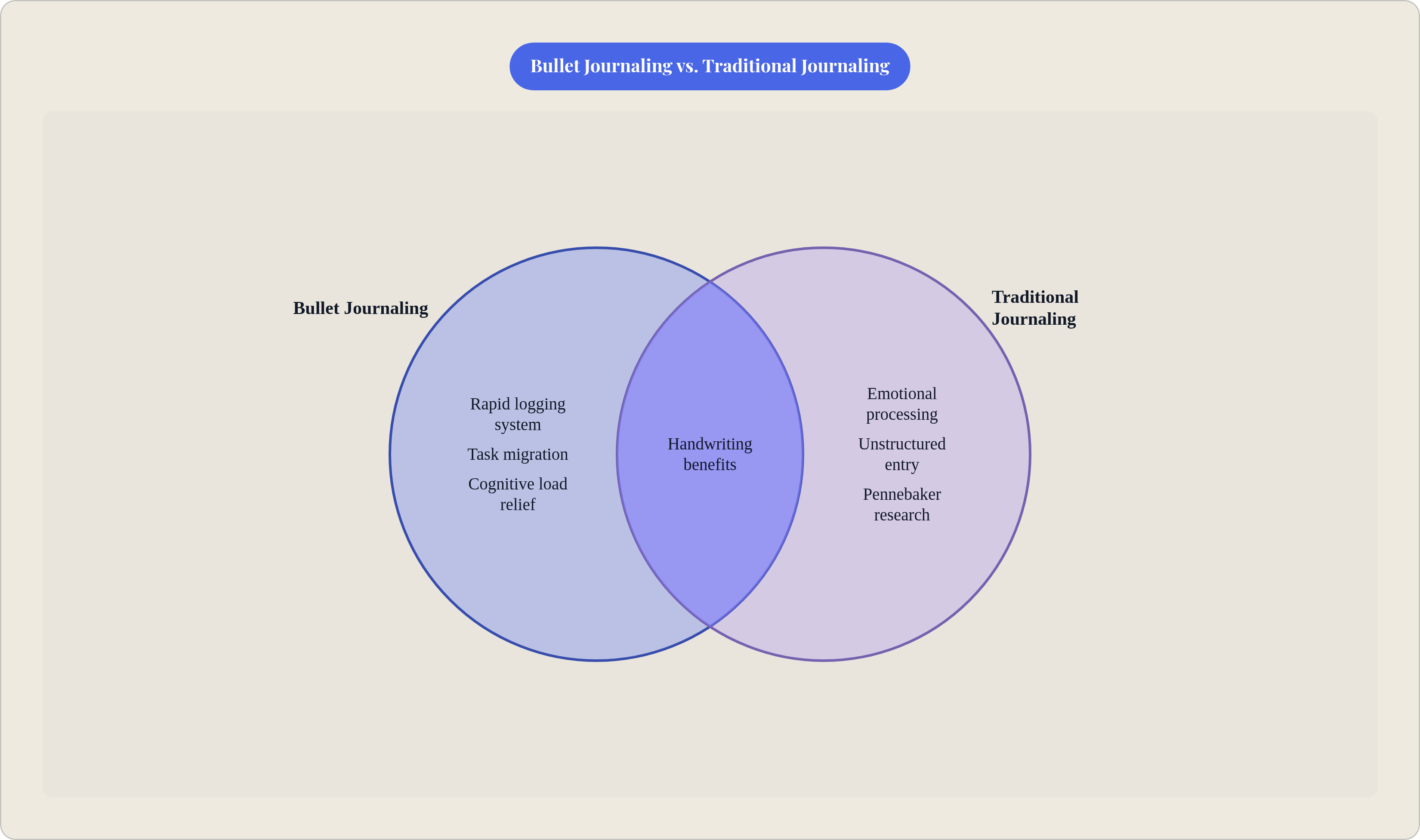
Why exactly does this happen? The working hypothesis is that unprocessed emotion doesn't disappear; it circulates. Writing creates an external container for it. That sounds similar to what a bullet journal does, but the purpose is different. The bullet journal externalises in order to execute. Expressive writing externalises in order to understand. One clears the runway; the other shows you where you've been standing all along.
Traditional journaling provides space for ambivalence, contradiction, and unresolved feeling; a record of emotional change over time rather than task completion; the slow, associative thinking that surfaces insight rather than action. None of that emerges from rapid logging, because the bullet journal was engineered for something else entirely rather than being deficient in any fundamental way.
The Brains and Situations Where Bullet Journaling Excels
Carroll built this system for his own brain, and the design choices are not arbitrary. They address specific cognitive challenges: working memory limitations, difficulty sustaining interest, and the shame spiral that accompanies inconsistency.
That last point deserves attention. Consider why dated planners fail so many people with ADHD. Missing a week means wasted pages. Wasted pages are a visible record of failure. A visible record of failure creates shame, and shame in this context is not motivating; it is paralysing. The bullet journal has no dates until the user writes them. Returning after a three-week gap costs nothing except a new page number in the index. That is, on its face, a small design decision. Its effect on sustained engagement is not small at all.
The broader applicability extends well beyond neurodivergent users. Anyone managing high task volume, multiple projects, or difficulty prioritising stands to benefit from the externalisation and migration framework. The system provides enough scaffolding to capture and organise thought while remaining customisable enough to change when a particular format stops working, which is exactly the kind of flexibility that derails people's relationships with rigid, pre-formatted planners.
But what if the primary need is not task management? What if someone comes to the bullet journal not because they're overwhelmed by competing obligations but because they're overwhelmed by emotion? Then the system is the wrong tool, however well-designed. Setup time and learning curve become friction with no corresponding payoff. What's needed is unstructured space, rather than a framework for capturing it.
The Instagram Version of Bullet Journaling Is Not the Bullet Journal
Something should be said plainly about what bullet journaling looks like on TikTok and Pinterest, because the gap between that and Carroll's original system is significant enough to cause real confusion, and possibly some wasted afternoon hours with a brush pen.
The social media version features elaborately decorated spreads: hand-lettered headings, washi tape borders, colour-coded mood trackers rendered with illustrated flair. Visually, it sits closer to an art project than a productivity system. For some people, the creative component adds personal investment and enjoyment, and neither of those is trivial. But critics within the community have noted for years that the aesthetic standards these platforms project have created a perfectionism that inverts the method's original purpose. Mistakes become shameful rather than irrelevant. Symmetry overrides function. The visual output becomes the point.
The effect on new users is predictable. Someone adopts bullet journaling expecting a creative outlet, encounters the productivity system underneath, and finds it either insufficient for that purpose or overwhelming for the other. Or they spend more time decorating than logging, which is a legitimate hobby but is not what Carroll built. The original system is deliberately minimal precisely because cognitive load was the problem being solved. Elaborate setup recreates the problem.
As of 2025, a visible shift back toward the original intention is underway in the broader BuJo community, toward simplicity and function, with creativity as an optional addition rather than the price of admission. A bullet journal dressed in washi tape and watercolour is still a bullet journal. A bullet journal stripped back to a dot and a dash? That one actually works.
Choosing Based on What You Actually Need, Not What Looks Good Online
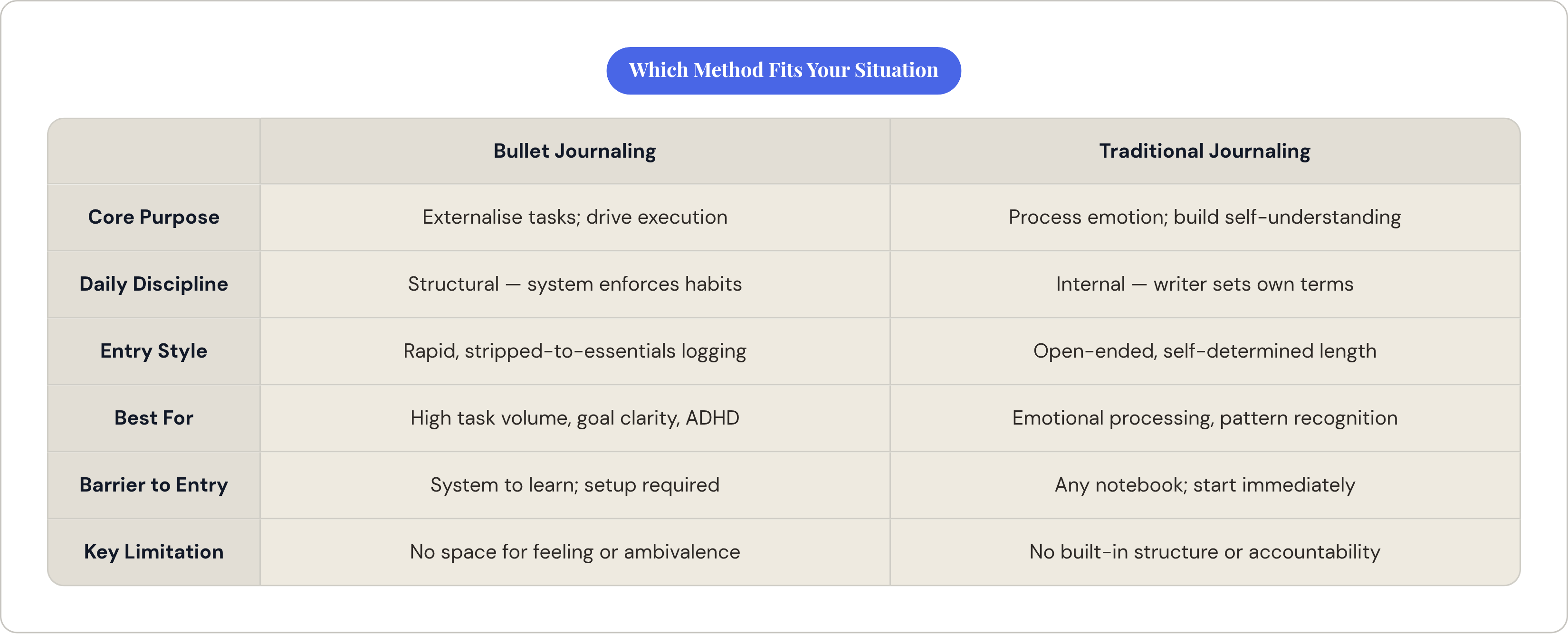
The diagnostic question is simpler than the comparison usually makes it seem. Is the primary problem getting things done and staying organised, or is it understanding yourself and processing experience? One method was engineered for the first. The other is suited, by design and by research, for the second.
Signals that bullet journaling fits: feeling overwhelmed by competing tasks; repeatedly losing track of goals; struggling with planners that feel punishing because missed days create visible failure; wanting a single place for tasks, notes, and plans rather than maintaining multiple tools simultaneously.
Signals that traditional journaling fits: carrying unprocessed emotion that needs somewhere to go; wanting to understand patterns in behaviour, mood, or relationships over time; needing low-barrier entry with no system to learn and no setup required. Traditional journaling can begin immediately, with any notebook, with no instruction. That accessibility is not a consolation prize.
One argument holds that choosing between them is a false dilemma, and that argument holds up. They solve different problems, so they don't compete. A bullet journal can handle task and goal management while a separate notebook holds reflection. Some users integrate brief reflective entries into their bullet journal without converting the whole thing into something it wasn't designed to be. The methods are not mutually exclusive.
The decision is also not permanent. Both are inexpensive to start and easy to adjust. The goal is to match the tool to the actual need rather than to the most aesthetically compelling version you encountered online. Joice, a conversational journaling app where you speak your thoughts aloud and it responds in real time rather than asking you to write anything down, sits closer to the traditional journaling end of that spectrum for people who think better out loud than on a page. That turns out to be harder than it sounds, which is probably why this comparison keeps getting written.