Evernote Alternatives for Personal Journaling
Journaling and note-taking solve different problems, requiring different tools.

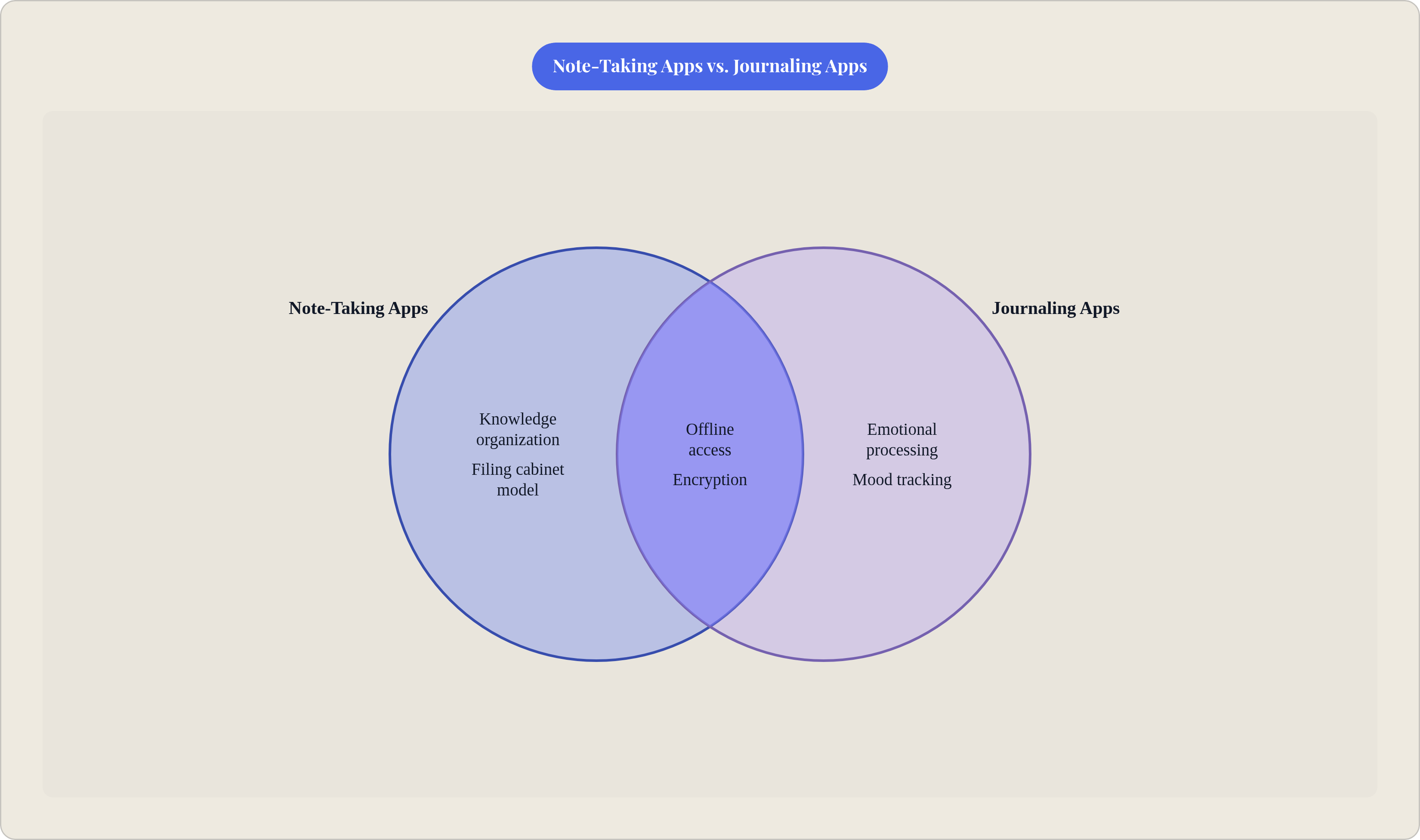
Most alternatives guides miss this distinction entirely, which is why they keep recommending the wrong tools. Note-taking optimizes for capture and retrieval: you record information so you can find it later. Journaling optimizes for something categorically different: emotional processing, reflective continuity, and the slow accumulation of self-knowledge across years. The cognitive job is different. The requirements follow accordingly. Think of it this way: a note-taking app is a filing cabinet, but a journaling app is a mirror — one stores what you know, the other shows you who you are.
Five criteria matter before evaluating any specific tool.
Privacy and encryption. Journal entries cover emotional states, difficult relationships, mental health, and fears. End-to-end encryption isn't a premium feature; for a journaler, it's a baseline. An app that can read your entries changes what you're willing to write. That change undermines the entire value of the practice.
Daily writing flow. A journaler opens the app every day, often at the same time, often under conditions of low mental energy. Frictionless entry creation matters enormously. Organizational depth matters very little. Nobody needs to file their morning pages across seventeen nested notebooks.
Emotional continuity. Timeline views, "on this day" prompts, mood tracking, and cross-temporal search support the reflective arc that makes journaling useful over years rather than days. Storing entries chronologically in a note-taking app is not the same thing. The interface should encourage you to look back.
Offline reliability. Journaling happens at fixed personal times: early morning, before sleep, during a commute. An app that requires connectivity to save an entry is a liability for anyone treating the practice seriously.
Low setup overhead. A tool that requires hours of configuration before it functions as a journal will be abandoned. Every minute spent building templates is a minute not spent writing.
Notion and Obsidian optimize for knowledge organization and retrieval. That's a respectable design goal; it's just a different one. For a large and growing population of digital journalers, getting the tool wrong doesn't mean a suboptimal productivity workflow. It means the practice doesn't stick.
Why the writing environment shapes what you write
This isn't a subjective preference claim. Three decades of peer-reviewed research confirm that writing changes how the brain processes stress, stores memories, and regulates emotion. James Pennebaker's research at the University of Texas demonstrated that expressive writing strengthens the connection between the limbic system and the prefrontal cortex, improving emotional regulation and cognitive processing. Klein and Boals (2001) found that writing about stressful events improved working memory by freeing up cognitive resources previously occupied by intrusive thoughts. The benefits are real. They also depend on conditions most apps don't think to provide.
But why does privacy affect what you write, not just whether others can read it? Because people self-censor in environments they don't fully trust. The cognitive benefits of expressive writing require full disclosure, the unedited version of events. A sanitized entry, written with ambient awareness of potential exposure, produces diminished returns. The tool isn't incidental to the practice. It's constitutive of it.
Evernote's lack of end-to-end encryption, in this context, isn't a minor product oversight. For journalers specifically, it's a structural problem. And losing an entry during sync, which Evernote mobile users reported with some regularity, lands differently depending on what was in that entry. A corrupted grocery list is annoying. A corrupted entry written the day a parent died is something else entirely. That's not hyperbole; it's the specific failure mode that dedicated journaling infrastructure is designed to prevent.
There is something absurd, when you sit with it, about the fact that people were using the same app to clip articles and write about grief, anxiety, or a marriage falling apart. That is broadly what Evernote became: a container for everything, which is exactly why it works well for some things and poorly for others. When Evernote gutted its free tier in 2023 and triggered a mass exodus, most coverage framed it as a pricing story. It was also an opportunity, largely missed, to ask what these users actually needed next.
Apps built specifically for journaling: Day One, Journey, Diarium, Reflectly, and Penzu
These are the tools designed for this use case. They don't require you to construct a journaling system. They are one.
Day One
Day One has been the reference standard for dedicated journaling apps since its 2011 launch. End-to-end encryption, "on this day" reminders, photo journaling, a timeline interface, and a functional free tier distinguish it from tools that support journaling as an afterthought. Over 150,000 five-star reviews and an Apple App of the Year award are reasonable proxies for sustained trust, though awards age faster than habits.
The free tier includes E2EE, tags, "On This Day," and export. The paywall is primarily one device. A premium plan runs approximately $34.99 per year for a purpose-built, well-maintained product, which is reasonable.
The 2025 Windows launch makes Day One cross-platform across iOS, macOS, Android, web, and Windows. For years, Android and Windows users were effectively second-class citizens in the Day One ecosystem. That limitation is largely resolved, though its roots remain deepest in Apple hardware.
For iOS and macOS primary users, Day One is a strong answer. For everyone else, it's still excellent.
Journey
Journey is the most direct Day One analog for Android-first users. Comparable feature set: automatic metadata capture, multimedia journaling, clean timeline presentation, templates. Its cross-platform coverage has historically been more consistent than Day One's, and it carries a lower price point. For Android-primary users who want Day One's feature set without the historical Apple-ecosystem dependency, Journey is the natural choice.
Diarium
Diarium occupies a specific and useful niche: the auto-populating journal. It pulls social posts, photos, step counts, weather, and location data into entries automatically, building a contextual record of your life even on days when you write nothing. For Windows users especially, it is the strongest dedicated journaling option currently available.
That said, it's worth considering what auto-population actually does to the practice. If the goal is emotional processing, does a pre-filled entry help or provide an easy escape from writing anything substantive? For people who want ambient context, the feature is useful. For people who need to be pushed to reflect, it's a crutch. That distinction is worth knowing before committing.
Reflectly
Reflectly approaches journaling through a different frame. Its three-part daily check-in, covering what happened, how you felt, and what's next, lowers the blank-page barrier considerably. With over ten million downloads, it has found a clear audience. Its core value is mood and activity correlation tracking over time.
Here's the useful precision: Day One records what happened; Reflectly tracks how you felt. These are different jobs. Someone who wants a narrative record of events will find Reflectly constraining. Someone whose primary interest is emotional pattern recognition will find Day One cumbersome. They're not competing products. They're serving different journalers.
Penzu
Penzu is the deliberate minimalist. AES-256 encryption, no advertising, no data monetization, no configuration complexity. It does one thing and is unapologetically unconcerned with doing anything else. For privacy-first journalers who want a clean, locked-down writing space with zero setup overhead, Penzu is a strong answer. It is not exciting. That's the point.
Writing-focused apps that can work for journaling with minimal setup: Bear, Reflect, and UpNote
These apps weren't built for journaling, but they require minimal adaptation and serve the practice reasonably well, provided you understand what they optimize for and what they don't.
Bear
Bear has one of the finest prose writing environments available on Apple platforms. The interface is clean, the typography is considered, and the long-form writing experience is pleasurable in a way most dedicated journals fail to match. It's the kind of app that gets out of your way, and getting out of your way turns out to matter more than it sounds.
What Bear lacks: calendar integration, mood tracking, timeline visualization, streaks, or any journaling-specific UI element. It's a writing tool that happens to be excellent for journaling, not a journaling tool that also handles writing. Most users feel that distinction eventually.
A web version launched in public beta in 2025, partially addressing the Apple-only limitation. Pricing is $2.99 per month or $29.99 per year, comparable to Day One.
If you want a streak counter or an "on this day" prompt, Bear is the wrong tool. If you want to write and have it feel good, it's the right one.
Reflect Notes
Reflect Notes is privacy-first and encrypted, with calendar sync and structured daily note prompts covering goals, tasks, and reflections. Its differentiator is light AI-assisted scaffolding: prompts that support habit formation without demanding the blank-page discipline that narrative journaling requires.
Some argue that AI assistance defeats the purpose of introspective writing, and that's a defensible position. But for users who struggle with entry initiation rather than the writing itself, a well-designed prompt system is often the difference between a practice that exists and one that doesn't. The blank page is a real obstacle, not a romantic one. For journalers who want structured prompts without sacrificing privacy, Reflect Notes is the most coherent option in that niche.
UpNote
UpNote is the most pragmatic option on this list. It replicates the Evernote experience more faithfully than any other alternative: notebook hierarchy, rich text editor, cross-platform sync, familiar organizational structure. Migration friction is as low as it gets.
What it doesn't offer: a timeline view, mood tracking, or any design element that makes journaling a distinct practice rather than sequential note-taking. It's an Evernote replacement. It is not a journaling app. Whether that matters depends entirely on how central journaling actually was to what you were doing in Evernote.
Pricing is unusual: $1.99 per month or $39.99 for a lifetime license, one of the most affordable entry points in the category. For Evernote migrants who want minimum workflow disruption and treat journaling as secondary, UpNote is the path of least resistance.
When productivity workspaces are the wrong answer for journaling: Notion and Obsidian
Both appear on nearly every Evernote alternatives list. Both are capable, well-developed products. Neither is a strong answer for personal journaling, and recommending them in that context reflects a misunderstanding of the use case.
Notion
Notion is a capable productivity platform. Block-based document construction, AI agent integration, and native email via Notion Mail represent a serious attempt at consolidating knowledge work into one environment. For teams, project management, and knowledge bases, it's legitimate.
The journaling-specific problems are significant. Notion has poor offline support; entries are inaccessible or lost without internet, which is a structural reliability failure for a daily practice. There is no end-to-end encryption; Notion can read your entries. The setup time required to make Notion function as a journal is non-trivial, which is precisely the wrong condition for habit formation.
It is also worth considering what the setup cost signals about who the tool is actually for. Notion is designed for people who enjoy building systems. Most people who want to journal are not that person. And most people who are that person probably shouldn't be spending their journaling time configuring databases.
The only reasonable case for Notion as a journal is when journaling belongs inside a larger Notion workspace that's already working. That's a real scenario. It's just a narrow one.
Obsidian
Obsidian's relationship to this conversation is more nuanced. It's local-first by default, offline without configuration, and the removal of the commercial license requirement in February 2025 made it free for all uses. The privacy and offline story is strong.
But the learning curve is steep, steeper than any dedicated journaling app, and there is no built-in timeline, no mood tracking, no "on this day" feature, no journaling-specific UI. Sync across devices costs extra through Obsidian Sync ($4 to $5 per month) or requires a self-managed solution using iCloud, Syncthing, or Git. That's a technically meaningful obstacle for most people.
The honest case for Obsidian as a journal is narrow: if you're already an Obsidian user building a knowledge base and you want daily notes to live inside that system, the incremental cost is low. As a first tool for someone trying to establish a journaling habit, it's actively counterproductive.
The core issue with both tools is the same. Recommending either to someone who wants to journal is like handing someone a Swiss Army knife when they asked for a pen — technically it writes, but that's not the point. Notion and Obsidian are the wrong tools for the vast majority of people who actually try to journal with them.
Free and open-source options for privacy-conscious journalers: Joplin and self-hosted alternatives
Joplin
Joplin is completely free, fully open-source, and entirely usable offline, with optional sync to services the user controls rather than a third-party server. Joplin Cloud sync runs at a few euros per month, or you can sync through Dropbox, Nextcloud, or WebDAV outside the Joplin ecosystem entirely.
It is not a dedicated journaling app. There is no calendar view, no mood tracking, no timeline. But for daily writing without cost or vendor lock-in, it's functional and reliable. For technically comfortable users who prioritize open-source tools and data portability over polished journaling features, Joplin is the strongest free option.
Self-hosted alternatives
Moving to a self-hosted solution gives complete control: entries touch no third-party servers, there are no subscription fees, customization is extensive. The tradeoff is meaningful technical overhead to set up and maintain.
That raises an important question: who is this actually for? The realistic audience is journalers who are also developers, or at minimum technically motivated users. For most people trying to build a daily writing habit, the setup cost of a self-hosted solution will deter them from writing a second entry. Recommending self-hosted options broadly because they're "free" ignores that the most significant cost isn't monetary.
Free and open-source tools are the right answer for a specific subset of journalers. Most alternatives guides imply that subset is nearly everyone. It isn't.
Matching the right app to the type of journaling you actually do
A 2019 study published in Behavior Modification found that participants matched with journaling methods aligned with their personality traits and goals showed significantly greater psychological benefit than those assigned a random method. The tool layer works the same way. The best journaling app is not the one with the most features; it's the one that corresponds to the kind of journaling you'll actually sustain.
Two questions cut through most of the decision tree. First: is end-to-end encryption non-negotiable? If yes, Notion and any app without E2EE are eliminated immediately. Second: do you need journaling-specific features like timeline views, mood tracking, or "on this day" prompts, or are you primarily looking for a reliable private writing environment?
From there, the choices narrow considerably, and they narrow in ways that the standard alternatives guides don't map cleanly.
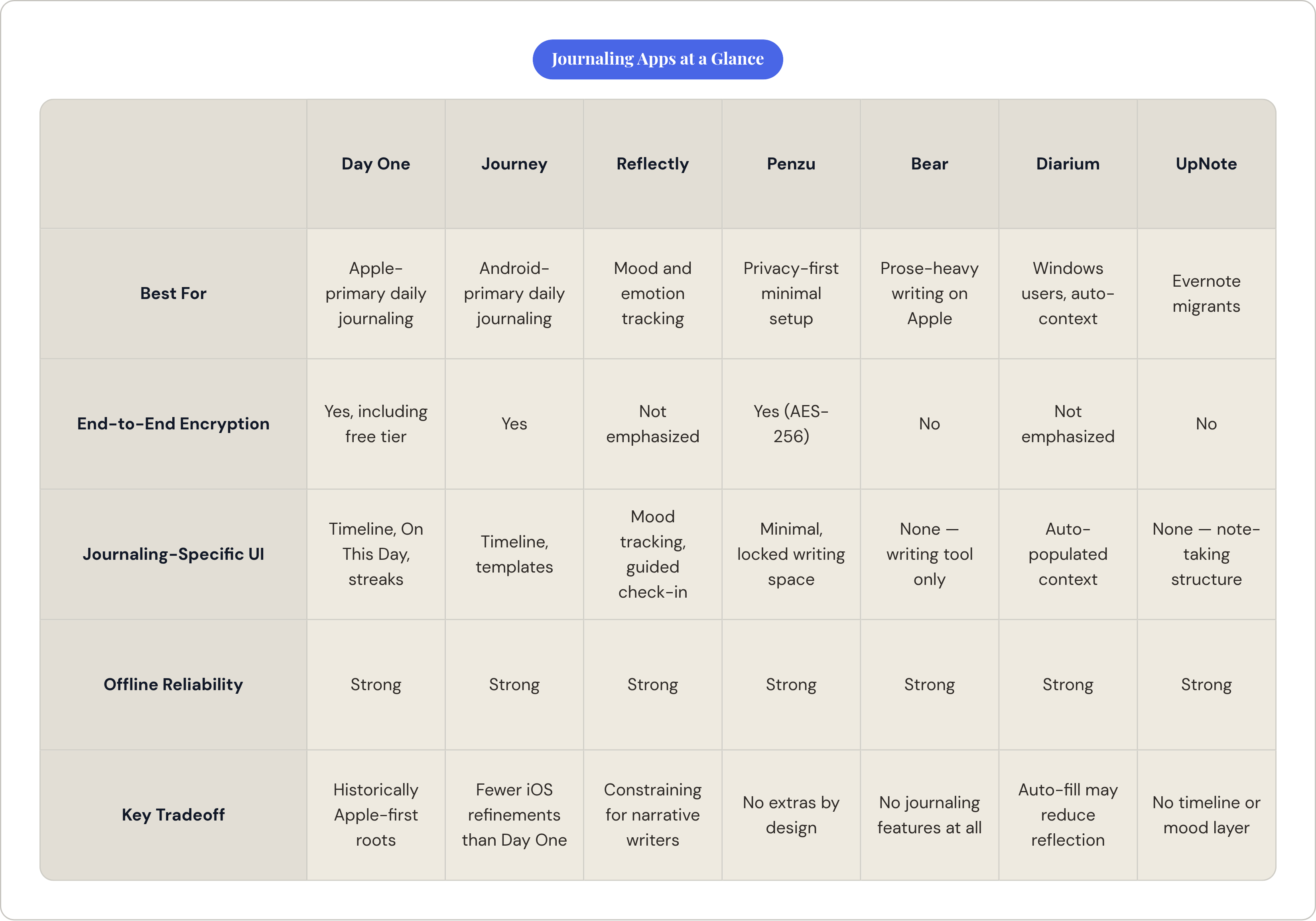
Daily narrative journaling with privacy as a priority points to Day One for Apple-primary users and Journey for Android-primary users. Penzu serves users who want encryption and zero configuration overhead. Emotional check-ins and mood pattern tracking point to Reflectly, which is purpose-built in a way Day One isn't. Prose-heavy journaling on Apple, where the quality of the writing environment matters most, points to Bear: you sacrifice journaling-specific features; you gain a better experience of actually writing. Windows-primary users have a strong dedicated option in Diarium. Structured daily reflection with AI-assisted prompts, without privacy compromises, points to Reflect Notes. Evernote migrants who want minimum disruption and treat journaling as secondary will find UpNote the path of least resistance.
For journaling inside an existing knowledge workspace, Obsidian is defensible if offline reliability and privacy matter and you're already in that ecosystem. Notion is acceptable only if you're already embedded in Notion workflows and offline access isn't a daily concern. For technically comfortable users who want free and open-source tools with full data portability, Joplin is functional and trustworthy.
The apps that appear on every Evernote alternatives list are evaluated on criteria that serve productivity users well. Journalers are not productivity users. The practice they're sustaining is psychologically distinct, the content they're generating is categorically more sensitive, and the conditions required for that practice to actually work are different from the conditions that make a notes app effective. The research on expressive writing is clear about the benefits. It's less explicit about the fact that the tool mediating the practice is not incidental to those benefits. It should probably be more explicit about that.