Best Journaling Apps for Daily Writing
Apps that support daily writing matter more than apps packed with features.

There is something quietly absurd about a $6.07 billion market built around the act of sitting down and writing your thoughts. Journaling is, at its core, one of the oldest and most frictionless human behaviors: find a surface, apply a writing instrument, continue until something clarifies. The digital journaling industry has looked at that simplicity and decided it needed a subscription tier, an AI coach, a mood-tracking widget, and a built-in book printer. Whether that is progress or irony is, perhaps, the central question of this entire evaluation.
The market is growing at roughly 9.57% annually, driven by two converging forces: demand for mindfulness tools, and the integration of AI-personalized features. Both trends, somewhat paradoxically, have produced a wave of increasingly feature-heavy applications competing for a user who, if the research is to be believed, would benefit most from an app that does as little as possible. That tension is not incidental to this review. It is the review.
Most roundups sort apps by features. This one does not. Feature count is a poor proxy for whether a journaling app actually supports a daily practice, and daily practice is the only outcome that matters. An app you use once a week, however beautiful, is a photo album, not a journal.
What the Science Actually Says Journaling Does, and What That Implies About the Tools
James Pennebaker's expressive writing research, spanning more than 200 peer-reviewed studies over four decades, identifies the core mechanism: 15 to 20 minutes of private, unfiltered writing about emotionally significant experiences, sustained across consecutive days, produces measurable psychological and physiological benefit. A meta-analysis of 13 randomized controlled trials found that expressive writing produced significant health improvements with an effect size of d = 0.47, which is comparable to many pharmaceutical interventions. That is not a trivial finding.
The key implication is this: consistency matters more than the medium. The cognitive benefits come from showing up, not from which app you use. Brain imaging research further suggests that neuroplasticity changes from consistent journaling become measurable after roughly four to six weeks of regular engagement. The first job of any journaling tool is not to impress you on day one. It is to keep you coming back through week six.
That raises an important question for any app evaluation: how many of the features that win awards and generate buzz actively interfere with the mechanism the science describes? If the answer is "quite a few," then the industry's incentive structure, optimized for acquisition and review scores, is working against the user's actual goal. That is an observation about market dynamics, not an accusation. Evaluating journaling apps by feature count is like evaluating running shoes by how many colors they come in — a vivid distraction from the only question that matters: will they carry you the distance?
The reliability-first frame used in this comparison is not an aesthetic preference. It is what the research demands.
The Specific Ways Apps Break Daily Writing Habits
Three structural failure modes appear repeatedly across the category, and naming them precisely makes the evaluation criteria that follow more defensible.
The first is connectivity dependency. Apps that require a network connection to open or sync create a hard stop the moment a writer is on a plane, in a waiting room, or somewhere with unreliable signal. This sounds like a niche inconvenience. It is not. Habit formation research is unambiguous that environmental consistency lowers the activation energy required to perform a behavior; an app that fails unpredictably trains the writer to distrust the tool, and distrust breaks streaks.
The second is feature-induced friction. A toolbar that prompts photo attachment, mood logging, weather tagging, and a daily question before the cursor reaches the text field adds decision overhead to what should be a zero-resistance act. Each prompt is individually benign. Collectively, they constitute a gauntlet. The writer who sits down tired at 10 p.m. does not want to tag their mood before they can write. They want to write.
The third is subscription instability. Apps that gate basic functionality behind a paywall, or that change pricing mid-use, break the psychological continuity of a journal in a way that is difficult to articulate but easy to feel. The entries feel less permanent when the app feels uncertain. This is not irrational on the user's part; it is a reasonable inference about data custody.
A secondary failure mode, worth flagging separately: apps designed primarily for review and reflection rather than daily input. Beautiful calendar views and "On This Day" flashbacks are genuinely rewarding features, but they signal an app optimized for looking back, not for showing up today. Both orientations have value; they are not the same orientation.
The practical standard this evaluation uses is blunt: an app should go from closed to cursor-in-blank-entry in under two seconds, work with no internet connection, and stay out of the way until writing is done.
The Evaluation Framework Used in This Comparison
Five criteria, each tied directly to the friction argument above.
Offline capability. Does the app work fully without a connection? Does it sync cleanly when connectivity returns, without duplicating or losing entries? This is a binary quality signal more than a gradient.
Speed to first word. How many taps or steps exist between opening the app and a blank writing surface? Is there a widget or shortcut that bypasses menus entirely? Fewer steps is not a preference; it is a measurable variable in habit maintenance.
Keyboard and input reliability. Does the app behave predictably with a hardware keyboard attached? Does it handle long-form text without lag or formatting interruption? Writers who use external keyboards, on iPad, Mac, or Windows, are often the most committed daily writers. An app that fights the keyboard is an app that fights its most serious users.
Privacy and data ownership. Where do entries live? Is end-to-end encryption available? Can entries be exported in a portable, human-readable format without losing structure? A journal is, by definition, private material. The architecture should reflect that.
Pricing stability. Is core functionality available without a subscription? Is the free tier genuinely usable for daily writing, or a demonstration of what paid users get? The bar here is not "free forever." It is "stable enough that the writer doesn't worry about the app when they should be thinking about their writing."
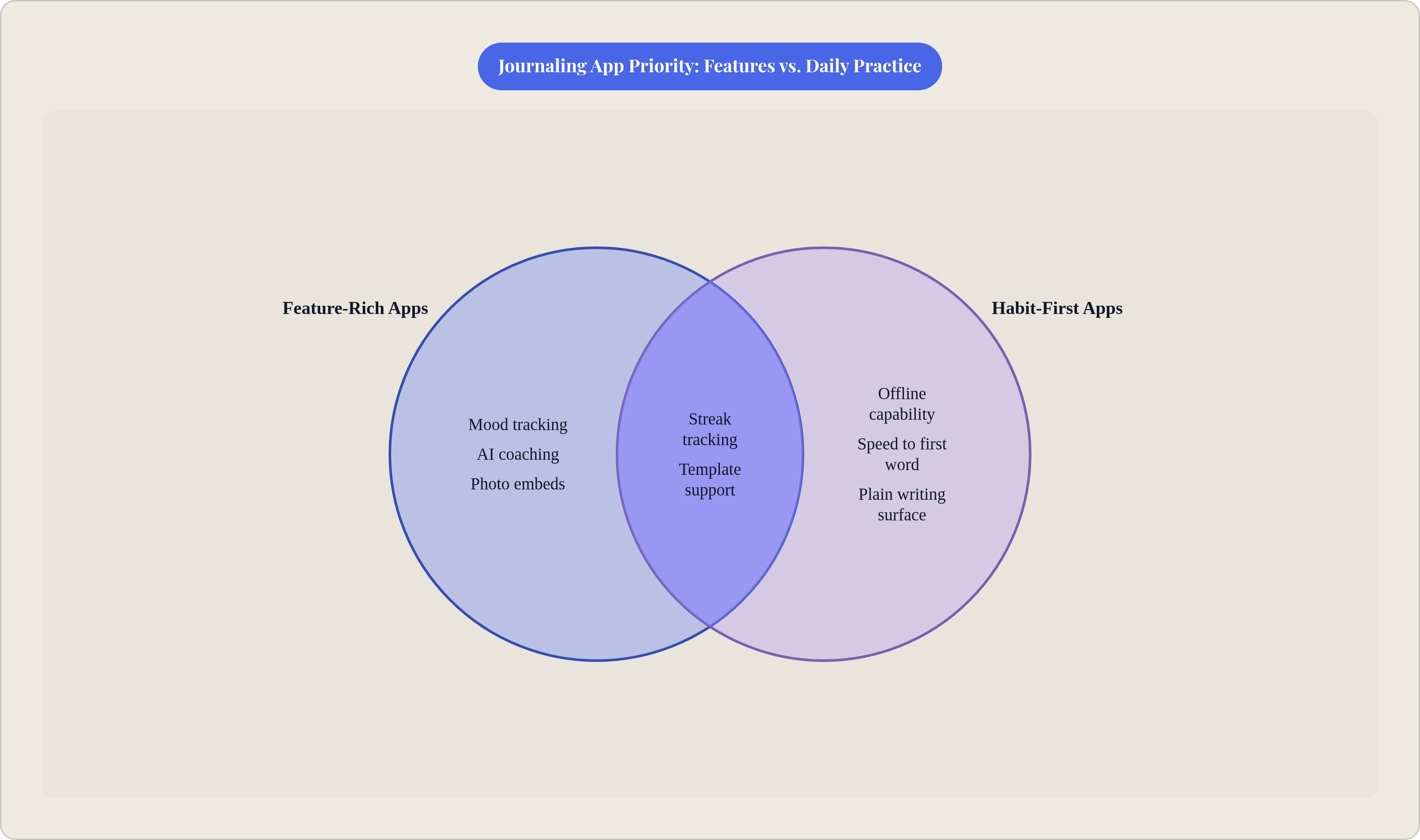
It is also worth considering what is absent from this framework. AI prompts, mood tracking, photo embeds, and social sharing are evaluated only as secondary considerations. They are features that enrich an established habit. They do not create one. Evaluating apps on these dimensions first is the category's most common analytical error, and most review sites make it.
Platform scope covers iOS, Android, macOS, and Windows. Cross-platform consistency is weighted, because writers who switch devices mid-habit face an additional source of friction that is easy to underestimate.
The Benchmark Every Other App Is Measured Against
One app has been the dominant journaling app since 2011. Over 150,000 five-star reviews and Apple's App of the Year recognition have established it as the default reference point for the category. That reputation is earned, not inherited, though it is also worth interrogating rather than accepting as permanent truth.
Against the framework: offline capability is strong, with entries stored locally and synced on reconnection. Speed to first word is fast on iOS; Apple Watch quick-capture and home screen widgets make entry creation genuinely frictionless for iPhone-primary writers. Keyboard reliability is solid on macOS and iOS. Privacy-conscious users will note that the 2021 acquisition by Automattic moved the model toward account-based sync, though end-to-end encryption remains available on Premium. The Gold tier, priced at a premium annual rate, adds AI features including Daily Chat, summaries, and image generation. The free tier is functional but limited in device count and storage.
One honest limitation deserves direct statement: the Android experience is less polished than the iOS counterpart. For cross-platform writers, the web version partially compensates, and the 2025 Windows launch addressed the platform's most conspicuous gap. Android-primary users should go in with calibrated expectations.
Features worth noting without overselling: "On This Day" flashbacks, printed book creation, and automatic logging via connected services are genuinely useful for writers who want passive context embedded in their entries. They are secondary to the writing experience, but they are executed well.
Verdict against the framework: this app is the closest thing to a gold standard for iOS-primary and Apple ecosystem writers. The reliability case is strong. The Premium paywall and Automattic ownership are legitimate considerations, not dismissible ones.
The Field of Serious Alternatives, and Where Each One Wins
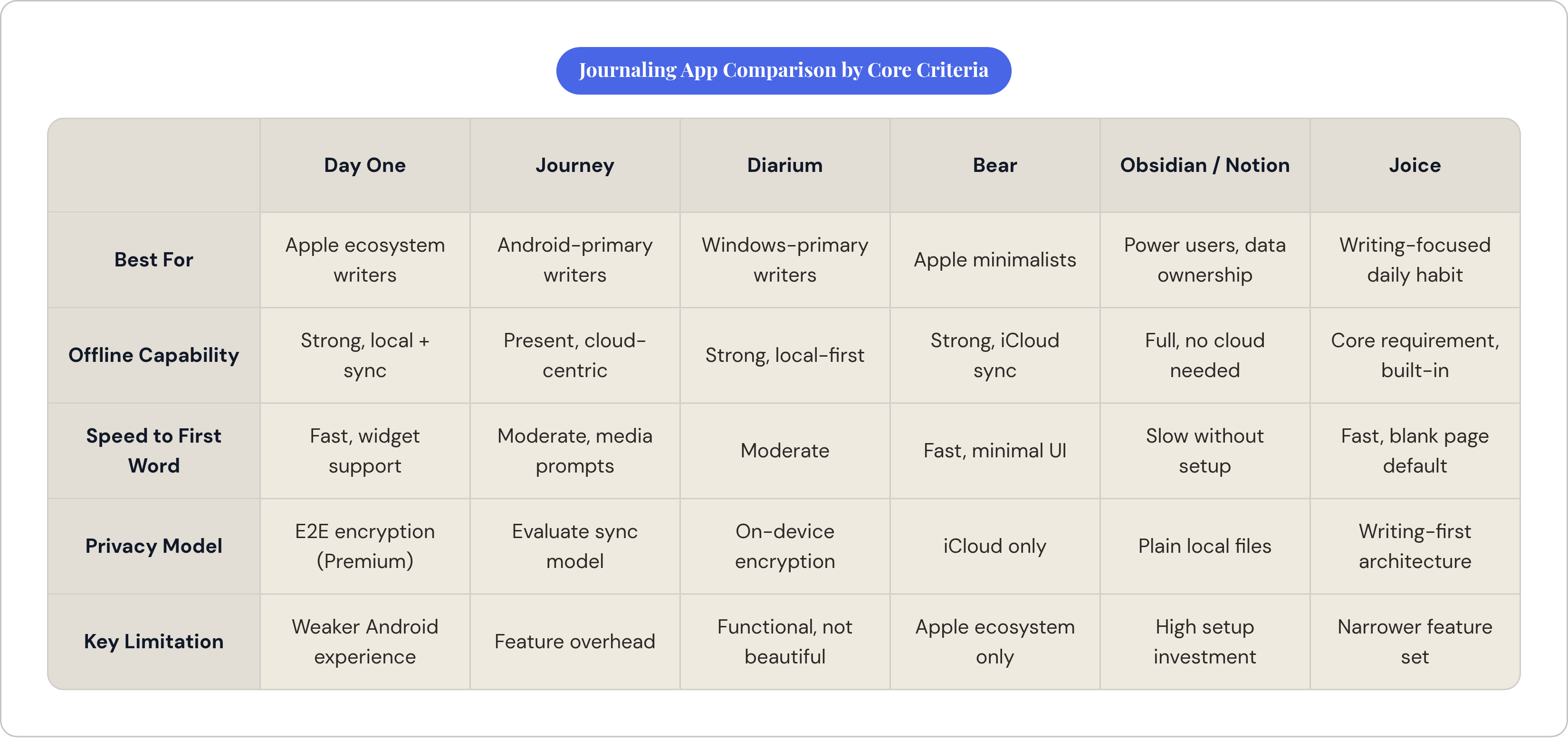
Journey is the most complete option for Android-primary writers who have historically felt like a secondary market for the category. Cross-platform support is genuine across Android, iOS, and web. The app is multimedia-forward, supporting photos, video, audio, and location tagging, which makes it well-suited to writers who want their journal to function simultaneously as a life log. AI coaching features are present and optional; useful for writers who want structured prompts, less useful for those who prefer a blank page and silence. Offline capability is present, though cloud sync is more central to the experience than in some alternatives. Privacy-conscious users should evaluate the sync model before committing.
Diarium makes the strongest case for Windows-primary writers, a constituency that the Apple-centric field has historically underserved. The local-first storage model is a meaningful privacy advantage; entries can be encrypted and stored on-device without requiring a cloud account. Auto-import from social media, fitness trackers, and weather data passively populates entries with contextual information, reducing the daily entry barrier for writers who want that layer without manual input. The interface is functional rather than beautiful. Writers who care about the writing surface rather than the visual aesthetic will find that a feature, not a compromise.
Notion and similar local-first, Markdown-based tools are not journaling apps by design, but both are used extensively for daily writing by people who prioritize data ownership and structural flexibility. The local-first, Markdown-based model offers the strongest portability case in the entire category: entries are plain text files that no company controls, no subscription governs, and no acquisition can complicate. The friction cost is real. Both require meaningful setup investment before they function reliably as daily writing surfaces, and speed to first word on day one is poor without templates in place. Best suited to technically comfortable writers who want a journaling system that doubles as a personal knowledge base. Beginners building a first habit will likely find these options overwhelming.
Bear operates exclusively within the Apple ecosystem, which is an immediate disqualifier for Android or Windows users. Within that constraint, it is excellent: clean Markdown editor, fast entry creation, reliable iCloud sync, and keyboard support that is among the best in the category. It is closer to a writing tool than a dedicated journal app, lacking date-based navigation and journaling-specific features like streak tracking. Best for Apple-only writers who prefer a minimal surface and are comfortable in Markdown.
Joice is a voice journaling app built on the idea that talking things out is the most natural way to understand yourself. You speak, it responds in real time with genuine curiosity, and every session is automatically transcribed and made searchable. That makes it a strong fit for people who have cycled through text-based apps and found that the blank page was quietly compounding their dropout risk. It is journaling done entirely through your voice rather than a keyboard, which is either exactly the entry point you need or a clear signal the app is not for you.
How Journaling Method Interacts With App Choice
Research in behavior modification has found that participants matched with journaling styles aligned with their personality traits and goals showed significantly greater psychological benefit than those assigned a random method. Method-to-goal alignment is not cosmetic. It meaningfully affects outcomes, which means app selection cannot be fully separated from method selection.
Three alignments are worth making explicit.
Stream-of-consciousness and expressive writing, Pennebaker's model of 15 to 20 minutes of unfiltered writing, demands a blank-page app with fast load and no prompts interrupting the flow. Apps such as Joice, a conversational journaling app where you talk through your thoughts instead of typing them and it responds in real time, can serve this use case well for people who find that speaking removes the resistance that writing creates. Local-first, Markdown-based tools work for Markdown-comfortable writers who have done the upfront configuration work.
Gratitude journaling, the practice of writing three to five things daily, benefits from structured templates and streak tracking. Research by Robert Emmons found consistent gratitude practice improved well-being by 25%. Journey and similar apps with a template layer serve this method well; the structure the method requires is something these apps provide naturally.
Bullet journaling, Ryder Carroll's rapid-logging system, is better served by Notion or Obsidian than by dedicated journal apps. The purpose is task and event management, not emotional processing, and conflating the two leads to apps chosen for the wrong reasons and methods practiced without their intended mechanism.
But what if the method and the app compound each other's friction? Pairing a high-demand method, say, morning pages requiring three longhand-equivalent pages of daily writing, with a high-friction app is like running a marathon in boots — neither obstacle alone would stop you, but together they will. Method friction and app friction are additive. The practical implication: identify your primary journaling goal first, then select an app that removes the obstacles specific to that method.
The One Question That Cuts Through Any App Decision
"Will I still open this app when I'm tired, offline, or in a hurry?"
That question excludes most of the market immediately.
Consider the writer who spent three months testing every major journaling app on the market. She had tried all of the major options: Journey, Notion, Bear, and others. Each time, she would open the app with good intentions, get asked to log her mood or attach a photo, and close it again without writing a word. She eventually switched to the simplest option she could find, one that opened straight to a blank page. She has not missed a day in two years. The app did not change her habit. It just stopped blocking it.
The analog parallel is instructive here. Handwriting-first practices and analog journaling communities are growing not in spite of digital tools but, at least partly, because some writers discovered what digital tools cannot do. Research on the neuroscience of handwriting suggests it activates more distinct brain regions than typing, engaging the writer in a qualitatively different cognitive mode. Some writers will find that the right answer is a hybrid rather than a single app, using a digital tool for accessibility and speed, and a physical notebook for depth and retention.
For writers who stay digital, the test is not which app performed best in a structured review. It is which app you still open on a Thursday night after a difficult day, when the last thing you want is to log your mood and attach a photo before the writing surface appears.
A $6.07 billion market produces many compelling products. Most of them are built for acquisition rather than retention. The apps that support daily writing are the ones designed around the writing, not around the app.