Journaling Apps for iPhone and iPad
The right journaling app depends on what emotional or cognitive work you're actually trying to do.

There is a version of this article that ranks journaling apps one through ten, hands you a winner, and sends you on your way. That version is wrong. Not wrong in the way that gets articles corrected, but wrong in the way that wastes your time: you download the app, use it for three days, abandon it, and conclude journaling isn't for you. The app wasn't bad. It was mismatched. That's a different problem entirely.
The iOS journaling market is fragmented, and not in a superficial way. Apps built for emotional processing, habit formation, daily life capture, and long-form cross-device writing all occupy the same App Store category, often with similar screenshots and overlapping feature lists. A reader who picks Day One because it won design awards but actually wants a quick mood-tracking habit will likely abandon it. One who picks Reflectly because the onboarding is frictionless but actually wants a long-form writing archive will outgrow it within weeks. The mismatch isn't a failure of willpower. It's a failure of diagnosis.
The useful question isn't which app has the most features. It's what job you are actually hiring the app to do.
Why the Best Journaling App for iPhone and iPad Is a Matching Problem, Not a Ranking Problem
Four distinct jobs exist within what we loosely call "journaling," and they reflect different cognitive functions, not personality quirks.
Processing difficult emotion requires depth, structured prompts, and privacy. Capturing daily life requires frictionless entry, media support, and searchability. Building a writing habit requires low activation energy and structure that removes the blank-page paralysis. Writing seriously across devices requires reliable sync, keyboard parity, and an app that doesn't fight you when you move from iPhone to iPad to Mac.
These aren't variations on the same task. They are different tasks that happen to share a format. An app optimized for one will actively underserve another.
That raises a question: why do most app comparisons ignore this? Partly because "best overall" is an easier headline. Partly because the differences between use cases only become visible after you've spent real time inside the wrong app. This piece maps the leading iOS options against those four distinct jobs so you can locate yourself before you commit.
What iPhone and iPad Journaling Apps Can and Can't Do for the Brain
Before getting into specific apps, it is worth understanding what the research actually says about journaling, because the science distinguishes between these use cases more sharply than most app marketing does.
Decades of research, anchored by James Pennebaker's expressive writing paradigm, established that writing about difficult experiences produces measurable improvements in psychological and physical health, and that how you write matters as much as what you write about. A structured prompt that asks "how did that make you feel and why?" does different cognitive work than a blank page, and a mood-tracking interface that surfaces charts of your emotional trends does still different work than either.
UCLA's Matthew Lieberman demonstrated that naming an emotion lowers its intensity, a mechanism sometimes summarized as "name it to tame it." The implication for app design is direct: a prompt that pushes you toward labeling and examining an emotion supports a specific kind of emotional regulation. Cognitive reappraisal, the process of rewriting a thought into a more adaptive version, is among the most well-supported self-regulation methods in the psychological literature; journaling is structurally suited for it because every entry allows drafting and then consciously reconsidering an emotional narrative. Apps built around structured prompts and reflection sequences are doing this scaffolding for you. Apps built around a blank text field are leaving it to you.
The capture use case operates through a different mechanism. Research by Klein and Boals showed that expressive writing about stressful events improved working memory by freeing up mental resources previously occupied by intrusive thoughts. The principle extends to daily logging: offloading the texture of your day to an external archive frees cognitive space and creates a retrievable record. The brain work here is about externalization, not reframing.
iPad users face an additional, underappreciated choice. A study by van der Meer and van der Weel at the Norwegian University of Science and Technology found that handwriting activates broader neural networks than typing, engaging the motor cortex, parietal lobe, and frontal language and memory regions simultaneously. This doesn't make apps like GoodNotes or Notability objectively superior to text-based tools. But it does mean that iPad users choosing between a stylus and a keyboard are making a cognitively meaningful decision, not merely an aesthetic one. For users with pain, disability, or strong preference, typing removes a barrier that would otherwise prevent journaling entirely, and removing that barrier is the higher-order gain.
The practical takeaway: apps designed around structured prompts, emotional depth, and reframing support different brain work than apps designed around quick capture, media logging, or habit streaks. That difference is the entire argument.
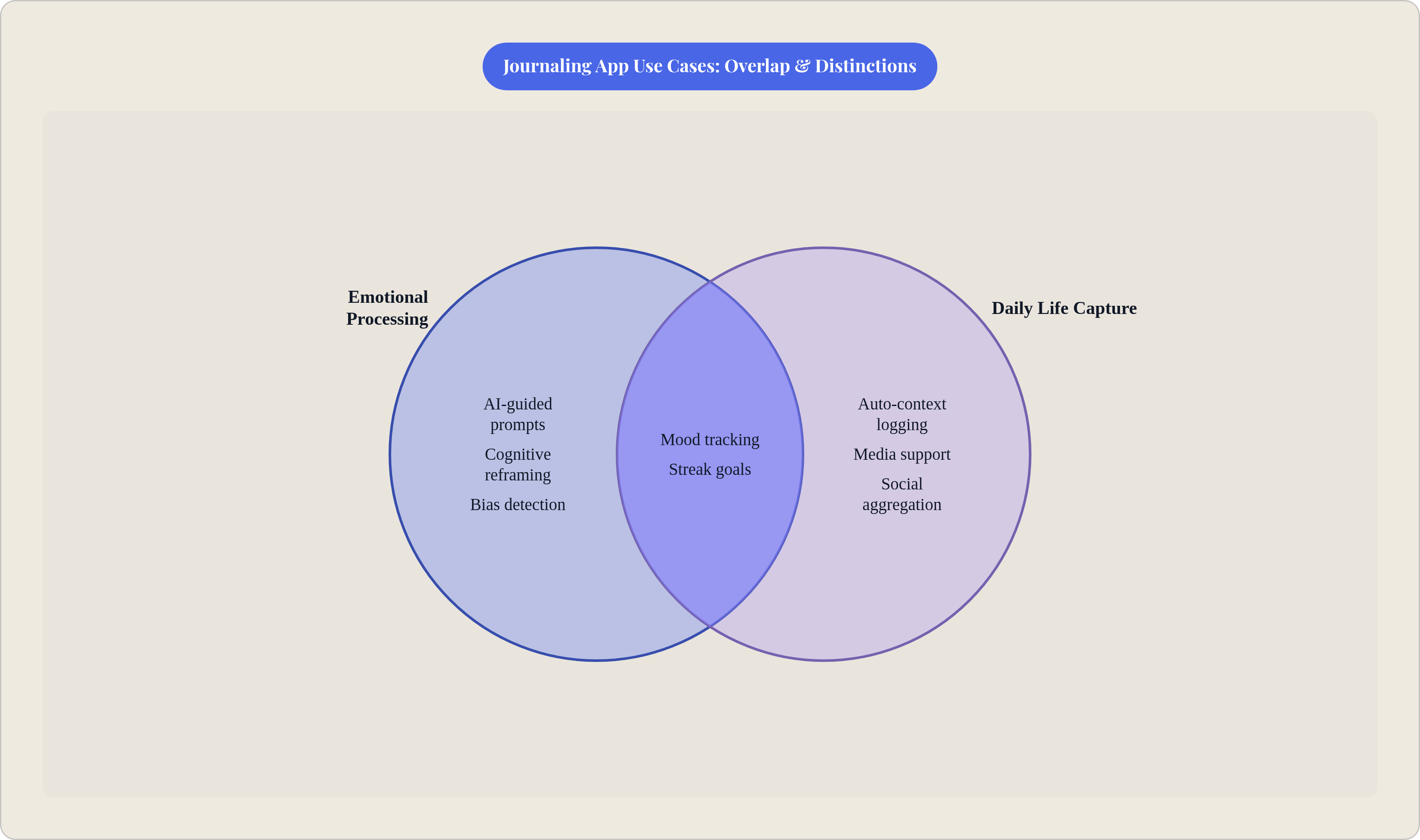
Processing Emotion: Apps Built Around Depth, Prompts, and Reflection
The core problem this use case solves is that a blank page gives someone trying to process anxiety, grief, or a difficult decision nothing to push against. Structured prompts do the cognitive scaffolding that moves a writer below surface-level summary into actual examination.
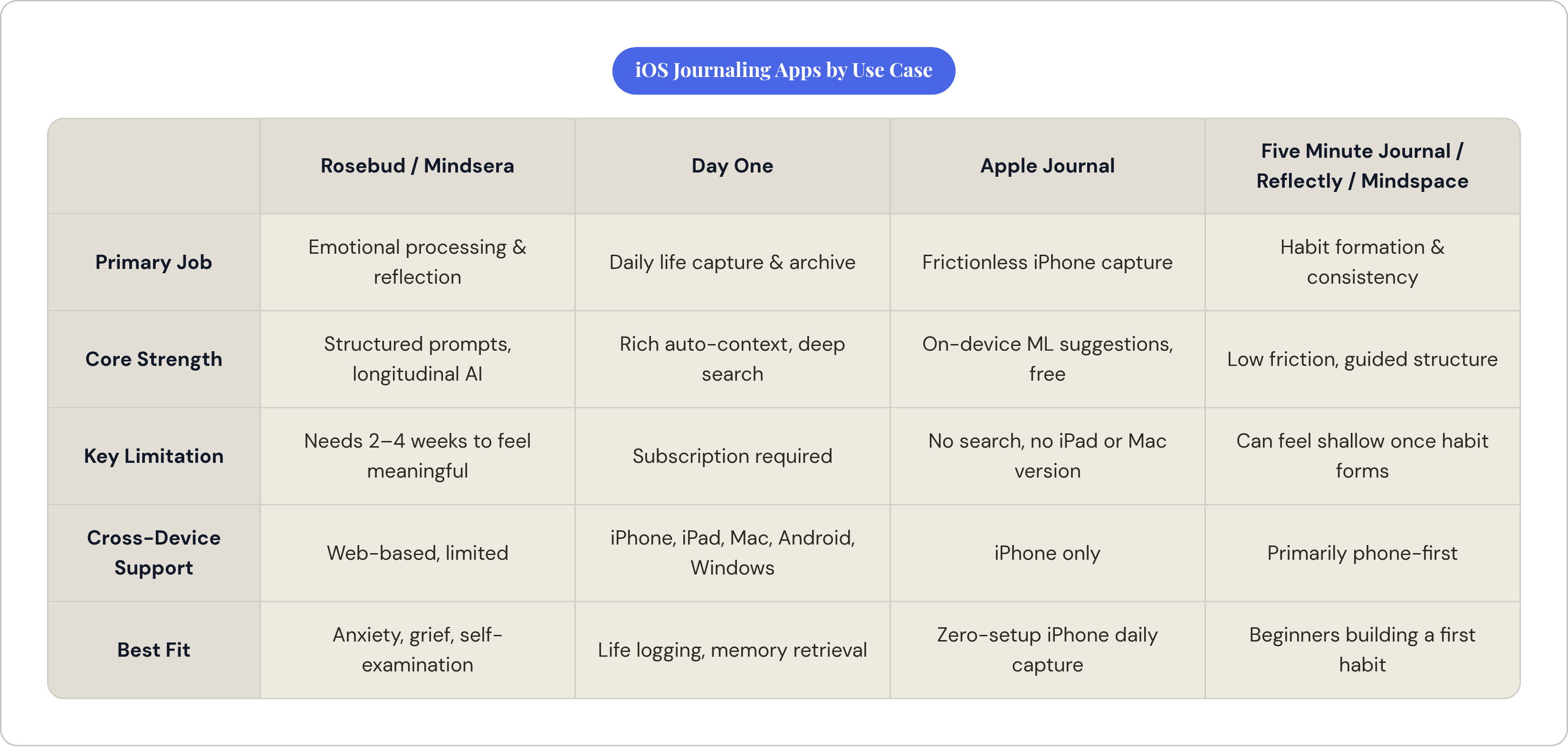
Rosebud was designed by therapists and uses AI to deliver clinical-style prompts and guided reflection through a chat-based interface rather than a blank document. The AI guides sessions through natural conversation, tracks mood patterns across entries over time, and surfaces weekly insights. In Rosebud's own internal data from 2025, a majority of users reported improvements in depression and anxiety symptoms after one week of use. These are self-reported figures, not peer-reviewed clinical outcomes, and readers should weigh them accordingly. The signal, however, is that the emotional-processing framing is working. Rosebud raised seed funding in 2025, which indicates the category is attracting serious investment. At roughly thirteen dollars per month, it positions as a lightweight emotional-support option.
Mindsera treats journaling as a thinking tool rather than purely an emotional outlet. It offers cognitive bias detection, reframing exercises, and more than fifty mental model frameworks. Where Rosebud centers on emotional conversation, Mindsera goes deeper across cognitive and personality dimensions, making it the better fit for users who want to examine the structure of their thinking, not just the texture of their feelings. It costs slightly more per month.
One distinction worth drawing out: both of these apps do something that a general large language model cannot. A purpose-built AI journaling app cross-references the current entry against the full history of past entries, notices recurring themes, and asks questions informed by what came before. That longitudinal awareness is what makes the prompts feel clinically useful rather than generic. It is also worth noting that this pattern recognition only becomes meaningfully accurate after two to four weeks of consistent entries. If you try Rosebud for three days and conclude the AI feels shallow, you may simply be too early.
What this use case does not need: elaborate media logging, cross-platform sync to non-Apple devices, or a drawing canvas. The job is introspection, and the right app keeps that as the central interaction.
A useful mental framework for evaluating prompts in this category is what practitioners sometimes call a reflection depth ladder: Event, Emotion, Pattern, Belief, Action. The best prompts in both Rosebud and Mindsera are trying to move users through that sequence. Users who end up in a free-form app can replicate the structure manually, though they rarely do.
Capturing Daily Life: Apps That Make Logging Frictionless and Searchable
The goal here is different in kind, not just degree. This is about building an accurate, retrievable record of what happened: less about reframing and more about preservation, context, and memory. The cognitive mechanism is externalization rather than reappraisal.
Day One has been the standard-bearer for this use case since 2011. It logs context automatically on every entry: location, weather, what podcast was playing, activity data, creating a richly annotated record without manual effort. It supports audio, video, multiple photos, and location tags per entry. Shared journals enable family or partner collaboration. Strava integration auto-logs runs and workouts. An "On This Day" feature resurfaces old entries and turns the archive into an active memory tool rather than dead storage. Apple Intelligence features, introduced in late 2025, added summarization and improved search across the full entry history. Day One is available on iPhone, iPad, Mac, Apple Watch, Android, Windows, and the web.
When Apple Journal launched, Day One's founder characterized it as an exciting development that would introduce digital journaling to a wider audience. That framing is telling. It signals confidence that Day One's feature depth keeps it categorically distinct from a free, native alternative.
Apple Journal, which arrived with iOS 17.2, is the first native journaling app in the iPhone's history. On-device machine learning suggests entries based on location visits, media interactions, and daily activities, effectively lowering the activation energy to start writing by surfacing what already happened. Privacy architecture is strong: entries are encrypted when the device is locked, Face ID and Touch ID authentication is available as a secondary layer, and iCloud sync is end-to-end encrypted. Streaks and goals are tracked; multiple journals are supported.
But Apple Journal has a critical limitation for this use case: no keyword search. For an app whose value proposition is a retrievable life archive, the absence of search is a significant structural gap. There is also no Mac version and no iPad version, which frustrates users who prefer writing at a desk. Apple Journal is best suited to iPhone-only users who want zero setup, zero cost, and short bursts of writing prompted by daily activities rather than a deliberate sit-down session.
Momento takes a different approach entirely: it aggregates social media activity and digital breadcrumbs into an organized diary with minimal writing required. The capture happens automatically. It represents a distinct philosophy, the journal as time capsule rather than reflective practice, and it's the right fit for users who want the archive without the writing habit.
The unresolved tension in this use case is worth naming directly. Apple Journal's missing search function undermines its long-term value as a life log. Day One solves that problem but requires a subscription and a cross-platform commitment. The reader must weigh how often they will actually want to retrieve what they capture, because that answer determines whether the cost differential is justified.
Building a Writing Habit: Apps Designed Around Consistency and Low Friction
The enemy of a journaling habit isn't lack of motivation. It's friction and paralysis. "What do I write about?" is the question that kills sessions before they start. For most beginners, structured prompts outperform the blank page not because the blank page lacks potential, but because it demands a decision before a habit is established.
The Five Minute Journal app is grounded in gratitude research and positive psychology. The time commitment is explicit in the name, which removes the "I don't have time" objection before it forms. Its structure is minimal by design: three things to be grateful for, two highlights from the day, one area for growth. That 3-2-1 framework is concise enough to complete in a few minutes morning or night, and the repetition is the point. Beginners who want a defined daily structure with no decisions about format will find this easiest to sustain.
Reflectly functions primarily as a mood tracker with journaling attached. Log how you feel, answer a short prompt, review charts of mood over time. Bright design, streaks, and mood statistics create the habit loop with the least time commitment of any app in this category. Pricing sits at roughly ten dollars per month or sixty dollars per year.
Reflectly is the easiest habit to start; it is not necessarily the most rewarding to sustain. If your actual goal is emotional processing rather than mood trend visibility, Reflectly may feel shallow after a few weeks. It's an accessible entry point, not a destination. Readers who begin there and outgrow it quickly haven't failed; they've graduated.
Mindspace was named the best overall journaling app for iPhone and iPad in a 2026 roundup, and its appeal in the habit-building context is specific: it requires no account, stores nothing on third-party servers, and removes both setup friction and privacy anxiety simultaneously. It includes mood trackers, habit trackers, a drawing canvas, and freeform entry options, making it versatile enough to serve multiple journaling styles from a single app. Its best fit is the reader who isn't yet sure what kind of journaler they are and wants to explore before committing to a specialized tool.
One practical note on habit formation: reminders work, but they work better when the writing session itself takes less than five minutes. Apps that combine customizable notifications with pre-structured prompts have the strongest retention profile for new journalers. The reminder gets you to the app; the prompt gets you through the blank-page paralysis before you close it.
Writing Seriously Across Devices: What Cross-Platform and iPad Keyboard Users Actually Need
Most iOS journaling apps are designed phone-first. iPad users who write at length on a keyboard, or who work across Mac, Windows, and Android alongside their iPhone, are often fighting the app's underlying assumptions rather than being served by them. The problem isn't feature gaps in isolation; it's that the app's architecture was never built for the workflow.
Day One is the strongest answer in this use case as well, but for different reasons than in the daily-capture context. The relevant quality here is genuine cross-platform parity: iPhone, iPad, Mac, Apple Watch, Android, Windows, and web. An entry started on an iPhone continues cleanly on a Mac keyboard without reformatting or sync anxiety. Apple Intelligence integration in late 2025 added summarization and improved archive search, which becomes meaningfully valuable for users with years of entries. The Zapier integration and activity service connections matter to users who want the journal to function as a hub rather than an island.
Diarium addresses a different cross-platform problem: iPhone to Android tablet to Windows laptop. Most iOS-native apps cannot match that particular combination. For users in mixed-device households or those who've migrated from Android to iPhone but kept other devices, Diarium is a practical option.
Journey is the strongest choice for readers managing an iPhone and Android device in the same workflow. Its cross-platform architecture is built with encryption as a first principle rather than a feature addition, which matters to users who keep sensitive personal writing in their archive.
What Apple Journal cannot do in this use case deserves plain statement: no iPad version, no Mac version. That is a hard stop for anyone who writes at length on a keyboard or larger screen. This limitation is the clearest signal that Apple Journal was designed as a capture habit for an iPhone, not a serious writing environment for someone who moves between devices.
The underlying principle here is simple, but frequently ignored in app comparisons: for long-form journal writing across multiple devices, reliable sync and keyboard parity matter more than feature count. An app that drops entries, reformats text between devices, or lacks a functional editing experience on an iPad keyboard with a physical keyboard attached isn't a journaling app for this use case. It's an obstacle wearing one's skin.
But what if you're still unsure which category describes you? That's the most honest version of the matching problem. Start with the question you most want your journal to answer. If it is "what am I feeling and why," look at Rosebud or Mindsera. If it is "what happened today and where was I," look at Day One or Apple Journal. If it is "can I actually build this habit," look at Mindspace or The Five Minute Journal. If it is "will this work on my iPad and my Mac," the answer is Day One, with fewer qualifications than anything else on this list.
The app is not the practice. But the wrong app can make the practice impossible before it starts.