Reflective Voice Journaling Only Works If the AI Has Been Paying Attention
Memory alone doesn't make voice journaling work—the AI must connect patterns across time.

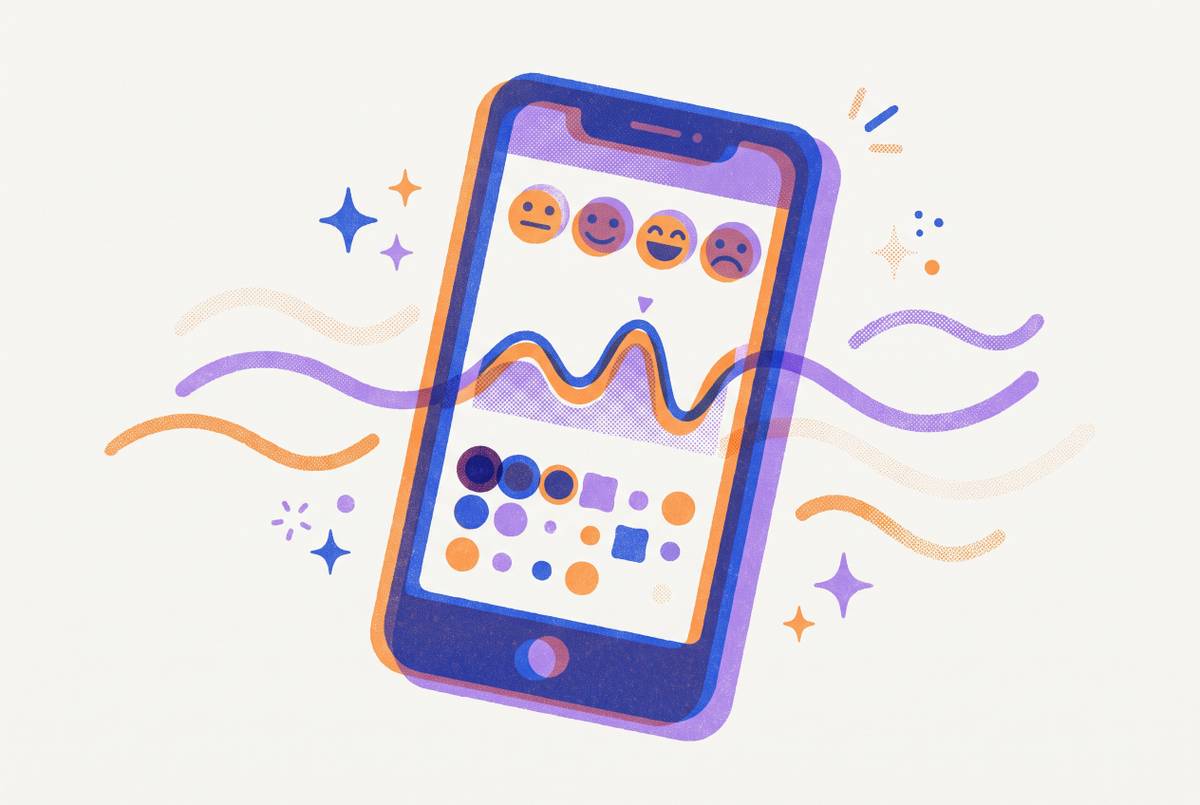
Reflective voice journaling needs an AI that remembers earlier conversations and asks follow-up questions about recurring emotions, changing perspectives, and unresolved threads. A response to the latest recording differs from considering entries across time. For anyone seeking a private voice journaling app with conversation memory, those are distinct requirements, and evidence of memory alone does not establish privacy.
Why a journal's value is built across time, not inside a single session
A single journal entry can externalize a thought, making it available for examination. A series of entries does something different. It reveals recurring emotions, unresolved tensions, and gradual shifts in outlook that may be invisible from within any one day. Without that continuity, interpreting a journal is like being handed one frame from a film and asked to follow the plot.
The distinction is between recording experience and recognizing its shape. An emotion that seems new today may resemble one described weeks earlier, while a concern that once dominated the journal may have quietly receded. Both observations require a before and an after. The journal gives the mind something to compare against its present account of events, allowing change and repetition to become visible.
Inner speech already involves more than producing words. It engages language centers including Broca's area and the auditory cortex, while the default mode network connects present experience to future imagination and long-term goal alignment. Psychologist Alain Morin identifies five functions of self-aware inner speech, including regulating behavior, guiding decisions, taking others' perspectives, driving self-improvement, and deepening social connection. These functions reach beyond the present moment. The design implication is an analogy. A useful journaling AI must support the mind's work of connecting experience across time rather than interrupting it with a fresh start after every session.
Why voice input makes the memory problem more urgent, not less
Voice lowers the effort required to make an entry. It also places less distance between feeling something and expressing it, allowing a person to speak without first shaping the experience into written prose. That immediacy is part of its appeal. Yet easier expression makes continuity more important, because a growing collection of emotionally rich entries offers little longitudinal insight if each is treated as an isolated event.
The CHI '26 embodied journaling study found that participants moved toward unfiltered emotional expression when writing-based norms and affordances were absent, sometimes forgoing words altogether. Subconscious body motion and paralinguistic acoustic qualities revealed deeper, sometimes hidden feelings. This study focused on embodied journaling. Its relevance is narrower but useful. Voice shares the spoken part of that less-filtered expression and sits between carefully written words and expression through the body.
A person speaking to a responsive interlocutor has reason to expect that what was said will inform what comes next, including the next conversation. A blank page makes no such promise. An AI that responds fluently today but knows nothing of yesterday creates a mismatch between the experience of conversation and the continuity behind it.
What session-amnesia actually costs the user
What does an AI lose when it cannot remember? It cannot ask, “you mentioned feeling this way a few weeks ago — what changed?” That question does more than demonstrate recall. It invites a comparison between two moments, giving the user a chance to identify a changed circumstance, a recurring response, or a tension that was never fully resolved.
Without prior context, the system cannot distinguish a new mood from a pattern. Nor can it recognize when something described as settled has returned. A follow-up question based on the latest recording can still clarify what the user means, but it operates within a narrower frame. Asking for more detail about today's concern and asking how that concern relates to an earlier one are different kinds of assistance.
Pennebaker's expressive writing research supplies an important objection to any claim that memory is the only source of value. That research supports the value of articulation itself for trauma processing specifically. Expression need not wait for a later comparison to be useful, and a person may benefit from speaking even when the tool remembers nothing. Articulation can help someone express an experience, while longitudinal pattern recognition requires access to more than that experience alone.
The cost also extends to the developing habit. If the same context has to be built up again at each visit, the tool has fewer ways to show that coming back offers something a first session cannot. Abandonment is not inevitable, but the reason to return weakens. A remembered thread gives the next conversation a starting point.
How multi-session AI systems have been designed to solve this
Existing research treats continuity as a design problem. The important distinction is between retaining raw entries and organizing relationships among emotional events over time. Storage is only the beginning of that work. For reflective dialogue, earlier material must become available in a form that helps connect what happened, how it felt, and what remains unresolved.
The SoulNote research at CHI '26 explored reflective songwriting for Deaf individuals and those with partial hearing loss through generative music AI. Its user-centered design included a design workshop and an early study, then a multi-session diary study that showed emotional growth. The system was designed to go beyond the single session that earlier music GenAI tools were limited to. Its relevance here is architectural. It shows why a system that helps people reflect must be built and tested for use across many sessions, though it does not show which voice journaling app is best.
InnerPond, which Seoul National University researchers presented at CHI '26, builds continuity around the different perspectives within a person. Grounded in Dialogical Self Theory, it represents those perspectives as distinct LLM-based agents that can persist and develop across sessions. Identity, rather than chronology alone, organizes the continuity. Values that compete and concerns that persist can therefore remain distinct voices in an ongoing dialogue.
For voice journaling, these approaches point toward structured, queryable narrative. A transcript preserves the words of an entry, but reflective memory must also support connections between entries. That is active work. These studies provide grounds for describing a design requirement, while the privacy practices and buyer fit of private apps remain unestablished by their findings.
What the multi-agent and dialogical self research adds to the picture
Whose perspective within the person did an entry express, and how does that perspective relate to the others? A journal may contain competing values, concerns, and aspirations without any one of them being the final account of what the person wants. Treating every entry as a statement from a single, settled viewpoint can flatten that tension. Continuity must preserve disagreement as well as agreement.
Dialogical Self Theory describes the self as a “dynamic multiplicity of I-positions.” These are distinct internal perspectives that can enter into dialogue, rather than separate people or a fixed inventory of traits. The design allows a perspective to remain recognizable while its relationship with other perspectives changes, making the ongoing inner dialogue available for examination.
The same study involved 17 young adults navigating career choices. Participants co-created inner voices with AI, composed relational inner landscapes, and orchestrated dialogue as observers and mediators. The value emerged from interaction among persisting perspectives across sessions. That distinction deepens the case for memory. A system needs more than a record that a concern was mentioned to examine how that concern competes with an aspiration.
This also refines the articulation objection without dismissing it. Speaking can bring one I-position into focus, which is useful in its own right. But understanding how that position repeatedly negotiates with other positions requires continuity across their appearances. The design ambition is an AI that can help the user examine how different parts of their outlook have developed in relation to each other.
Where the embodied and paralinguistic dimensions complicate the memory requirement
Even a well-organized transcript preserves only part of a spoken entry. Pauses, pacing, and tone belong to the expression too, and their changes may be relevant to what the person is trying to understand. Words are not the whole record.
The embodied journaling study makes that limitation concrete. Its finding that paralinguistic acoustic qualities could reveal deeper, sometimes hidden feelings suggests that reflective expression cannot always be reduced to verbal content. Spoken journal entries also carry feelings through sound, even without the body movements that were part of the study. The implication concerns what the system retains. If the transcript is the only surviving representation, some of the expressive material available during the session is no longer available for later comparison.
A voice memory architecture that meets this need must therefore keep or summarize paralinguistic markers along with the transcript. The relevant continuity includes how speech changed during an entry and whether a similar pattern appeared before. Yet this creates a second interpretive burden. Preserving a change in pace or tone is not the same as knowing what it means, so the design requirement should not be mistaken for evidence that an AI can read hidden feelings with certainty.
This is a higher standard than transcription-first design generally meets. It also complicates what a buyer means by conversation memory, because a tool may remember words while losing the way those words were spoken. Privacy remains a separate question throughout.
Why sustained engagement over time is both the goal and the proof
Longitudinal insight has a practical dependency that no architecture can bypass. The person must return often enough to build a history that can be interpreted. Voice helps by lowering the effort of each entry, allowing material to accumulate before the habit is fully formed. Memory supplies a different part of the incentive. It allows later sessions to build on earlier ones, so returning can offer more than another opportunity to start talking.
SoulNote's multi-session study found emotional growth in three areas it measured, which were self-insight, emotion regulation, and everyday attitudes toward emotions and self-care. The authors argue that multi-session design enables longer-term emotional gains demonstrated specifically in the reflective songwriting study. Nevertheless, the evaluation principle transfers directly. A claim about development over time needs evidence gathered over time.
People coming back to a tool does not by itself prove that it helps them gain insight, but even a convincing result in one session cannot show that it spots patterns across many. Can the system revisit an unresolved thread, recognize a returning concern, or ask a follow-up that would have been impossible without the earlier conversation?
For the person seeking a voice journal that actually remembers, the decisive distinction is between an answer that sounds attentive and one that draws meaningfully on a shared history. Low friction opens the conversation.
Sources
- From Daily Song to Daily Self: Supporting Reflective Songwriting of Deaf and Hard-of-Hearing Individuals through Generative Music AI
- InnerPond: Fostering Inter-Self Dialogue with a Multi-Agent Approach for Introspection
- Reflective Motion and a Physical Canvas: Exploring Embodied Journaling in Virtual Reality
- ODKM Insight: The Neuroscience of Self-Talk—Your Inner Voice Can Work for You
- InnerPond: Fostering Inter-Self Dialogue with a Multi-Agent Approach for Introspection
- Dialogical Self Theory: Playing with Positions Seriously